
Running a business today is no longer just about managing sales or maintaining records. As operations grow, businesses struggle with disconnected data, manual processes, and lack of real-time visibility. These challenges directly impact efficiency, decision-making, and profitability.
This is exactly where ERP software becomes critical.
ERP (Enterprise Resource Planning) is not just a tool — it is a business management system that brings structure, automation, and clarity to your operations. For growing businesses in India, ERP is quickly becoming a necessity rather than a choice.
ERP software is a centralized system that integrates all core business functions into a single platform. It connects departments such as sales, inventory, procurement, and finance, allowing them to operate with shared data and real-time updates.
Instead of managing separate tools or spreadsheets, ERP creates a unified ecosystem where every action reflects across the system instantly.
For example, when a sales order is processed:
This level of synchronization eliminates delays, reduces errors, and improves operational control.
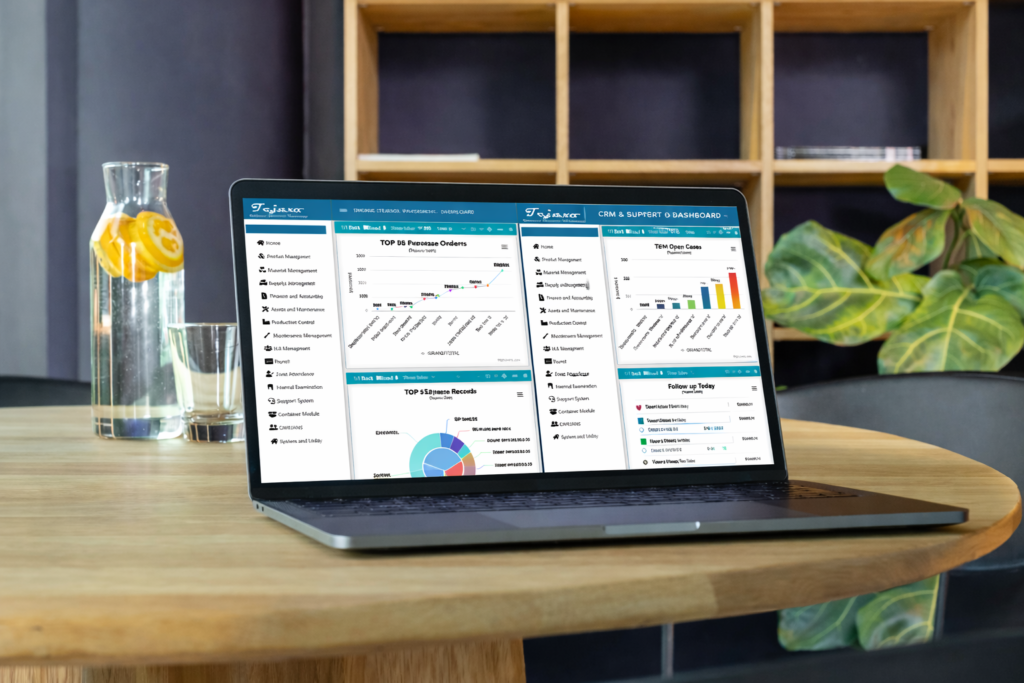
Most businesses don’t fail because of lack of effort — they struggle due to inefficient systems.
Common challenges include:
ERP addresses these issues by creating a single source of truth for the entire organization.
ERP systems function through interconnected modules. Each module handles a specific process but shares data with the entire system.
Core Modules Include:
Inventory Management: Real-time stock tracking and control
Sales Management: Order processing, invoicing, customer tracking
Procurement: Vendor management and purchase workflows
Finance & Accounting:GST, transactions, and financial reporting
The key advantage is integration — data entered once is reflected everywhere.
Automation reduces manual tasks and speeds up daily operations.
Business owners can monitor performance instantly through dashboards and reports.
With a single system, duplication and human errors are minimized.
Access to accurate and real-time data enables faster and smarter decisions.
ERP systems are built to support business expansion without operational chaos.
The business landscape in India is rapidly evolving. With increasing competition and digital adoption, companies can no longer rely on outdated systems.
Small and medium businesses, in particular, are now adopting ERP to:
ERP is no longer limited to large enterprises — it is now a growth tool for modern businesses.
While tools like Excel are useful for basic tasks, they lack integration, automation, and scalability.
ERP, on the other hand, provides:
For any business planning long-term growth, ERP is the more reliable solution.
Selecting the right ERP system is crucial. Businesses should look for:
A well-chosen ERP system not only improves operations but also enhances overall business performance.
Tejaxo ERP is built specifically to address the operational challenges faced by Indian businesses. It combines simplicity with powerful functionality, making it easy to adopt and highly effective in execution.
With Tejaxo ERP, businesses can:
Its intuitive design and business-focused features make it a practical choice for companies looking to modernize their operations without complexity.
ERP software is no longer a luxury — it is a foundation for efficient and scalable business operations.
As businesses continue to grow and adapt to a digital-first environment, having a centralized system becomes essential. ERP provides that structure, enabling better control, faster decisions, and sustainable growth.
For businesses in India aiming to stay competitive, adopting ERP is a strategic step forward.
If you are looking to streamline operations, reduce inefficiencies, and scale your business effectively, it’s time to adopt a smarter system.
Explore how Tejaxo ERP can help you bring clarity, control, and growth to your business operations.
