
Every forging customer eventually asks the same question: which heat of steel did this part come from? In automotive and engineering supply chains it is often asked after a failure, with a deadline. A forging unit that can answer in minutes – and also say which other lots used the same heat – keeps the customer. One that searches registers for two days usually does not. This guide explains what heat number traceability means, how the heat number travels from the steel mill’s test certificate to the invoice, and how an ERP keeps the chain unbroken.
What a heat number is
Steel is made in batches called heats. Every bar or billet from one heat shares the same chemistry and mechanical properties, which the mill records on a mill test certificate (MTC) carrying the heat number. If the forged part’s properties are ever questioned, the heat number is the link back to that certificate – and to every other part made from the same heat.
Why forging units need heat-wise traceability
- Customer requirements: automotive and engineering customers expect the heat number of every lot, and the MTC on request.
- Containment: when one lot fails, every other lot from the same heat must be found and held – in stock, at the job worker, in transit or already dispatched.
- Root cause: rejections and defects can be compared heat by heat, so a weak heat or a supplier problem shows up early.
- Real cost: steel is the largest cost in a forging; costing jobs at the rate of the heat actually issued gives the true margin.
Where the chain usually breaks
- The heat number is written on the bar but not entered at receipt.
- Material is issued to the forge “from the rack” without recording which heat went to which work order.
- Two heats are mixed in one lot and nobody records it.
- Parts go to an outside machining or heat-treatment vendor and come back without their lot identity.
- The invoice and packing slip carry the part number but not the lot, so the customer’s complaint cannot be traced back.
From billet to invoice: how the heat number travels in Tejaxo ERP
- Purchase and gate: steel is received against the purchase order at the gate.
- Incoming quality: the heat number and MTC are recorded at incoming inspection, with accepted and rejected quantity and a reason for every rejection.
- Stock by batch: accepted steel is held batch-wise, so every billet in stock belongs to a known heat.
- Issue to the work order: the heat or batch number entered on issue stays on the lot from that point on.
- Forging and later stages: good and rejected quantity are recorded with a reason at each stage; lots can be merged, and the lot history shows what each lot was “made from” and what it “went into”.
- Outside processes: material sent for machining, heat treatment or plating goes out on a returnable gate pass and comes back against it, keeping its lot – see job work with returnable gate passes.
- Finished goods, packing and invoice: the finished-goods batch is carried on the packing slip and the invoice.
Because batch numbers are carried at every step – sales order, work order, job card, requisition, purchase order, gate, goods receipt, inspection, issue, operations, finished-goods batch, packing slip and invoice – the chain can be followed both ways: forward from a heat to every invoice it reached, and backward from an invoice to the melt.
Worked example: a complaint on one lot
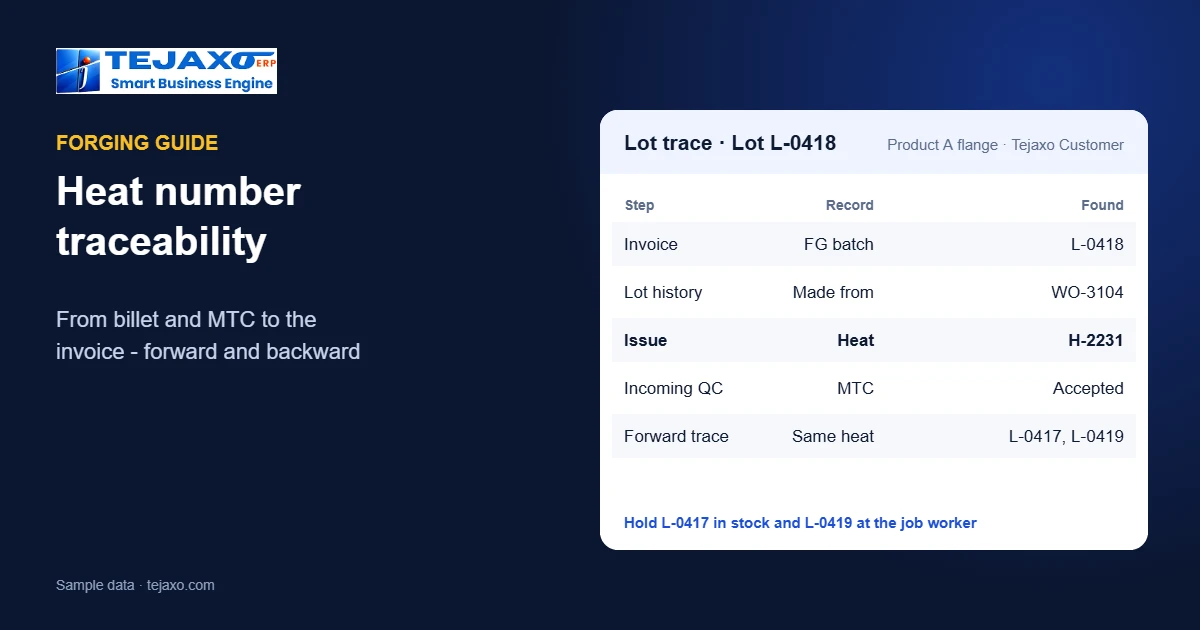
Tejaxo Customer reports a crack on a flange (Product A) from a recent dispatch (sample data). Here is how the trace runs:
| Step | Record | Found |
|---|---|---|
| Invoice | FG batch on invoice | Lot L-0418 |
| Lot history | Made from | WO-3104, heat H-2231 |
| Incoming QC | MTC for H-2231 | Accepted, 4,200 kg |
| Forward trace | Other lots of H-2231 | L-0417 in stock, L-0419 at job worker |
Within minutes the quality team holds lot L-0417 in stock and lot L-0419 at the machining vendor, pulls the MTC for heat H-2231, and checks whether other customers received parts from the same heat. Without the chain, the same exercise means searching receipts, issue slips and challans by hand while the customer waits.
Traceability and the real cost of a job
The same records give the real margin. In Tejaxo ERP, work-order costing charges material at the rate of the batch actually issued, machine time at the machine rate, labour at the paid minutes of operators and helpers, plus overhead, and compares the total with the invoiced value. When the price of steel changes from one heat to the next, each job carries the cost of its own heat rather than an average.
Reports a forging unit should watch
- Heat- and batch-wise traceability – forward and backward.
- Rejection by heat, PPM and defect Pareto – to spot weak heats and recurring defects.
- Scrap and yield – steel in versus good parts out.
- Job-work pendency – what is lying with which vendor, and for how long.
- Work-order P/L – margin per job at the issued heat’s cost.
Getting started: what to prepare
- Clean steel item masters: one item code per grade and size, so heats of the same grade can be compared.
- Heat-wise opening stock: on the day you start, count the steel in stock by heat number and enter it batch-wise, with the MTC for each heat.
- Issue discipline: agree that nothing leaves the store for the forge without the heat number recorded against the work order.
- Lot rules on the floor: decide when lots may be merged and make sure every merge is recorded.
- Vendor discipline: tell job workers that every return must quote the gate pass and the lot.
Most units find that the first month is about habits rather than software – once the store and the forge record the heat every time, the traceability reports simply work.
Common mistakes
- Recording the heat only on the bar. Paint and tags do not survive the forge; the record must be in the system from receipt.
- Issuing without a heat. One unrecorded issue breaks the chain for every lot that follows.
- Mixing heats silently. If two heats go into one lot, record the merge so both can be traced.
- Losing identity at the job worker. Send and receive on returnable gate passes, lot by lot.
- Keeping MTCs in a file cabinet. Link the certificate to the heat at incoming inspection so it can be produced with the lot.
Next step
See heat-wise traceability on your own items and heats. Book a free demo, or read more about ERP for the forging industry and coil-wise batch tracking.
Frequently asked questions
What is heat number traceability?
The ability to link every forged part to the heat of steel it was made from – and through the heat number to the mill test certificate – and to find every other part made from the same heat.
Where is the heat number recorded in an ERP?
At incoming inspection, together with the MTC. From then on the heat or batch number is carried on stock, issue, every production stage, the finished-goods batch, the packing slip and the invoice.
How do you trace a customer complaint back to the heat?
Start from the batch on the invoice, follow the lot history back to the work order and the heat issued to it, then pull the MTC. A forward trace from the same heat shows every other lot to hold.
What happens to traceability when parts go to a job worker?
Material is sent and received on returnable gate passes lot by lot, so it keeps its identity at the vendor and comes back to the same lot.
Can heat-wise traceability help costing?
Yes. Work-order costing can charge material at the rate of the heat or batch actually issued, so each job carries the cost of its own steel.
What is an MTC?
A mill test certificate issued by the steel mill for a heat, recording its chemistry and mechanical properties. It is the reference document when a part made from that heat is questioned.