
Every plant buys machines, and every machine is depreciated twice: once in the books under the Companies Act, and once in the tax return under the Income Tax Act. The two use different methods and different rates, so the written-down values drift apart from the first year. Many manufacturers keep the asset register in a spreadsheet, work out tax depreciation separately at year-end, and discover at audit that the register, the ledger and the tax computation do not agree. This guide explains both methods with a worked example, why the difference matters, and how to keep one register that serves both.
Depreciation in the books: Companies Act, Schedule II
Schedule II of the Companies Act, 2013 prescribes useful lives for classes of assets rather than rates. Depreciation is spread over the useful life after keeping a residual value – generally not more than 5% of cost – using the straight-line or written-down-value method consistently. For general plant and machinery, the useful life in Schedule II is 15 years. Assets bought during the year are depreciated from the date they are put to use, pro rata.
Depreciation for tax: Income Tax Act, section 32
For tax, assets are grouped into blocks with a prescribed rate, applied on the written-down value of the block. The general rate for plant and machinery is 15%. If an asset is put to use for less than 180 days in the year of purchase, only half the rate is allowed that year. Additions and sales are adjusted in the block rather than asset by asset. Special rates and additional allowances apply to some assets and businesses – confirm the treatment for your case with your chartered accountant.
Worked example: one CNC machine, three years
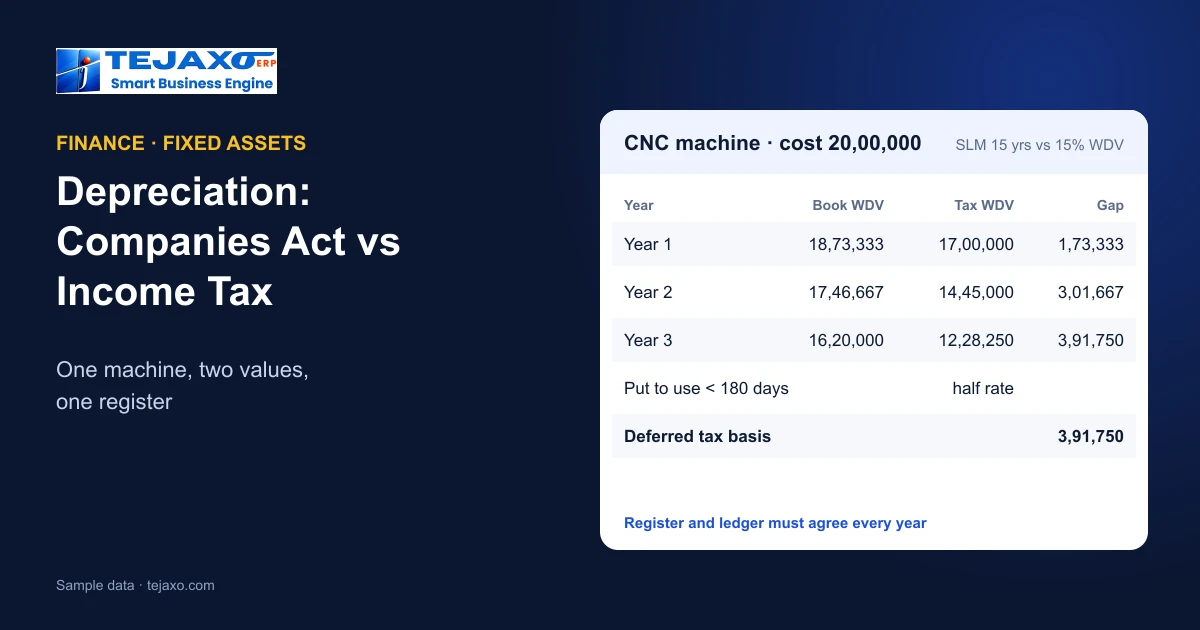
Tejaxo Manufacturing (sample data) buys a CNC machine for 20,00,000 and puts it to use at the start of the year. In the books it is depreciated straight-line over 15 years with a 5% residual value – 1,26,667 a year. For tax it is in the plant-and-machinery block at 15% WDV.
| Year | Books dep. | Tax dep. | Book WDV | Tax WDV | Gap |
|---|---|---|---|---|---|
| Year 1 | 1,26,667 | 3,00,000 | 18,73,333 | 17,00,000 | 1,73,333 |
| Year 2 | 1,26,667 | 2,55,000 | 17,46,667 | 14,45,000 | 3,01,667 |
| Year 3 | 1,26,667 | 2,16,750 | 16,20,000 | 12,28,250 | 3,91,750 |
After three years the machine stands at 16,20,000 in the books but 12,28,250 for tax – a gap of 3,91,750. That gap is a timing difference: tax depreciation is front-loaded, so taxable profit is lower in the early years and higher later. It is the basis of the deferred tax figure in the accounts, and it grows each year until the tax WDV starts catching up. Had the machine been put to use in the second half of the year, tax depreciation in year 1 would have been only 1,50,000 (half of 15%), while the books would charge about 63,333 for six months.
Why one register for both
- Audit: the auditor checks that the register agrees with the fixed asset and depreciation ledgers. A spreadsheet register drifts as soon as someone forgets an addition or a sale.
- Tax: block-wise WDV must carry forward correctly year after year; a mistake in one year repeats in every later year.
- Deferred tax: the books-vs-tax difference has to be known asset by asset or block by block.
- Insurance and replacement: location, cost and condition of each machine are needed when a claim or a replacement decision comes up.
What the register should hold for each asset
- Asset code, description, class under Schedule II and block under the Income Tax Act.
- Supplier, invoice, cost including installation and freight, and the date put to use.
- Location – plant, department, machine centre – and the person responsible.
- Useful life, residual value and method for the books; rate for tax.
- Additions, disposals and sale value, with the dates.
Components with different lives
Schedule II also expects significant parts of an asset with a different useful life to be depreciated separately. A press with a long-life frame and a control system that will be replaced much sooner, or a furnace whose lining is rebuilt every few years, are typical cases. The register should allow one machine to carry more than one component, each with its own cost and life, while the tax block treats the machine as one asset.
Assets not yet in use
A machine bought, delivered and still being installed is not yet depreciated – neither in the books nor for tax – until it is put to use. Until then its cost, along with installation, foundation and commissioning costs, sits in capital work in progress. Recording the put-to-use date correctly decides both how much depreciation is charged in the year and, for tax, whether the full or the half rate applies.
Sales, scrap and transfers
When a machine is sold or scrapped, the books record the profit or loss against its book value, while for tax the sale value is reduced from the block. Machines moved between plants keep their history but change location – in a multi-plant company the register must follow them; see goods in transit between plants for the same principle applied to stock.
Machine cost in job costing
Depreciation is also part of what a machine hour costs. Plants that cost jobs by machine minutes include depreciation, power and maintenance in the machine rate, so a new, expensive machine shows up in the cost of the jobs it runs – see work order costing.
Year-end checklist
- Add every capital purchase of the year with its put-to-use date.
- Record every sale or scrapping with the sale value.
- Run book and tax depreciation and post the book depreciation.
- Reconcile the register with the ledger – cost and accumulated depreciation by class.
- Take the books-vs-tax difference to the deferred tax working.
- Verify physically a sample of assets against the register.
How Tejaxo ERP handles it
Tejaxo ERP keeps a fixed asset register with depreciation under Companies Act Schedule II and Income Tax section 32, shows the books-vs-tax difference, and reconciles the register with the ledger. Finance includes vouchers, ledgers, trial balance, P&L, balance sheet and cost-centre profitability, with one-click audit checks for unbalanced vouchers, fallback-ledger postings and wrong openings, and consolidated reports for multi-plant companies.
Common mistakes
- Capitalising late, so depreciation starts from the wrong date.
- Ignoring the 180-day rule for tax on assets bought late in the year.
- Sales not removed from the register, so depreciation continues on assets that are gone.
- Register and ledger kept separately and reconciled only at audit.
Next step
See the fixed asset register, books and tax depreciation and the register-to-ledger reconciliation in a free demo.
Frequently asked questions
What is the difference between Companies Act and Income Tax depreciation?
The Companies Act (Schedule II) spreads cost over a prescribed useful life after a residual value; the Income Tax Act (section 32) applies block-wise rates on written-down value. The two give different figures every year.
What is the useful life of plant and machinery under Schedule II?
For general plant and machinery, Schedule II gives a useful life of 15 years; specific classes have different lives. Residual value is generally not more than 5% of cost.
What is the 180-day rule for tax depreciation?
If an asset is put to use for less than 180 days in the year it is acquired, only half the normal rate is allowed for that year under the Income Tax Act.
Why does book and tax depreciation create deferred tax?
Because the difference is a timing difference: tax depreciation is usually higher early on, lowering taxable profit now and raising it later. The accounts recognise the future tax effect as deferred tax.
What should a fixed asset register contain?
Asset code and description, Schedule II class and tax block, cost and put-to-use date, location and owner, useful life, residual value, method and rate, and additions and disposals.
Does Tejaxo ERP calculate both depreciations?
Yes. Its fixed asset register calculates Companies Act Schedule II and Income Tax section 32 depreciation, shows the books-vs-tax difference and reconciles the register with the ledger.