
Every plant knows its problem machines by reputation: the press that “always” breaks down, the CNC that “takes forever” to repair. Reputation is a poor basis for maintenance decisions. Two simple numbers turn it into evidence: MTBF – mean time between failures – shows how often a machine breaks down, and MTTR – mean time to repair – shows how long it stays down each time. Together they tell the maintenance team whether to work on preventing failures or on repairing faster, and they explain much of the availability loss in OEE. This guide explains both, with a worked example of two machines that need very different actions.
The two measures
- MTBF = operating time / number of breakdowns. Operating time is planned production time minus the downtime itself. A higher MTBF means a more reliable machine.
- MTTR = total repair time / number of breakdowns. Repair time runs from the moment the machine stops to the moment it is producing again – including waiting for the technician and for spares. A lower MTTR means faster recovery.
Availability from breakdowns alone is MTBF / (MTBF + MTTR). It connects directly to the availability factor in OEE – see how to calculate OEE.
Worked example: two machines, one month
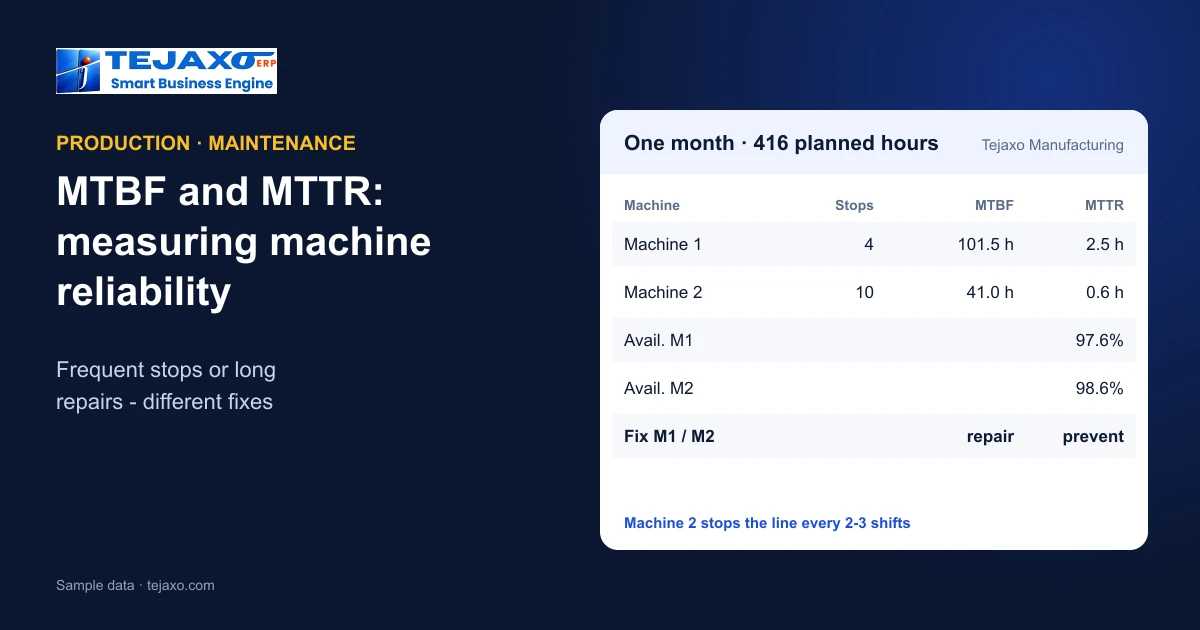
Tejaxo Manufacturing (sample data) plans each machine for 26 days x 2 shifts x 8 hours = 416 hours in the month.
| Machine | Breakdowns | MTBF | MTTR | Avail. |
|---|---|---|---|---|
| Machine 1 | 4 | 101.5 h | 2.5 h | 97.6% |
| Machine 2 | 10 | 41.0 h | 0.6 h | 98.6% |
Machine 1 broke down 4 times for 10 hours in total: MTBF 101.5 hours, MTTR 2.5 hours. Machine 2 broke down 10 times but for only 6 hours: MTBF 41 hours, MTTR 0.6 hours. Machine 2 actually has the better availability, yet it is the one stopping the line every two or three shifts – each restart costs set-up, scrap and planning disruption that the availability figure does not show. The two machines need different work:
- Machine 1 – long repairs: look at MTTR. Are spares in stock? Is the technician on shift? Is the fault diagnosed quickly, or found by trial and error?
- Machine 2 – frequent stops: look at MTBF. Which failure repeats? Is lubrication, cleaning or a worn part the root cause? Preventive maintenance belongs here.
Recording downtime properly
MTBF and MTTR are only as good as the downtime records behind them. Each stoppage needs a start time, an end time, the machine and a reason from a fixed list – breakdown (mechanical, electrical, hydraulic), set-up, no material, no operator, quality hold, planned maintenance. Only breakdowns count for MTBF and MTTR; the others are separate losses with separate owners. Free-text reasons such as “problem” or “machine issue” cannot be counted. Keep the list short enough that operators actually use it – ten to fifteen reasons is usually enough – and review “other” every month, adding a reason when the same cause keeps appearing there.
Where the numbers lead
- Breakdown Pareto by reason and by machine – the same idea as a defect Pareto; see PPM and the defect Pareto.
- Preventive maintenance schedules set from the actual MTBF, so planned work happens before the typical failure point.
- Critical spares stocked for the machines with the longest MTTR, with reorder levels – see the reorder point calculator.
- Machine cost – frequent breakdowns raise the cost per good part; see work order costing.
Planned maintenance is not a breakdown
Planned maintenance stops the machine too, but it should not be counted in MTBF or MTTR. It is scheduled, its length is known in advance and production can plan around it. Recording it separately shows the trade-off the maintenance team manages: a few hours of planned work each month should reduce the number of unplanned breakdowns. If planned hours rise and breakdowns do not fall, the preventive tasks are the wrong ones; if breakdowns fall, the planned time is paying for itself.
Setting targets
Targets work best per machine and as a direction, not an absolute number from a book. Take the last three months as the baseline, then aim to raise MTBF and lower MTTR by a modest step each quarter. A new machine, an old press and a heavily loaded CNC will never share the same figures; comparing each machine with its own history is fairer and shows whether maintenance work is having an effect.
Look below the machine
Once breakdown reasons are recorded consistently, the same calculation can be run for the parts that fail most – a particular motor, a hydraulic seal, a sensor. A component with a short, predictable life is a candidate for replacement at a fixed interval, before it fails during a busy shift. Keeping that spare in stock then becomes a planned purchase rather than an emergency one at a premium price.
Machine data instead of manual entries
Manual downtime registers miss short stops and round long ones. Reading run and idle time directly from CNC and VMC machines gives exact start and end times, while the operator adds the reason. The combination – machine for the time, person for the reason – gives the most reliable MTBF and MTTR. See machine monitoring for CNC and VMC.
A weekly maintenance review
- List the top five machines by downtime for the week.
- For each, check MTBF and MTTR against the last four weeks to see whether it is getting better or worse.
- Pick one action per machine – a preventive task, a spare to stock, a training point, a repair method.
- Record the action against the machine and review it the following week.
How Tejaxo ERP handles it
Tejaxo ERP captures OEE on production entry and reports OEE, utilisation, MTBF, MTTR and scrap-yield. On the production boards, machine tiles show running, idle and down with a reason, and downtime is recorded by dragging a reason chip onto the machine. For connected plants, CNC and VMC cycle counts, run and idle time, OEE and downtime come straight from the machine, and SCADA alarms flow into production and maintenance.
Common mistakes
- Counting set-ups and material waits as breakdowns, which makes MTBF look worse and hides the real cause.
- Measuring repair time from when the technician arrives, not from when the machine stopped.
- Averaging across all machines, which hides the two or three that cause most of the loss.
- Reporting without action. A number reviewed every week but never acted on changes nothing.
Next step
See downtime by reason, MTBF and MTTR on your own machines in a free demo, or work out your machines’ OEE with the free OEE calculator.
Frequently asked questions
What is MTBF?
Mean time between failures: operating time divided by the number of breakdowns. It shows how often a machine fails; higher is better.
What is MTTR?
Mean time to repair: total repair time divided by the number of breakdowns, measured from when the machine stops to when it produces again. Lower is better.
How do MTBF and MTTR relate to availability?
Availability from breakdowns is MTBF / (MTBF + MTTR). It is part of the availability factor in OEE.
Which is more important, MTBF or MTTR?
Both, but they lead to different actions: a low MTBF calls for preventive maintenance and root-cause work; a high MTTR calls for spares, skills and faster diagnosis.
What downtime should count as a breakdown?
Only unplanned failures of the machine. Set-ups, material shortages, missing operators and quality holds are separate losses and should be recorded with their own reasons.
Does Tejaxo ERP report MTBF and MTTR?
Yes. It reports OEE, utilisation, MTBF, MTTR and scrap-yield, records downtime by reason on the production boards, and can take run and idle time directly from CNC and VMC machines.