
A company with two or more plants moves stock between them every week: raw material from the central store, semi-finished parts to the plant that finishes them, finished goods to the warehouse nearest the customer. On paper it looks simple – stock leaves one plant and arrives at another. In practice the truck takes days, quantities do not always match, and at month-end some of the stock is on the road. If the books do not show that stock as goods in transit, it simply disappears: the sending plant has issued it, the receiving plant has not received it, and the company’s stock is understated. This guide explains how to handle inter-plant transfers so stock, value and responsibility stay clear at every step.
The three moments of a transfer
- Dispatch – the sending plant issues stock against a transfer document, with item, quantity, batch and value. Its stock goes down.
- In transit – the stock belongs to the company but sits in neither plant. It should appear in a goods-in-transit account and report, not vanish.
- Receipt – the receiving plant records what actually arrived against the same transfer document. Its stock goes up; any difference is a transit shortage or excess to be explained.
Recording the receipt against the dispatch document – not as a fresh, unlinked entry – is what lets the system match the two and show what is still on the road.
Worked example: one month, three transfers
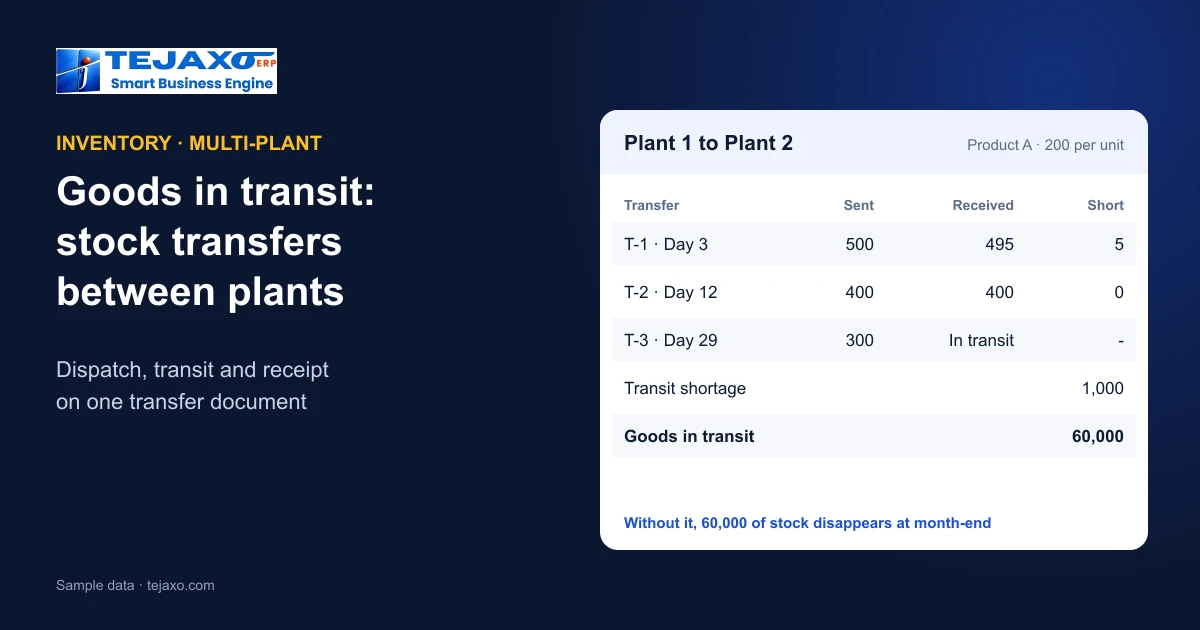
Tejaxo Manufacturing (sample data) moves Product A from Plant 1 to Plant 2, valued at 200 per unit.
| Transfer | Sent | Qty | Received | Qty in | Short |
|---|---|---|---|---|---|
| T-1 | Day 3 | 500 | Day 6 | 495 | 5 |
| T-2 | Day 12 | 400 | Day 15 | 400 | 0 |
| T-3 | Day 29 | 300 | In transit | – | – |
Transfer T-1 arrived 5 short: a transit shortage of 5 units, 1,000, to be investigated with the transporter or written off with approval. T-2 matched. T-3 left on day 29 and had not arrived when the month closed. Without a goods-in-transit record, Plant 1’s stock is down by 300 and Plant 2’s is not up: 60,000 of stock missing from the balance sheet. With it, the 60,000 sits in goods in transit until Plant 2 receives it next month.
Why it matters
- Correct stock value at month-end and in the balance sheet, especially for groups that report consolidated figures.
- Accountability for losses – a shortage is visible per transfer, per transporter and per route, instead of hiding in two plants’ stock differences.
- Planning – stock on the road is stock that will be available in a few days; the receiving plant’s planning should see it.
- Plant-wise results – when plants are measured separately, transfer value decides which plant carries the cost.
Transfer price and plant-wise books
Transfers are usually valued at cost – the sending plant’s stock value of the batch issued – so no profit is created by moving stock inside the company. Some groups use a fixed transfer price to measure each plant as a separate business; then the difference must be eliminated when the group’s figures are consolidated. Whichever method is used, set it once, apply it to every transfer and make sure the receiving plant’s stock takes the same value the sending plant gave up.
GST on transfers between plants
Tax treatment depends on registration. Plants under the same GST registration usually move stock on a delivery challan. Plants in different states have separate GST registrations, and a transfer between them is generally treated as a supply that needs a tax invoice, with input tax credit at the receiving plant. Confirm the treatment for your own registrations with your tax adviser, and keep the transfer document, the tax document and the receipt linked so the stock and tax records agree.
Controls that keep transfers clean
- One transfer document from dispatch to receipt – no unlinked receipts.
- Batch on every transfer, so traceability continues across plants – see batch and expiry picking.
- Count at receipt, with the difference recorded and approved, not quietly adjusted.
- An ageing view of goods in transit – anything on the road longer than the normal transit time needs a phone call today.
- Month-end cut-off: every transfer dispatched before the close is either received or in transit; nothing is in between.
Reading the goods-in-transit report
A useful goods-in-transit report lists every open transfer with the sending and receiving plant, dispatch date, days on the road, quantity and value. Sorting by days on the road puts the problems at the top: a transfer that normally takes three days and has been open for ten is either lost, unloaded at the wrong plant or received without being recorded. Totalled by receiving plant, the same report tells planning how much stock is about to arrive.
Semi-finished goods between plants
When one plant machines a part and another assembles it, the transfer carries work in progress, not finished stock. The value should include the material and processing cost already incurred, and the batch should travel with it so the assembling plant’s work order can still trace back to the original material lot – see work order costing.
How Tejaxo ERP handles it
Tejaxo ERP supports multi-plant operation with plant-wise numbering series, stock and books, and shows goods in transit alongside stock ageing, ABC and FSN analysis, re-order levels, bin locations and physical verification – see inventory management and ABC and FSN analysis. Multi-plant owners get consolidated finance reports and an MIS on a single screen with growth and sales by plant, state and customer. For groups that run SAP or Microsoft Dynamics, Tejaxo also builds group dashboards around the existing ERP – see extending SAP and Dynamics.
Setting it up
- Define each plant as its own location with its own stock and numbering series.
- Agree the transfer value – cost of the batch issued, or a fixed transfer price – and the GST treatment per pair of plants.
- Train both ends: dispatch always issues against a transfer document; receipt always receives against it.
- Review goods in transit weekly and at every month-end close.
Common mistakes
- Receiving as a fresh purchase or adjustment, so the transfer never closes and stock is counted twice or not at all.
- No transit stage, so stock on the road disappears at month-end.
- Adjusting shortages silently at the receiving plant instead of recording them against the transfer.
- Different values at each end, creating stock differences that nobody can explain.
Next step
See plant-wise stock, inter-plant transfers and goods in transit on your own plants in a free demo, or check the effect of the valuation method with the free stock valuation calculator.
Frequently asked questions
What is goods in transit?
Stock that has left one location and not yet arrived at another – for example a transfer between two plants. It still belongs to the company and should be shown in a goods-in-transit account, not dropped from stock.
How should a stock transfer between plants be recorded?
Issue the stock at the sending plant against a transfer document, hold it in transit, and receive it at the other plant against the same document, recording any difference as a transit shortage or excess.
At what value are inter-plant transfers recorded?
Usually at cost – the stock value of the batch issued – so no profit is created inside the company. Some groups use a fixed transfer price and eliminate the difference on consolidation.
Is GST payable on stock transfer between plants?
It depends on registration. Under the same GST registration a delivery challan is usually used; between registrations in different states a transfer is generally a supply needing a tax invoice. Confirm with your tax adviser.
How are transit shortages handled?
Record the received quantity against the transfer, show the difference, and investigate it with the transporter or approve a write-off – rather than adjusting stock silently.
Does Tejaxo ERP handle multiple plants?
Yes. It keeps plant-wise numbering series, stock and books, shows goods in transit, and gives multi-plant consolidated finance reports and an MIS by plant, state and customer.