
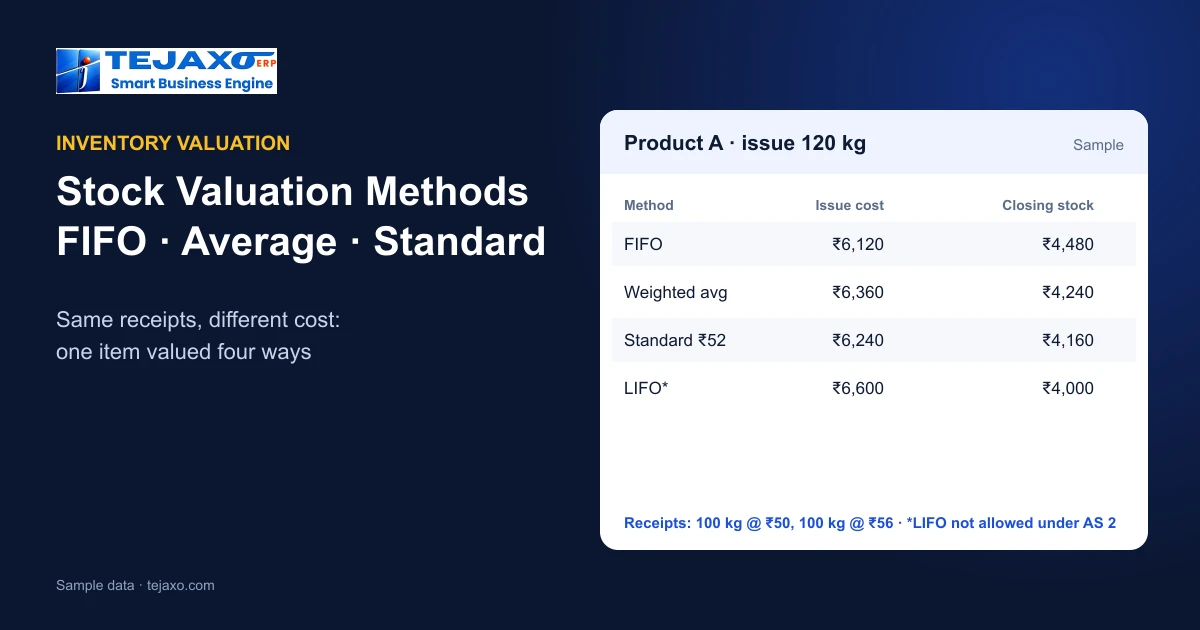
The same receipts and issues can give three different material costs and three different closing stock values, depending only on the stock valuation method. For a manufacturer this is not an accounting detail: it changes the cost of every work order, the gross margin in the monthly MIS and the closing stock in the balance sheet. This guide compares the main stock valuation methods – FIFO, weighted average and standard cost – with one worked example, explains what Indian accounting standards allow, and shows how to choose and run a method in an ERP.
What a stock valuation method decides
Every time material is issued to production or sold, the system must put a rate on it. When the item was bought at different rates, the valuation method decides which rate is used. Two numbers move together: the cost of material issued (which flows into work orders and cost of goods sold) and the value of closing stock. Whatever is not charged to issues stays in closing stock, so a method that gives a lower issue cost always gives a higher closing stock, and the other way round.
The main stock valuation methods
FIFO (first in, first out). Issues are valued at the oldest purchase rates first. Closing stock carries the most recent rates, so it is close to the current replacement cost.
Weighted average. Every receipt is blended into one average rate for the item (a moving average recalculated on each receipt, or a periodic average for the month). Issues and closing stock carry the same rate, which smooths out price swings.
Standard cost. A fixed planned rate is set for the item for a period. Receipts and issues are valued at standard, and the difference between the actual purchase rate and the standard is booked separately as a purchase price variance.
LIFO (last in, first out). Issues carry the latest rates. Some ERPs, Tejaxo ERP included, offer it as an option, but it is not permitted for financial statements under AS 2 / Ind AS 2 – more on this below.
Worked example: one item, four answers
Tejaxo Manufacturing (sample) buys raw material Product A twice in a month and issues part of it to production:
- 1 October: receipt 100 kg at ₹50 per kg (₹5,000)
- 10 October: receipt 100 kg at ₹56 per kg (₹5,600)
- 15 October: issue 120 kg to a work order
Total purchases are ₹10,600 for 200 kg, and 80 kg remain at month-end. The standard rate for Product A is ₹52 per kg.
| Method | Issue cost (120 kg) | Closing stock (80 kg) | Variance booked |
|---|---|---|---|
| FIFO | 100 x 50 + 20 x 56 = ₹6,120 | 80 x 56 = ₹4,480 | – |
| Weighted average (₹53) | 120 x 53 = ₹6,360 | 80 x 53 = ₹4,240 | – |
| Standard cost (₹52) | 120 x 52 = ₹6,240 | 80 x 52 = ₹4,160 | ₹200 adverse price variance |
| LIFO (not for financial statements) | 100 x 56 + 20 x 50 = ₹6,600 | 80 x 50 = ₹4,000 | – |
In every row, issue cost plus closing stock (plus any variance) adds up to the same ₹10,600 of purchases – the method only decides where the cost sits. With prices rising, FIFO gives the lowest material cost in the work order and the highest closing stock; weighted average sits in between; standard cost keeps the work order at the planned ₹52 and shows the ₹200 overspend separately, as (50 – 52) x 100 = ₹200 favourable on the first receipt and (56 – 52) x 100 = ₹400 adverse on the second.
What Indian standards allow
- AS 2 / Ind AS 2 allow FIFO or weighted average for items that are not specifically identified. Standard cost may be used as a measurement technique if the results approximate actual cost, which means standards must be reviewed regularly. LIFO is not permitted.
- ICDS II (for income-tax computation) similarly allows FIFO or weighted average, with standard cost as a technique when it approximates actual cost.
- Consistency matters. Once chosen, the method should be applied consistently and changed only for a sound reason, with the effect disclosed. Confirm the choice with your auditor before go-live.
How to choose a stock valuation method
- Batch and expiry items (pharma, food, chemicals): FIFO usually matches how stock physically moves – see FIFO vs FEFO picking. Keep in mind that physical picking order and valuation method are separate settings.
- Commodity inputs with frequent price swings (steel, polymers, paper): weighted average gives steadier work-order costs from month to month.
- Repetitive production with planned costing (auto parts, assemblies): standard cost makes product cost and quotations stable, and the purchase price variance report shows exactly where material cost has drifted – see purchase price variance and price trends.
- Imported material: whichever method you use, the rate going into stock should be the landed rate, including duty and clearing – see landed cost explained.
How Tejaxo ERP handles stock valuation
Tejaxo ERP supports FIFO, LIFO, weighted average and standard valuation methods. Production issues follow FIFO batch order, and batch tracking with lot sizes keeps each receipt’s rate traceable to the stock that is consumed. The inventory module adds stock ageing, ABC and FSN analysis, re-order levels, goods in transit, bin locations and physical verification, so the valued stock and the physical stock can be checked against each other. Valued issues flow into work-order costing – see work order costing – and stock moved between plants stays valued while it is in transit – see goods in transit between plants.
Common mistakes
- Changing the method mid-year without an opening adjustment, so month-on-month costs stop being comparable.
- Leaving standard rates unchanged for years, so standard cost no longer approximates actual cost and large variances pile up.
- Valuing imports at invoice rate only, leaving duty and clearing charges out of stock.
- Back-dated receipts after issues are posted, which silently change FIFO or average rates for issues already costed – lock periods after month-end.
- Ignoring slow-moving stock, which carries old rates in the closing value; review the ageing report before closing.
Next step
Want to see how your own items would be valued and costed? Book a free consultation and bring a few months of receipts and issues.
Frequently asked questions
What are the main stock valuation methods?
FIFO (first in, first out), weighted average and standard cost. LIFO also exists, but it is not permitted for financial statements under AS 2 / Ind AS 2.
Which stock valuation method is allowed in India?
AS 2 / Ind AS 2 and ICDS II allow FIFO or weighted average. Standard cost can be used as a technique when it approximates actual cost. Confirm the choice with your auditor.
Is FIFO or weighted average better for a manufacturer?
FIFO keeps closing stock near current prices and suits batch and expiry items. Weighted average smooths price swings and suits commodity inputs. Both are acceptable; apply one consistently.
What is standard cost valuation?
Items are valued at a fixed planned rate for the period, and the difference between the actual purchase rate and the standard is booked as a purchase price variance.
Does the valuation method change profit?
Yes, within a period. It decides how much of total purchase cost goes to material issued and how much stays in closing stock, which changes gross margin for that period.
Which valuation methods does Tejaxo ERP support?
FIFO, LIFO, weighted average and standard, with FIFO batch issue to production, batch tracking, stock ageing and ABC / FSN analysis.