
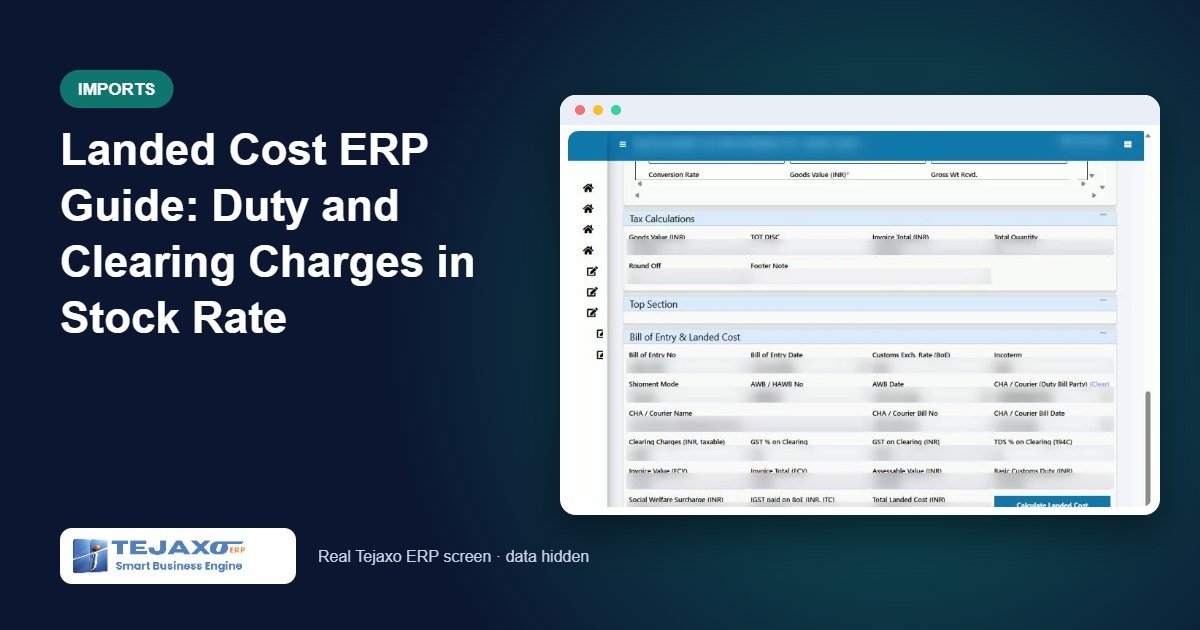
Ask three people in a plant what an imported part costs and you may get three answers: the purchase team quotes the supplier’s euro or dollar price, stores uses the rupee value on the invoice, and accounts adds up everything paid to customs and the clearing agent. Only one of these is the right stock rate, and a landed cost ERP process is how you get it consistently, shipment after shipment.
Getting landed cost wrong is expensive in quiet ways. If duty is left out, every product made from that part looks more profitable than it is. If import IGST is added in, stock is overstated and the same tax is also claimed as credit. This article explains exactly what Tejaxo ERP puts into landed cost, what it keeps out, and how the calculation works with a worked example.
What goes into landed cost, and what stays out
Landed cost is the cost of bringing the material to your store, ready for use. In Tejaxo ERP it is built from the following parts:
| Component | Source | Treatment |
|---|---|---|
| Goods value (FCY × exchange rate) | Supplier invoice | Cost |
| Supplier freight or packing share | Charge line on the supplier invoice | Cost |
| Basic Customs Duty (BCD) | Bill of Entry or item / HSN rate | Cost |
| Social Welfare Surcharge (SWS) | 10% of BCD by default | Cost |
| Clearing charges of the agent or courier | CHA / courier bill | Cost |
| Import IGST | Bill of Entry | Input tax credit, not cost |
| GST on clearing charges | CHA / courier bill | Input tax credit, not cost |
| Forex gain or loss on payment | Bank rate vs book rate | Separate ledger, not cost |
The principle is simple: anything you can claim back as credit does not belong in stock value, and anything that arises after the material is received (such as a currency movement before payment) belongs in the profit and loss account, not in the item rate.
The formula, step by step
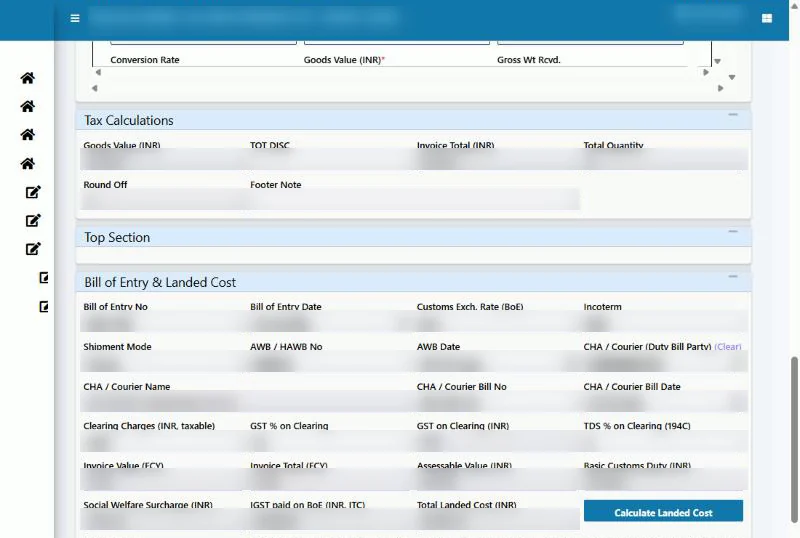
Tejaxo ERP calculates landed cost in the Import MRR, line by line, in this order:
- Assessable value = (invoice value in FCY + supplier freight share − discount share) × customs exchange rate.
- BCD = assessable value × BCD %, taken from the item master or HSN.
- SWS = BCD × 10%.
- Import IGST = (assessable value + BCD + SWS) × IGST %. This is recorded as credit.
- Landed cost = goods value in INR + freight share + BCD + SWS + clearing share.
- Landed rate = landed cost ÷ bill quantity. This becomes the stock rate of the MRR line.
Because each line carries its own BCD % and IGST %, a shipment that mixes items with different duty rates is costed correctly without any manual split.
Worked example: two items, two duty rates
Tejaxo Manufacturing receives one shipment from Tejaxo Vendor, invoiced in US dollars on CIF terms: 100 units of Product A at USD 40 and 50 units of Product B at USD 120. The exchange rate and the customs rate on the Bill of Entry are both ₹84.00. Product A attracts 7.5% BCD and Product B 10%; both carry 18% IGST. The clearing agent charges ₹8,000, which in this example is shared in proportion to assessable value (40% to Product A, 60% to Product B).
| Line | Product A ₹ | Product B ₹ | Total ₹ |
|---|---|---|---|
| Assessable value (USD 4,000 / USD 6,000 × 84.00) | 3,36,000.00 | 5,04,000.00 | 8,40,000.00 |
| BCD (7.5% / 10%) | 25,200.00 | 50,400.00 | 75,600.00 |
| SWS (10% of BCD) | 2,520.00 | 5,040.00 | 7,560.00 |
| Clearing share | 3,200.00 | 4,800.00 | 8,000.00 |
| Landed cost | 3,66,920.00 | 5,64,240.00 | 9,31,160.00 |
| Quantity | 100 | 50 | |
| Landed rate per unit | 3,669.20 | 11,284.80 | |
| Invoice rate per unit in INR | 3,360.00 | 10,080.00 | |
| Import IGST at 18% (ITC, kept out) | 65,469.60 | 1,00,699.20 | 1,66,168.80 |
Two things stand out. First, the landed rate is 9.2% above the invoice rate for Product A and 12% above it for Product B, because of the different duty rates. A plant that values both at the invoice rate understates the cost of every assembly that uses Product B. Second, if import IGST were wrongly added, Product A would carry about ₹655 more per unit, roughly 18% more than its true cost, while the same IGST would also be claimed in GSTR-3B.
Rate-based duty or Bill of Entry amounts
The Bill of Entry section of the Import MRR has fields for BCD, SWS and IGST “as per BoE”. Each field follows one rule:
- Blank: the ERP calculates the amount from the line rates, as in the example above.
- Zero: the duty is nil. This is common on courier-cleared shipments where the bill shows only IGST.
- An amount: the ERP uses exactly that amount and spreads it across the lines in proportion to their assessable value.
Use the exact amounts whenever you have the Bill of Entry in hand. Customs may assess a different value or rate, and the books should match what was actually paid, not what you expected to pay. The customs exchange rate printed on the Bill of Entry has its own field; if it is left blank, the shipment’s exchange rate is used.
Splitting a CHA or courier bill into cost and credit
The clearing agent’s bill is where most errors creep in, because one bill mixes three different things. Take a sample courier bill of ₹12,540 for a small parcel cleared on behalf of Tejaxo Manufacturing:
In the Import MRR, the agent is selected as the duty bill party; the IGST of ₹9,000 goes into “IGST as per BoE / CHA bill”, BCD and SWS are entered as zero, the clearing charges as ₹3,000 with GST 18% and TDS 2%. The ERP calculates the GST on clearing itself. Only ₹3,000 of the ₹12,540 reaches the stock value. When the agent bills from another state, the GST on the service is IGST. TDS under section 194C is deducted at 2% for a company or 1% for an individual, subject to the threshold, and only on the service charges, never on the duty or IGST reimbursed.
Three exchange rates, one landed rate
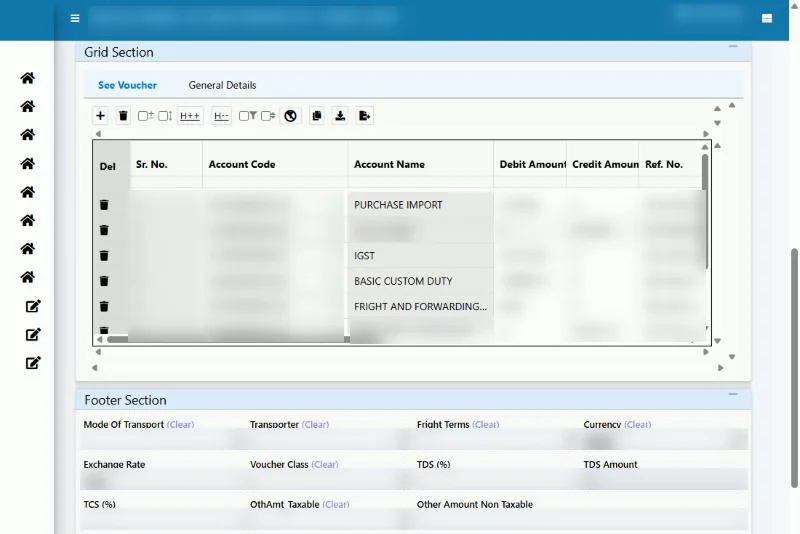
An import can touch three exchange rates, and each has a clear job:
- Book rate (on the gate entry and MRR): converts the supplier invoice to INR and fixes the supplier liability.
- Customs rate (on the Bill of Entry): used for assessable value and therefore for the duty.
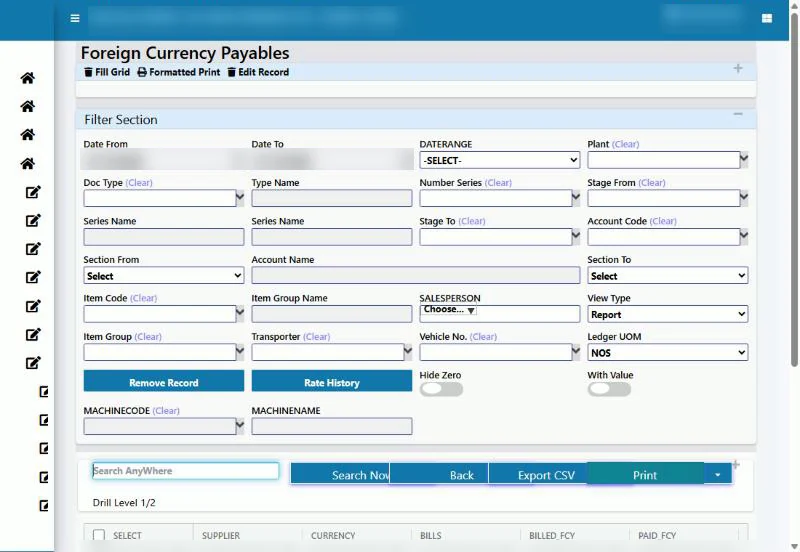
- Bank rate (on the payment voucher): what the bank actually charged. The difference from the book rate goes to the Forex Gain/Loss ledger.
The landed rate is fixed when the material is received and does not move when the payment is made later. This keeps stock valuation and work-order costing stable, while the currency effect shows up honestly in the forex ledger.
Common landed cost mistakes
- Valuing stock at the invoice rate: duty and clearing end up as expenses, and product costing is understated.
- Adding import IGST to cost: stock is overstated and the credit is claimed as well. Tejaxo ERP posts it to its own ledger and shows it in a separate column of the landed cost register.
- Booking the whole agent bill to one expense ledger: IGST credit is lost and TDS is calculated on the wrong base.
- Treating supplier freight as a separate stock item: in Tejaxo ERP the freight line carries zero stock value because its cost is already in the goods’ landed rate.
- Duty entered without a Bill of Entry: the ERP will not save an MRR that has duty or import IGST but no Bill of Entry number and agent.
Where landed cost is used
Once the Import MRR passes quality, the landed rate becomes the stock rate. It flows into stock valuation, issue rates and work-order costing, so the material cost of a finished product reflects the duty actually paid. The Import Landed Cost Register shows the item-wise breakup (goods, BCD, SWS, freight and clearing, landed value and rate, with IGST in its own column), and the Bill of Entry / Import IGST Register gives the month-wise credit for GSTR-3B table 4(A)(1). You can read more about valuation on our inventory management software page and about costing and reports on the business intelligence page. To see how FIFO, LIFO and weighted average value the same receipts differently, try our free stock valuation calculator.
Who needs this
Any manufacturer that imports machines, spares, dies, sensors or raw material benefits, but the effect is largest where imported parts are a big share of product cost, as in many plants in the Japanese and export zones of Rajasthan and Haryana. See our page on manufacturing ERP in Neemrana. Smaller importers can start with the same flow; our page on ERP for small manufacturing businesses explains how.
How Tejaxo implements this
We begin with a discovery session with your purchase and accounts teams to agree how duty, clearing and freight should be treated. We then run a pilot on your own items and a recent shipment, reconcile the landed cost with your accountant’s working, and go live with training for stores and accounts. The same team supports you after go-live. Landed cost is part of the import module of Tejaxo ERP.
Check your own numbers
Bring the Bill of Entry and agent bill from one recent import, and we will calculate its landed cost in Tejaxo ERP with you, line by line. Book a free demo or WhatsApp us at +91 96717 27474.
Frequently asked questions
What is included in landed cost for imported material?
Landed cost is the goods value in INR plus the supplier freight share, Basic Customs Duty, Social Welfare Surcharge and the clearing charges of the customs agent or courier. It becomes the stock rate of the item.
Is import IGST part of landed cost?
No. Import IGST paid on the Bill of Entry is claimed as input tax credit, so it is posted to an IGST Input on Import ledger and kept out of the stock value.
How is SWS calculated on imports?
In Tejaxo ERP the Social Welfare Surcharge defaults to 10% of the Basic Customs Duty on each line, and the IGST is then calculated on assessable value plus BCD plus SWS.
What if the Bill of Entry duty differs from the calculated duty?
Enter the exact BCD, SWS and IGST amounts from the Bill of Entry. The ERP uses those amounts and spreads them across the lines in proportion to assessable value instead of calculating them from the rates.
Does forex gain or loss change the landed cost?
No. Stock stays at the landed rate fixed at receipt. The difference between the book rate and the bank rate on payment is posted to the Forex Gain/Loss ledger.
Is GST on the clearing agent bill a cost?
No. The agent service charges are cost, but the GST charged on them is input credit. TDS under section 194C is deducted on the service charges only.