
Most stock-outs in a factory are not caused by a supplier failing – they are caused by a purchase order placed too late. The reorder level formula answers “when should we reorder?”, safety stock answers “how much buffer do we keep for bad days?”, and EOQ (economic order quantity) answers “how much should we order each time?”. This guide explains all three with one worked example on a raw material, adds the minimum and maximum stock levels, and shows how to run them in an ERP instead of a stores register.
The four numbers every stores team needs
- Safety stock – the buffer held for days when consumption is higher or the supplier is slower than usual.
- Reorder level – the stock level at which a new requisition must be raised.
- Economic order quantity (EOQ) – the order size that balances the cost of ordering against the cost of holding stock.
- Minimum and maximum levels – warning limits: below the minimum the item is at risk; above the maximum, cash is locked in stock.
The formulas
| Measure | Formula |
|---|---|
| Safety stock | (Maximum daily usage x maximum lead time) – (average daily usage x average lead time) |
| Reorder level | (Average daily usage x average lead time) + safety stock |
| EOQ | √(2 x annual demand x cost per order / holding cost per unit per year) |
| Maximum level | Reorder level + EOQ – (minimum daily usage x minimum lead time) |
| Minimum level | Reorder level – (average daily usage x average lead time) |
Lead time means the full time from raising the requisition to accepted stock in the store – approval, PO, supplier dispatch, transit, gate entry and incoming inspection – not just the supplier’s promised delivery days.
Worked example: one raw material
Tejaxo Manufacturing (sample) uses raw material Product A. From the last six months of issues and receipts:
- Daily usage: average 40 kg, maximum 55 kg, minimum 30 kg
- Lead time: average 7 days, maximum 10 days, minimum 5 days
- Working days: 300 a year, so annual demand = 40 x 300 = 12,000 kg
- Cost of placing one order (approval, PO, follow-up, gate, inspection, accounting): ₹1,500
- Holding cost: ₹6 per kg per year (interest, storage, handling and losses)
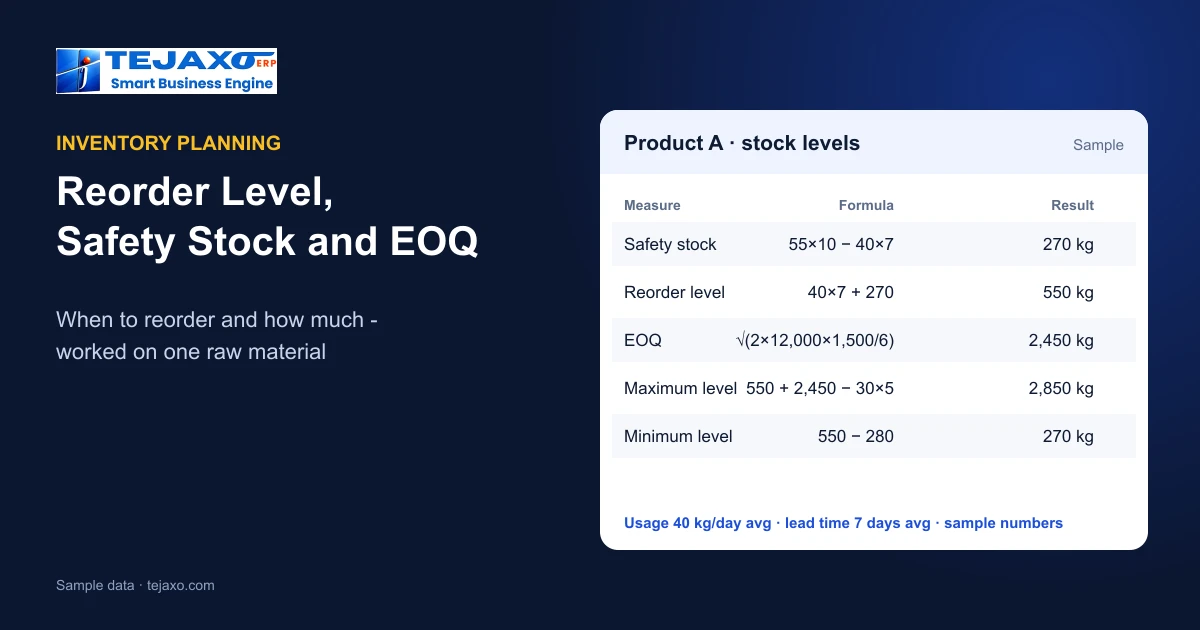
| Step | Calculation | Result |
|---|---|---|
| Safety stock | (55 x 10) – (40 x 7) = 550 – 280 | 270 kg |
| Reorder level | (40 x 7) + 270 | 550 kg |
| EOQ | √(2 x 12,000 x 1,500 / 6) = √6,000,000 | about 2,450 kg |
| Maximum level | 550 + 2,450 – (30 x 5) | 2,850 kg |
| Minimum level | 550 – 280 | 270 kg |
Reading the result: when Product A falls to 550 kg, the stores raise a requisition for about 2,450 kg – roughly five orders a year. If stock ever falls below 270 kg, the plant is eating into its safety stock and the purchase team should chase the open order. Stock above 2,850 kg means something was over-ordered or consumption has dropped.
When the formulas need adjusting
- Seasonal or order-driven demand: recalculate from recent months, or plan from the production schedule instead – see master production schedule, where safety stock is part of the MPS calculation.
- Minimum order quantities and pack sizes: round the EOQ to the supplier’s MOQ, coil or pallet size.
- Unreliable suppliers: a wide gap between average and maximum lead time inflates safety stock; fixing delivery reliability is cheaper than holding more stock – see vendor rating.
- Low-value items: do not spend effort on precise levels for C-class items; focus on A-class items – see ABC and FSN analysis.
- Slow-moving and non-moving items: set no reorder level at all until demand returns.
How Tejaxo ERP helps
Tejaxo ERP keeps re-order levels in the inventory module alongside stock ageing, ABC and FSN analysis, goods in transit, bin locations and physical verification. Purchase requisitions are raised manually or from MRP and flow into purchase orders with an approval workflow and delivery schedules; PRs and POs can be released from the phone, so a requisition raised at the reorder level does not wait for someone to reach a desk. Gate entry, GRN with batch-wise receipt and incoming quality complete the cycle, and the purchase reports – schedule vs actual, purchase TAT and vendor rating – give the real lead times that the formulas need. See 3-way match and GRNI for the rest of the procure-to-pay chain.
Common mistakes
- Using the supplier’s promised lead time instead of the measured time from requisition to accepted stock.
- Setting levels once and never reviewing them, although usage and lead times change every quarter.
- Counting rejected or on-hold stock as available when comparing with the reorder level.
- Ignoring open purchase orders, so a second requisition is raised for material already on the way.
- One rule for every item – A, B and C items need different attention.
Next step
Want to see re-order levels, requisitions and approvals working on your own items? Book a free consultation.
Frequently asked questions
What is the reorder level formula?
Reorder level = average daily usage x average lead time + safety stock. Without a separate safety stock figure it is often written as maximum daily usage x maximum lead time.
How do you calculate safety stock?
A simple method: (maximum daily usage x maximum lead time) – (average daily usage x average lead time). It covers days when usage is higher or delivery slower than usual.
What is EOQ?
Economic order quantity is the order size that balances ordering cost and holding cost: the square root of (2 x annual demand x cost per order / holding cost per unit per year).
What lead time should be used?
The full time from raising the requisition to accepted stock in the store, including approval, transit, gate entry and incoming inspection, measured from your own records.
How often should reorder levels be reviewed?
At least every quarter, and whenever consumption or supplier lead times change noticeably. Review A-class items more often than C-class items.
Does Tejaxo ERP support re-order levels?
Yes. Re-order levels sit in the inventory module with stock ageing and ABC / FSN analysis, and requisitions flow into purchase orders with approvals that can be released from the phone.