
Most payment mistakes in a plant are not fraud. They are a supplier billing 1,000 pieces when the store accepted 980, a rate that crept up by two rupees without a revised order, or a bill paid twice because it arrived by email and by post. The control that catches all three is the 3-way match: before a bill is passed, the purchase order, the goods receipt and the supplier invoice must agree. Its companion is GRNI – goods received not invoiced – which shows what the plant owes for material already in the store but not yet billed. This guide explains both, with a worked example of each.
The three documents
- Purchase order (PO): what was agreed – item, quantity, rate, tax and delivery schedule – after approval.
- Goods receipt (GRN / MRR): what actually arrived and was accepted after incoming inspection, batch by batch.
- Supplier invoice: what the supplier is asking to be paid.
A 2-way match compares only the PO and the invoice. It catches rate differences but not short or rejected supply. The 3-way match adds the receipt, so the plant pays only for what it accepted, at the rate it agreed.
Worked example: one invoice, two differences
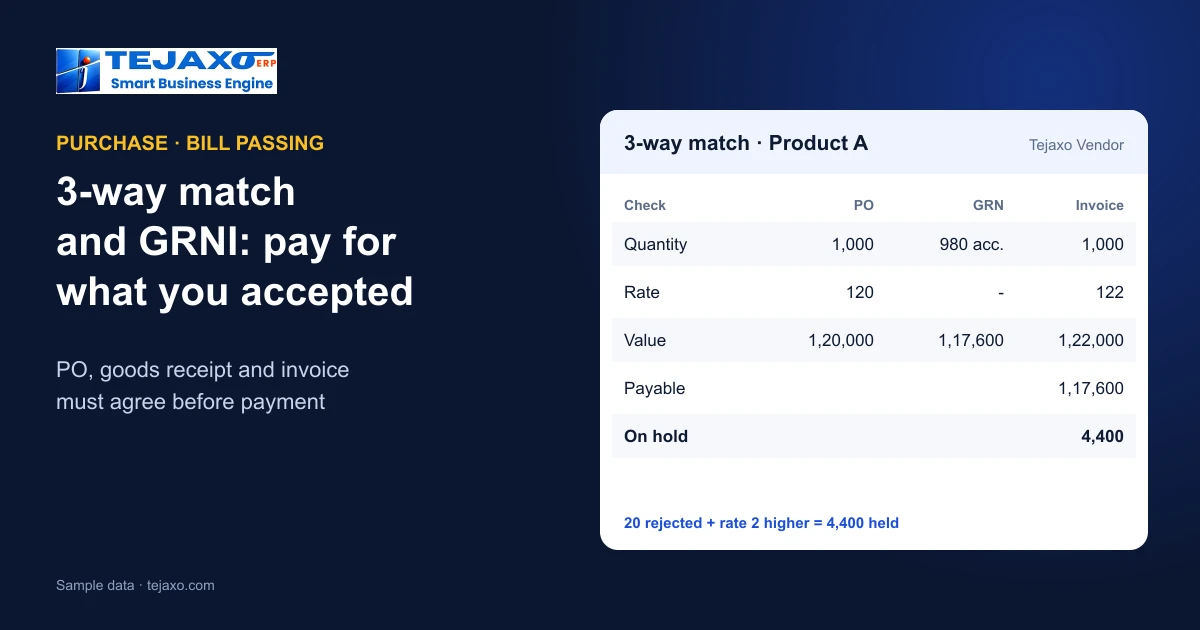
Tejaxo Manufacturing (sample data, amounts before GST) orders 1,000 pieces of Product A from Tejaxo Vendor at 120. The store receives 1,000; incoming inspection rejects 20. The supplier invoices 1,000 pieces at 122.
| Check | PO | GRN | Invoice |
|---|---|---|---|
| Quantity | 1,000 | 1,000 recd / 980 accepted | 1,000 |
| Rate | 120 | – | 122 |
| Value | 1,20,000 | 1,17,600 (accepted x PO rate) | 1,22,000 |
The match finds two differences. Quantity: 20 pieces billed were rejected – 2,440 at the invoice rate. Rate: 122 billed against 120 agreed on the 980 accepted – 1,960. The amount payable is 1,17,600, and 4,400 is held until the differences are settled: the rejected 20 go back on a purchase return with a debit note (see from gate entry to debit note), and the rate is either corrected by the supplier or approved by purchase with a revised PO.
Tolerances: what to let through
A strict match on every paisa creates work without value. Most plants set tolerances:
- Quantity: a small percentage for items sold by weight or length – steel, coils, paper reels, chemicals – where the billed and weighed quantity rarely agree exactly.
- Rate: zero for most items; any change needs a PO amendment.
- Value: a small absolute amount for rounding.
Anything outside tolerance stops the bill and goes to the person who can resolve it – purchase for rate, stores and quality for quantity.
Who resolves which mismatch
- Rate or terms differ: purchase – get a corrected invoice or approve a PO amendment with a reason.
- Quantity short or rejected: stores and quality – confirm the count and the inspection result; purchase raises the return and debit note.
- Item or tax mismatch: accounts with purchase – an invoice for the wrong item code or with the wrong tax rate must be corrected by the supplier, not adjusted in the books.
- Invoice with no receipt: stores – either the material has not arrived, or it was received against the wrong PO; find out which before anything is paid.
Routing each exception to one owner, with the reason recorded, keeps bills from sitting in an accounts tray with nobody responsible.
GRNI: goods received not invoiced
When material is accepted into stock, the plant owes for it – whether or not the bill has arrived. GRNI lists receipts that have no matching purchase voucher yet. At month-end it is the liability that the books should carry for material already used or in stock.
| Receipt | Qty | PO rate | Value |
|---|---|---|---|
| GRN 1 · Product A | 500 | 80 | 40,000 |
| GRN 2 · Product B | 200 | 150 | 30,000 |
| GRN 3 · Product C | 60 | 250 | 15,000 |
| Total GRNI | 85,000 |
In this sample, 85,000 of material is in the store without a bill. If the month is closed without it, stock is in the books but the liability is not, and the profit for the month is overstated. Reviewing GRNI also finds lost bills, suppliers who invoice late, and receipts posted against the wrong PO.
Where GST fits
Input tax credit on a purchase needs the supplier’s invoice and the goods received; credit on a quantity the plant rejected and returned is reversed through the debit note. Running the 3-way match before the purchase voucher keeps the tax on the voucher consistent with what was actually accepted, and the GST returns prepared from the books follow the same figures.
How Tejaxo ERP handles it
In Tejaxo ERP the procure-to-pay chain runs from requisition (manual or from MRP) to a purchase order with an approval workflow and schedules, gate entry with or without a PO, batch-wise MRR / GRN, incoming QC with accept, reject and PPM, and a purchase voucher 3-way matched to the PO and the receipt. Purchase reports include the 3-way match, GRNI, vendor rating, price trends, schedule vs actual and purchase TAT. Supplier invoices can be scanned at the gate with AI and read straight into the gate entry – see AI invoice scanning – and suppliers can upload invoices through the supplier portal. Imported material follows the same chain with landed cost – see import purchase from PO to payment.
Setting it up
- No bill without a PO for stock items – services and petty purchases can follow a lighter route.
- Receive against the PO at the gate and in the store, so every GRN carries the PO line.
- Inspect before accepting, and record rejected quantity with a reason.
- Agree tolerances per item group and write them down.
- Review GRNI weekly and before every month-end close.
Measuring the process
- Share of bills matched first time – rising as POs, receipts and supplier billing improve.
- Bills on hold and their age – a long hold usually means an exception with no owner.
- GRNI by age – receipts older than a month without a bill point to lost invoices or wrong postings.
- Purchase TAT – the time from requisition to receipt, to see where the chain slows down.
Common mistakes
- Matching against received instead of accepted quantity, so rejected material is paid for.
- Accepting rate changes on the invoice without a revised PO.
- Closing the month without GRNI, which overstates profit.
- Booking the bill twice because the same invoice number arrived on paper and by email – a duplicate check on supplier and invoice number prevents it.
Next step
See the 3-way match, GRNI and vendor rating on your own purchases in a free demo, or read how work order costing uses the rate of the batch actually received.
Frequently asked questions
What is a 3-way match in purchase?
Checking that the purchase order, the goods receipt and the supplier invoice agree on item, quantity and rate before the bill is passed for payment.
What is the difference between a 2-way and a 3-way match?
A 2-way match compares only the purchase order and the invoice. A 3-way match also checks the goods receipt, so the plant pays only for the quantity it actually accepted.
What is GRNI?
Goods received not invoiced: receipts accepted into stock for which no supplier bill has been booked yet. It is a liability the books should carry at month-end.
Should the match use received or accepted quantity?
Accepted quantity. Material rejected at incoming inspection is returned with a debit note and should not be paid for.
What tolerances are normal in a 3-way match?
Usually a small quantity tolerance for items sold by weight or length, zero rate tolerance without a PO amendment, and a small value tolerance for rounding.
Does Tejaxo ERP do a 3-way match?
Yes. The purchase voucher is 3-way matched to the PO and the receipt, and the purchase reports include the 3-way match, GRNI, vendor rating, price trends and schedule vs actual.