
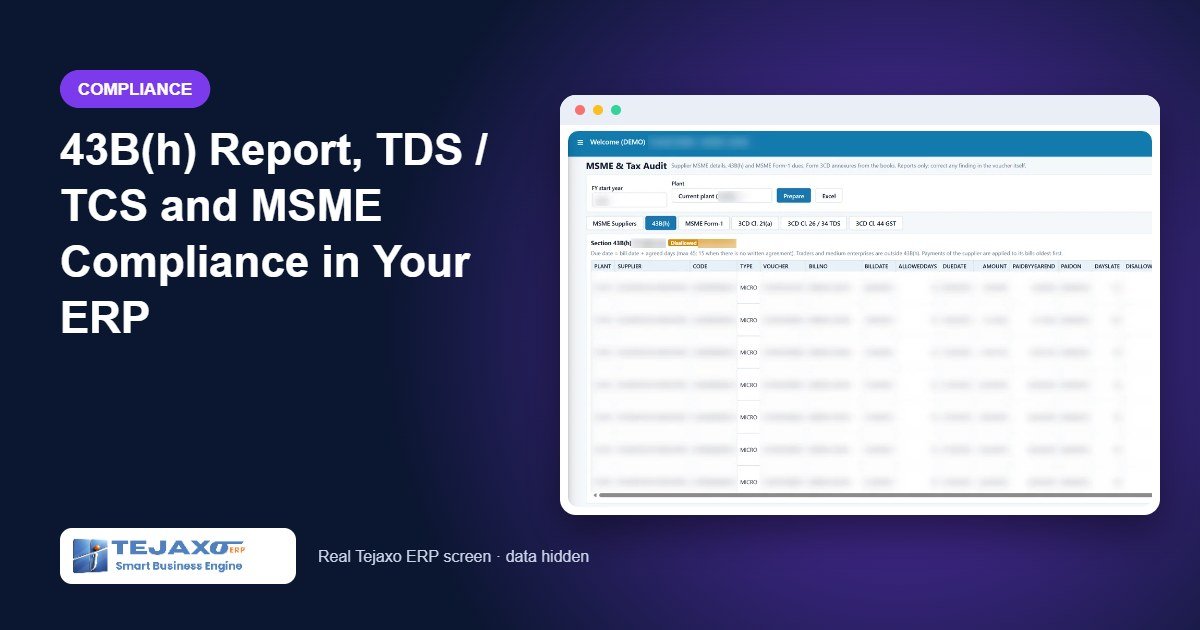
Since section 43B(h) of the Income-tax Act came into force, every manufacturer that buys from micro and small enterprises has a new year-end question: which supplier bills were not paid in time, and how much expense will be disallowed? Add monthly TDS deposits, quarterly 26Q and 27EQ returns, TCS on scrap sales and the tax-audit clauses, and the accounts team spends a large part of every year-end rebuilding data that already exists in the books. A 43B(h) report built inside the ERP, along with TDS and TCS registers, turns this into a routine check instead of a year-end scramble.
This article explains how Tejaxo ERP handles MSME supplier details, the 43B(h) and MSME Form-1 reports, TDS and TCS management, and the Form 3CD tax-audit data – with a worked example and the audit checks that catch common errors.
MSME supplier details: the foundation
Every report on MSME payments depends on knowing which suppliers are MSMEs. In Tejaxo ERP, each supplier’s Udyam details are recorded on the MSME suppliers screen: enterprise type (micro, small or medium), activity (manufacturing, services or trading), Udyam registration number and the agreed credit days. The Udyam number format is checked on entry.
The activity matters: suppliers registered as traders are outside section 43B(h), and the ERP excludes them from the report automatically. Suppliers can maintain their own details through the vendor management portal, which reduces follow-ups by the purchase team.
How the 43B(h) report works
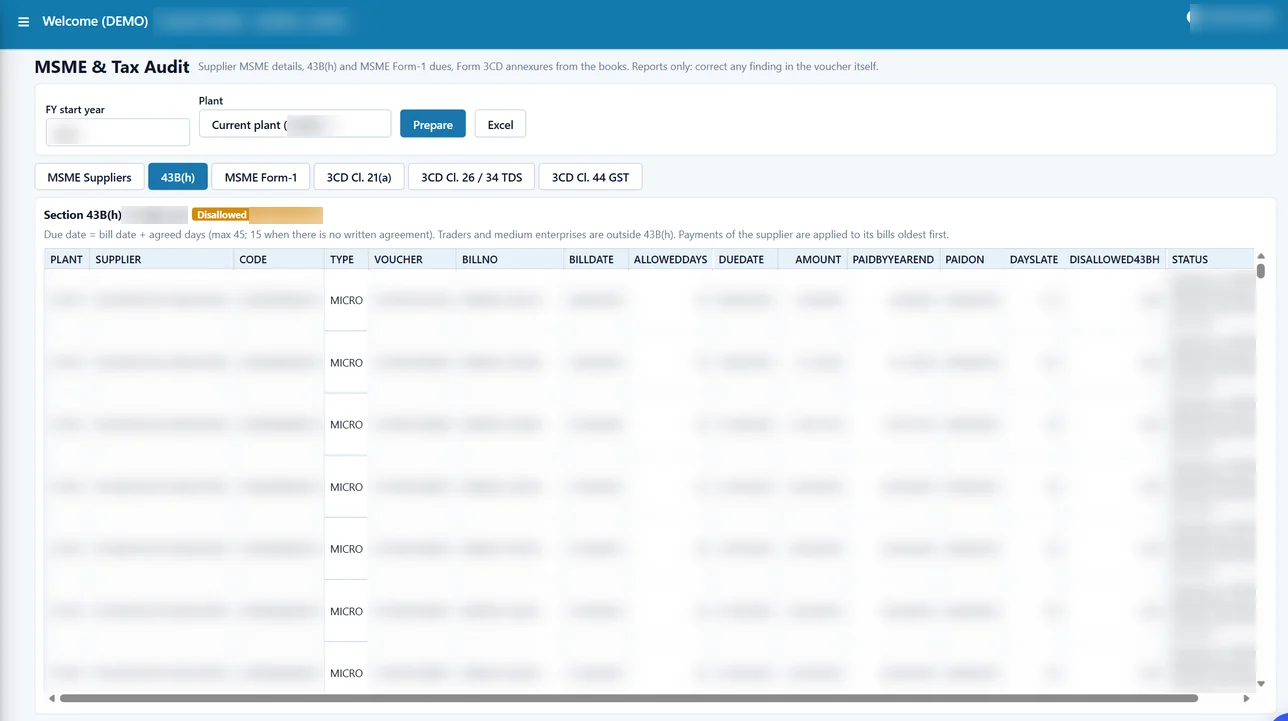
Section 43B(h) allows a deduction for amounts owed to micro and small enterprises only when they are paid within the time limit of the MSMED Act – the agreed credit period, which cannot exceed 45 days (15 days where there is no written agreement). An amount still unpaid after its due date at year end is disallowed for that year and allowed in the year it is actually paid.
Tejaxo ERP prepares the report for a financial year in four steps:
- Due date per bill – bill date plus the agreed days, capped at 45.
- Payment allocation – payments are applied to the oldest bills first (FIFO), so each bill shows whether and when it was paid.
- Status – paid on time, paid late, not yet due at year end, or unpaid and overdue at year end.
- Disallowance – the total of bills unpaid and past their due date at year end.
Bills paid late within the year are shown with their own status, so the team can review them separately.
Worked example: 43B(h) for FY 2025-26
Tejaxo Manufacturing has three MSME suppliers. Sample bills and payments:
| Supplier (type, agreed days) | Bill | Bill date | Amount (Rs) | Due date | Position on 31 Mar 2026 | 43B(h) status |
|---|---|---|---|---|---|---|
| Tejaxo Vendor 1 (Micro, manufacturing, 30) | INV-0001 | 10 Feb 2026 | 2,00,000 | 12 Mar 2026 | Paid 20 Mar 2026 | Paid late – allowed on payment |
| Tejaxo Vendor 1 (Micro, manufacturing, 30) | INV-0002 | 5 Mar 2026 | 1,50,000 | 4 Apr 2026 | Unpaid | Not yet due – no disallowance |
| Tejaxo Vendor 2 (Small, services, 45) | TV-0101 | 1 Jan 2026 | 3,00,000 | 15 Feb 2026 | Unpaid | Disallowed |
| Tejaxo Vendor 3 (Micro, trading) | TV-0300 | 2 Jan 2026 | 80,000 | – | Unpaid | Outside 43B(h) |
The report shows a disallowance of Rs 3,00,000 for FY 2025-26. That amount is allowed in the year it is paid. Without bill-wise payment allocation, the team would have to reconstruct every payment by hand from the ledger – and the trader bill might wrongly have been included.
MSME Form-1, half-yearly
Companies that owe micro or small enterprises for more than 45 days must file MSME Form-1 every half-year. Tejaxo ERP prepares the bill-wise list of dues older than 45 days for the selected half-year and includes a reason for delay column, which the filing requires. Because it uses the same supplier details and payment allocation as the 43B(h) report, the two never contradict each other.
TDS management
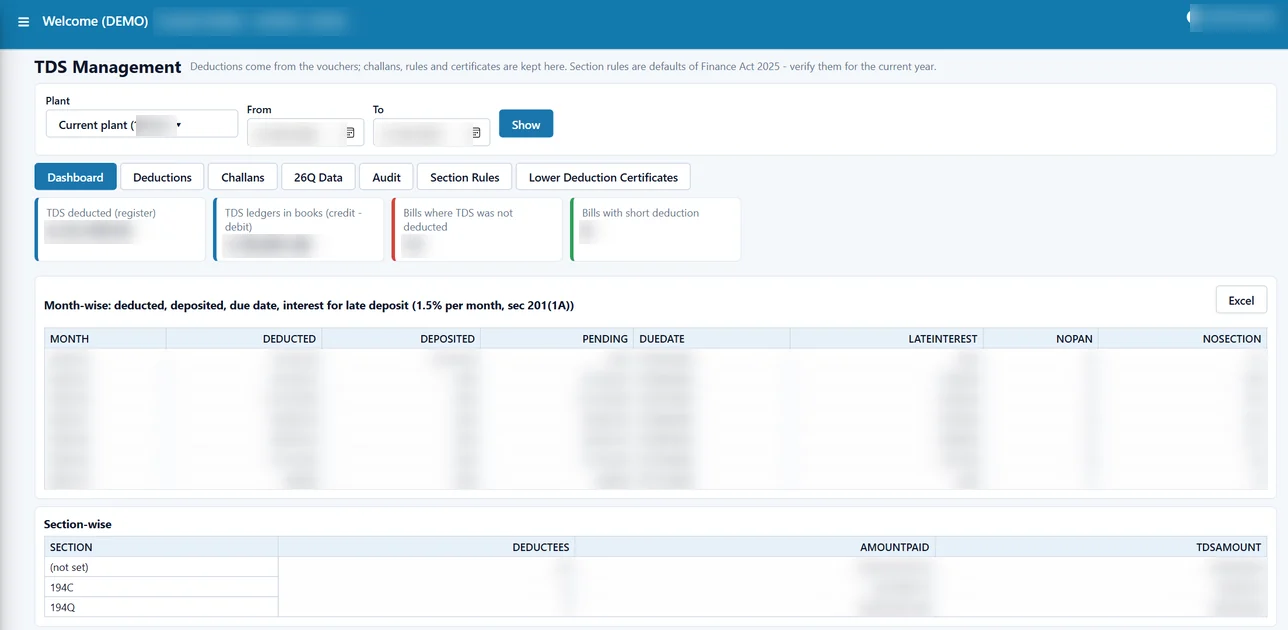
The TDS module brings deductions, deposits and returns together:
- Dashboard – TDS deducted for the year compared with the TDS ledgers in the books, bills where TDS was not deducted, and month-wise deposit status with interest where deposits are late.
- Deductions register – every deduction with party, PAN, section, amount, rate, due date, status and interest.
- Challans – select a pending month and all its deductions are ticked; enter the BSR code, challan serial number and date, and save.
- 26Q data – deductee-wise rows for the quarter, exported to Excel for the return preparation utility. Missing PAN, section or challan details are listed at the top so they are fixed before filing.
- Section rules – default rates, no-PAN rates and threshold limits per section, which the finance team can edit.
TDS applicability audit
The audit compares what was deducted with what the rules require. Typical findings: TDS under section 194Q deducted although the Rs 50 lakh threshold for that seller was not crossed; a party with no PAN; or section 194C TDS not deducted although the party’s total for the year crossed the limit. It also shows interest under section 201(1A) for late deduction or late deposit.
TCS management
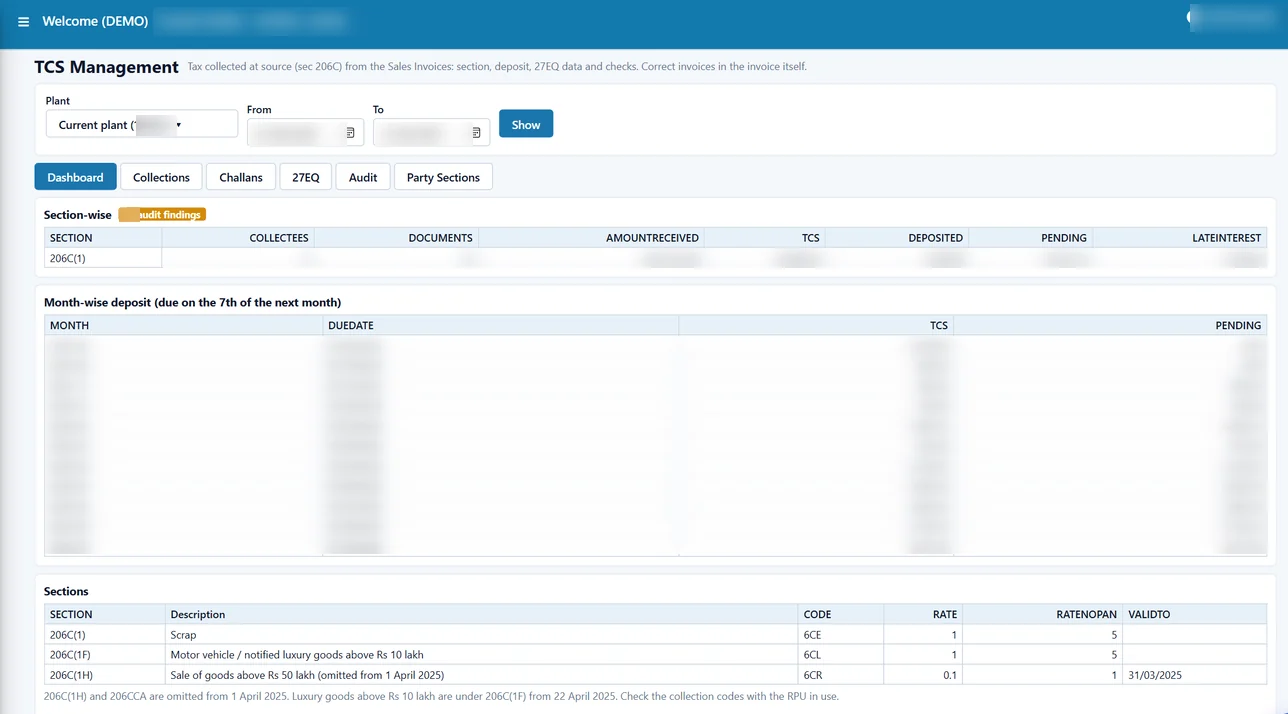
For manufacturers who sell scrap, TCS under section 206C(1) is a monthly task. Tejaxo ERP picks TCS collections from sales invoices and shows the month-wise due date (the 7th of the following month) and pending amounts. Challans are entered against selected invoices, and the ERP refuses a challan dated before an invoice it covers, because tax cannot be deposited before it is collected.
The 27EQ data shows collectee PAN, collectee code (6CE for scrap), amount, TCS and challan for each quarter. The TCS audit flags a wrong rate (for example 2% charged on scrap where the rate is 1%), parties without PAN who attract the higher rate under section 206CC, and deposits made after the due date that attract interest under section 206C(7). The TCS section can be set customer by customer.
Form 3CD data for the tax audit
The tax auditor asks for the same schedules every year. Tejaxo ERP prepares them from the books:
- Cash payments above Rs 10,000 (clause 21) – party-wise and day-wise cash payments above the limit. Where many employees are paid through one salary ledger, those entries need an employee-wise review.
- TDS compliance (clause 34) – section-wise amounts paid, TDS deductible, deducted and deposited, bills where TDS was not deducted, amounts deducted but not deposited, and interest under section 201(1A).
- GST-wise expenditure (clause 44) – expenditure split between GST-registered and unregistered parties, with exempt and nil-rated, import and other expenses on separate lines, ready whenever the clause has to be reported.
Common mistakes the ERP prevents
- Treating every MSME the same – traders and medium enterprises are not included in the 43B(h) disallowance.
- Applying payments to the wrong bill – FIFO allocation gives a consistent, auditable answer.
- Deducting TDS where it is not due, or missing it where it is – the applicability audit lists both.
- TDS register and ledgers drifting apart – the dashboard shows the two totals side by side.
- Wrong TCS rate on scrap – the TCS audit flags the rate and no-PAN cases.
Rates, limits and section references change with each Finance Act. Because section rules are editable, the finance team can update them without waiting for a software release; we recommend reviewing them with your chartered accountant at the start of every financial year.
Who it is for and how Tejaxo implements it
These reports suit any manufacturer that buys from MSMEs, deducts TDS on contractors and goods, or sells scrap – which covers almost every plant. Small and mid-sized units can read more on our ERP for small manufacturing businesses page, and the full module list is on the Tejaxo ERP page.
Implementation starts with a discovery session with your accounts team and auditor to confirm supplier MSME data, TDS sections and current practice. A pilot on your own books for a live month follows, with the audit reports compared against your existing workings. Go-live includes training, and the same team supports you afterwards – see our ERP implementation approach.
To see the 43B(h) report and TDS / TCS audit on sample data, book a free demo or WhatsApp us at +91 96717 27474.
Frequently asked questions
What is the 43B(h) report?
It lists bills of micro and small enterprise suppliers that were not paid within the agreed credit period (maximum 45 days) and shows the amount disallowed for the year. Tejaxo ERP prepares it bill by bill from the books.
Are trader MSMEs covered by section 43B(h)?
No. Suppliers registered as traders are outside section 43B(h), and Tejaxo ERP excludes them based on the activity recorded in the supplier Udyam details.
How does the ERP decide which bill a payment settles?
Payments are applied to the oldest bills first (FIFO), so each bill shows whether and when it was paid.
Can Tejaxo ERP prepare MSME Form-1?
Yes. It prepares the half-yearly list of dues to micro and small enterprises older than 45 days, with a reason-for-delay column.
Does the ERP prepare 26Q and 27EQ data?
Yes. Deductee-wise 26Q data and collectee-wise 27EQ data are prepared for each quarter, with missing PAN, section or challan details shown first.
Which Form 3CD clauses does Tejaxo ERP support?
It prepares data for cash payments above Rs 10,000 (clause 21), TDS compliance (clause 34) and GST-wise expenditure (clause 44) from the books.