
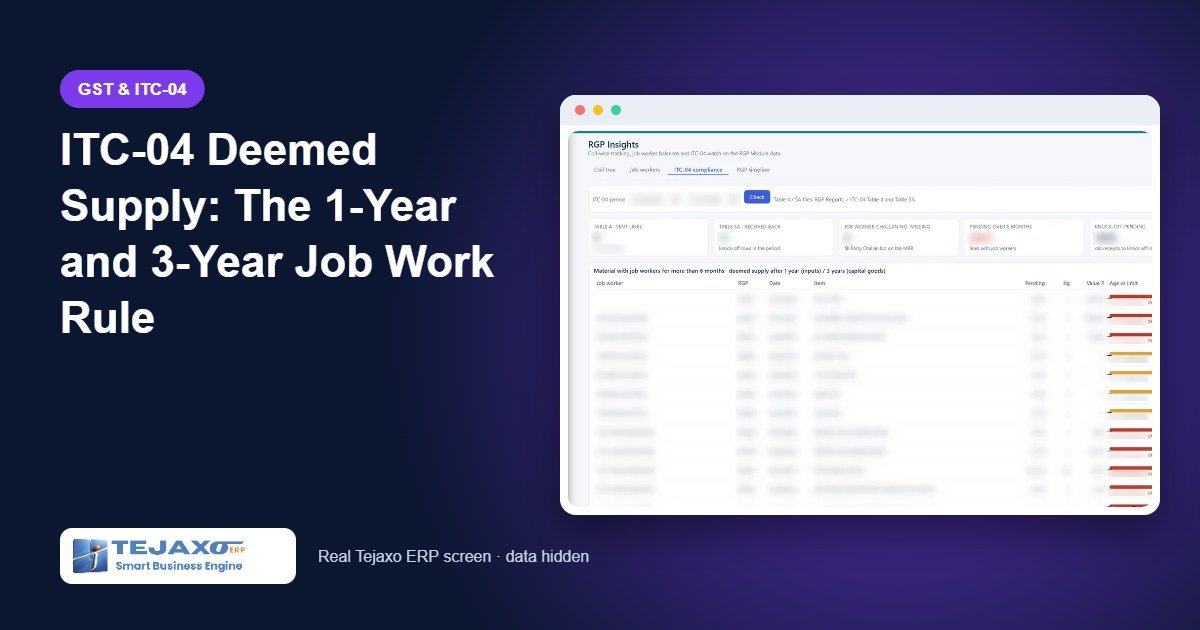
Most accountants know that job work material has to be reported in ITC-04. Fewer track the rule that sits behind it: material sent to a job worker has a time limit. If inputs are not back within one year, or capital goods within three years, GST treats them as supplied to the job worker on the day they left your gate. That is an ITC-04 deemed supply, and it means tax and interest on material you still consider your own.
The risk is rarely one large consignment. It is dozens of small challans: a few kg of strip still shown with a plater, a fixture sent for repair and forgotten, receipts booked on an MRR that was never linked to the challan. This article explains the rule in plain words and shows how Tejaxo ERP flags these lines months before the limit. For how ITC-04 Table 4 and Table 5A are prepared and exported, see our ITC-04 filing from ERP page; this article covers only the time-limit side.
The rule in plain words
Under Section 143 of the CGST Act, a registered principal can send inputs and capital goods to a job worker without paying tax, on a challan. In return, the law sets a clock:
- Inputs must be received back, or supplied from the job worker’s premises, within one year of being sent out.
- Capital goods must be received back, or supplied from there, within three years.
- If not, the goods are deemed to have been supplied by the principal to the job worker on the day they were originally sent out. Tax becomes payable as on that date, so interest runs from that date too.
- The Commissioner may extend the period, on sufficient cause, by up to one year for inputs and up to two years for capital goods.
- The one-year and three-year limits do not apply to moulds and dies, jigs and fixtures, or tools sent to a job worker.
The practical point is the date. Because the supply is deemed to happen on the day of dispatch, a challan that crosses the one-year mark today creates a liability dated a year ago. Every month it remains unnoticed adds interest. Always confirm the treatment of a specific case, including any extension or exemption, with your tax adviser.

Why plants get caught
In practice, deemed-supply exposure usually comes from records, not from material that is truly lost:
- Receipts not linked to the challan. The material came back, stores booked an MRR, but the challan line was never knocked off. On paper it is still with the job worker.
- Converted items. A coil went out and sheets came back. If the receipt is not linked to the coil, the coil looks pending forever.
- Process loss never recorded. Scrap and burning loss stay as “pending” because nobody wrote them off.
- No aging view. Registers show what is pending, not how long it has been pending.
Each of these makes the deemed-supply list longer than it should be. Your accountant then has two bad choices: pay tax on material that is actually back, or spend weeks proving it is.
How Tejaxo ERP flags lines before the limit
Tejaxo ERP’s RGP module has 13 job work reports. All of them read the same module data, so old documents and new ones report together. Three of them work as an early-warning system.
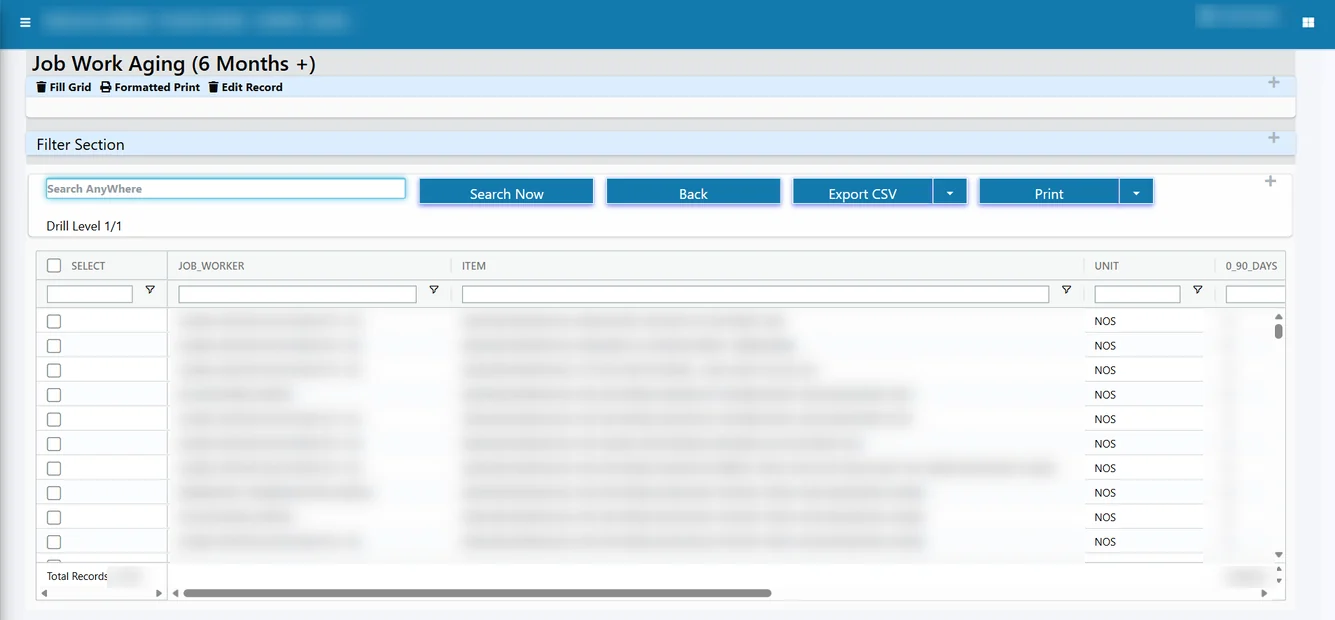
1. Job Work Aging (6 months +)
Pending RGP lines are bucketed by age. Anything over six months is on the watch list: it still has time, but it needs a follow-up call to the job worker now, not in month eleven.
2. ITC-04 compliance watch in RGP Insights
A period check shows Table 4 lines and value, Table 5A rows, receipts missing the job worker’s challan number, lines over six months and receipts still waiting for knock-off. Job worker cards add pending kg, open challans and the oldest pending days per job worker, so you know whom to call first.
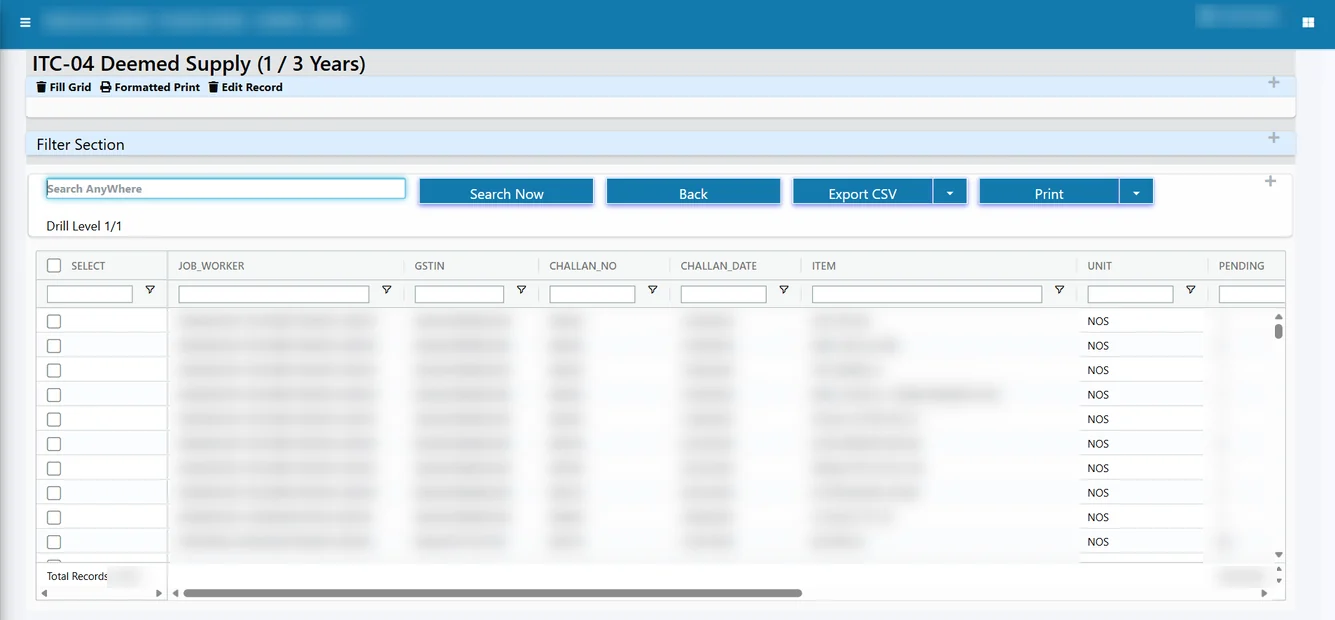
3. ITC-04 Deemed Supply (1 / 3 Years)
This report lists every challan line where inputs have been pending for more than one year or capital goods for more than three years. It is the list your accountant reviews before deciding on any tax payment.
Worked example: a review on 31 October
Tejaxo Manufacturing runs its half-yearly job work review on 31 October 2026. The open challan lines look like this:
| Challan | Sent on | Goods | Type | Days pending | Status in reports | Action |
|---|---|---|---|---|---|---|
| CH-0398 | 05-08-2025 | 300 kg strip for slitting | Input | 452 | Deemed supply list; also “knock-off pending” in Insights | Material came back on an old MRR. Admin knock-off links it; line closes and leaves the list. |
| CH-0412 | 12-09-2025 | 120 kg sheet for pressing | Input | 414 | Deemed supply list | Job worker confirms 110 kg returned as parts (linked) and 10 kg process loss (written off with reason). Line closes; the adviser reviews the GST treatment of the 10 kg loss. |
| CH-0201 | 10-09-2023 | 1 gearbox for overhaul | Capital goods | 1,147 | Deemed supply list | Genuinely still with the job worker. Tax adviser decides on treatment. |
| CH-0305 | 15-01-2025 | 1 press die for repair | Tool | 654 | Over one year; shown for review | Dies and tools are outside the time limit; the adviser confirms and the review is noted. Follow up for return. |
| CH-0587 | 18-03-2026 | 200 brackets for plating | Input | 227 | Aging over 6 months | Not yet due. Call the plater this week. |
| CH-0633 | 02-07-2026 | 80 castings for machining | Input | 121 | Normal pending | No action. |
On paper, four lines are past a limit. After the clean-up, one closes because the material was already back, one closes with a recorded process loss, and the die falls outside the time limit. Only the gearbox remains as a genuine deemed-supply question for the adviser. Without the aging view, the brackets on CH-0587 would have been the next problem in March.
Shrinking the list: clean records first
The deemed supply report is only as good as your knock-offs. Before treating any line as a supply, make sure it is not simply a record that was never closed:
- Clear old receipts. In RGP Reco, the “knock-off pending (old receipts)” filter shows lines where a matching receipt exists. A one-time admin knock-off closes them with a reversible ADMIN link. This step alone can remove a large share of old lines.
- Link converted items. Where a coil came back as sheets, or a bracket as a painted bracket, link the receipt to the sent line. The Coil / Batch Tracking Tree shows where each coil went.
- Write off true process loss. Scrap and loss are written off as separate documents with a reason and a mandatory remark, never by editing the challan, and can be reversed if needed.
- Capture the job worker’s challan number at the gate. The ITC-04 watch flags receipts where it is missing.
Only what remains after these steps is a real deemed-supply question. That is a much shorter, better documented list to take to your adviser.
A simple monthly routine
- Every month: open RGP Insights, review the job worker cards and the over-six-months count, and call the job workers with the oldest material.
- Every month: check the “knock-off pending” count and clear it before it grows.
- Before each ITC-04 period: run the Deemed Supply (1 / 3 Years) report, export it to Excel and review it with your accountant along with Tables 4 and 5A.
Who this is for
Any manufacturer that sends material out for processing: forging units sending parts for heat treatment, auto component suppliers using platers and painters, and machinery makers who send fixtures and sub-assemblies to fabricators. The higher the number of job workers and challans, the more the aging view pays for itself in avoided interest and audit time.
How Tejaxo implements this
We start with discovery: how many job workers you use, how material is sent and received, and how old your open challans are. In the pilot we load your own masters and open challans, run the knock-off proposal and show you the deemed supply list on your own data before go-live. Training covers stores, accounts and the person who reviews ITC-04, and the same Tejaxo team supports you afterwards. Our ERP implementation page describes the approach.
Deemed supply is easy to avoid when you can see the clock running on every challan. Book a free demo to see the aging and deemed supply reports on sample data, or WhatsApp us on +91 96717 27474.
Frequently asked questions
What is deemed supply in job work under GST?
If inputs sent to a job worker are not received back or supplied from the job worker’s premises within one year, or capital goods within three years, they are treated as supplied by the principal to the job worker on the day they were originally sent out. Tax then becomes payable with interest.
Does the one-year limit apply to moulds, dies and tools?
The law excludes moulds and dies, jigs and fixtures, and tools from the one-year and three-year limits. Confirm the treatment of your specific items with your tax adviser.
Can the time limit for job work be extended?
Yes. On sufficient cause, the Commissioner can extend the period by up to one year for inputs and up to two years for capital goods. The request has to be made and approved; it is not automatic.
Is deemed supply the same as not filing ITC-04?
No. ITC-04 is the return in which the principal reports goods sent to and received from job workers. Deemed supply is a tax consequence of material staying with the job worker beyond the time limit, whether or not ITC-04 was filed.
How does Tejaxo ERP help avoid deemed supply?
It gives a Job Work Aging report for lines over six months, an ITC-04 Deemed Supply (1 / 3 Years) report for lines past the limit, and an ITC-04 compliance watch in RGP Insights, all from the same RGP and gate data.