
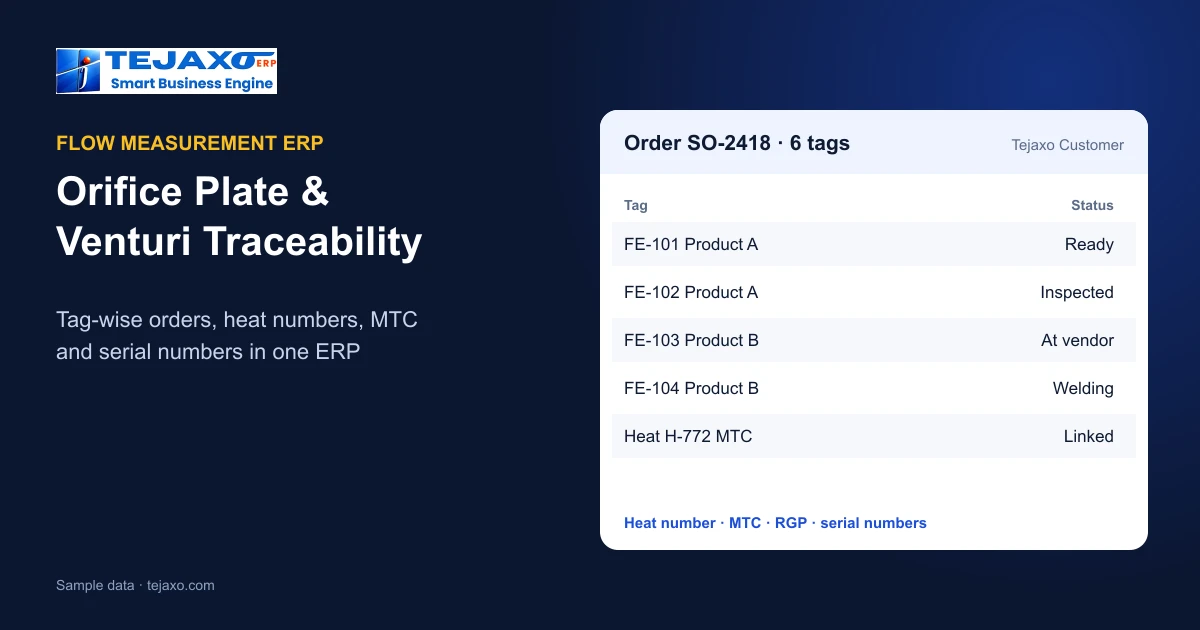
Orifice plate and venturi manufacturing is made-to-order work: every instrument is built to a customer data sheet, from certified material, and is dispatched with a documentation pack that has to match the instrument exactly. The hard part is not the machining; it is keeping the tag, the material heat number, the mill test certificate (MTC), the vendor work, the inspection result and the serial number together. This guide follows one order from data sheet to dispatch and shows how Tejaxo ERP keeps those records linked, so the documentation is ready the day the instrument is.
Why flow elements are different from batch production
A flow element manufacturer rarely makes a hundred identical pieces. A typical order from an EPC contractor or a process plant has several tags – say six orifice plate assemblies and two venturi tubes – each with its own line size, bore, material and pressure class taken from the customer’s data sheet. Plates and venturis are usually designed to a standard such as ISO 5167, and the customer or a third-party inspector often asks for material certificates, dimensional reports and test records for every tag before dispatch.
That changes what the factory needs from its software. It needs to know, for each tag: which material was used and which certificate covers it, where the part is right now (in house or at a welding or machining vendor), whether it has passed inspection, and which serial number and label it carries. When these live in Excel sheets and folders, one missing certificate or one mixed-up serial number holds back the whole dispatch.

The tag as the unit of work
In Tejaxo ERP the order is entered as a sales order with one line per tag, each with its own item, quantity and delivery schedule. From that point every later document – work order, material requisition, purchase order, gate entry, material receipt, quality check, job card, packing slip and invoice – refers back to the order, and batch numbers are carried forward and backward through every step. A question such as “which tags of this order are not ready?” then has one answer instead of three different spreadsheets.
From data sheet to dispatch: the order flow
| Stage | What usually goes wrong | What the ERP records |
|---|---|---|
| Order and tags | Tags and delivery dates copied by hand into a job register | Sales order with one line per tag and its own delivery schedule |
| BOM and planning | Plate, pipe, flange and fastener needs worked out on paper | Multi-level BOM per instrument type; MRP raises requisitions |
| Material receipt | MTC kept in a file, not linked to the stock | Heat number and MTC captured at incoming quality, carried with the batch |
| Machining and welding | Parts at vendors followed up on the phone | Job cards in house; outside work on returnable gate passes with pending quantity |
| Inspection | Pass / fail written on the job card | Accepted and rejected quantity with a mandatory reason; only accepted quantity moves on |
| Serial and label | Serial numbers allotted in a notebook | Serial number per instrument, scanned by barcode or QR, carried to the packing slip |
| Dispatch and invoice | Documents collected from three departments on dispatch day | Packing slip and tax invoice against the order, with the traceability already linked |
Material: heat number and MTC from the first receipt
Plates are commonly cut from stainless steel or other alloy plate, and venturis are fabricated from pipe or plate with flanges welded on. Customers usually want the MTC of every pressure-bearing part. The record has to start at the gate, not at dispatch.
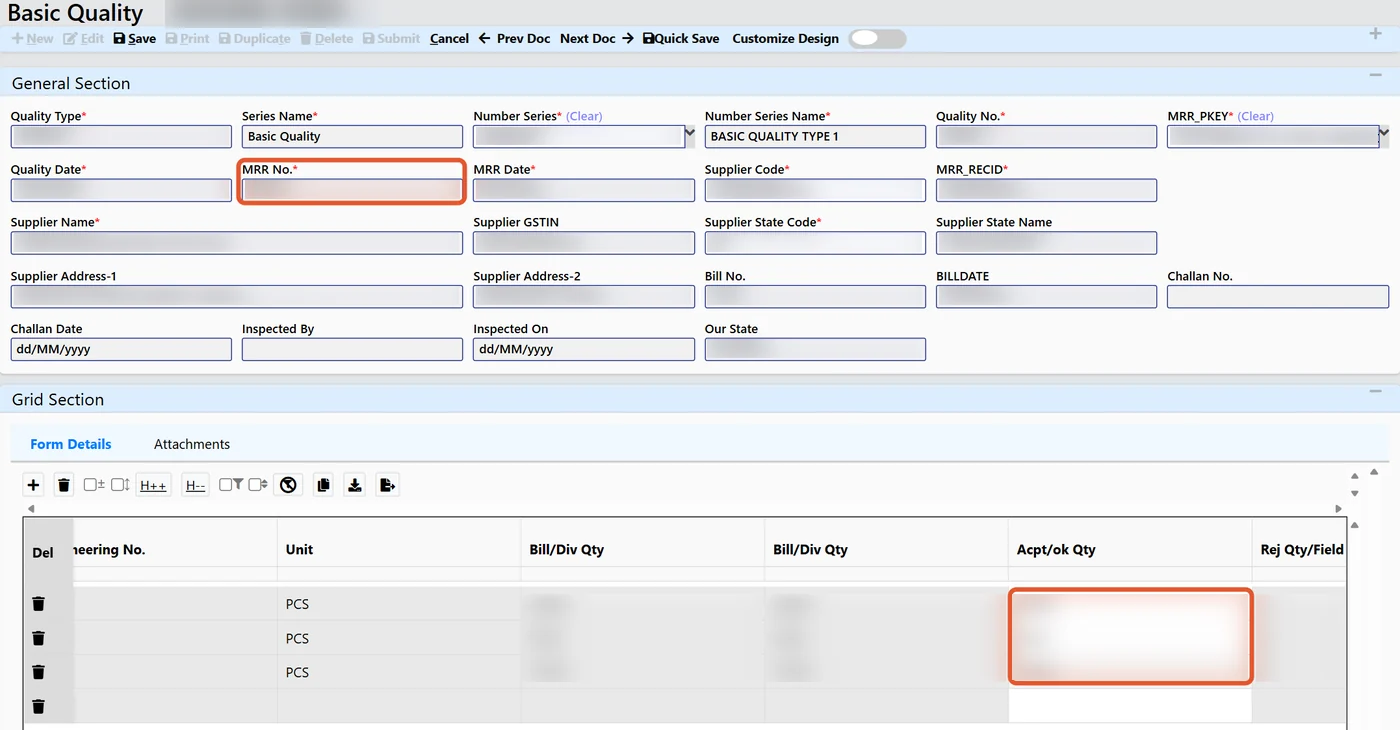
In Tejaxo ERP the supplier’s bill can be read from a photo or PDF into a pre-filled gate entry, the material receipt is made against that gate entry, and the incoming quality check records the accepted and rejected quantity with a reason. The heat number and MTC are captured at this quality step and stay with the batch. When that plate material is issued to a work order, the heat number goes with it – so the certificate for a finished plate is found from the plate, not by searching a folder.
Vendor work: welding, machining and finishing outside
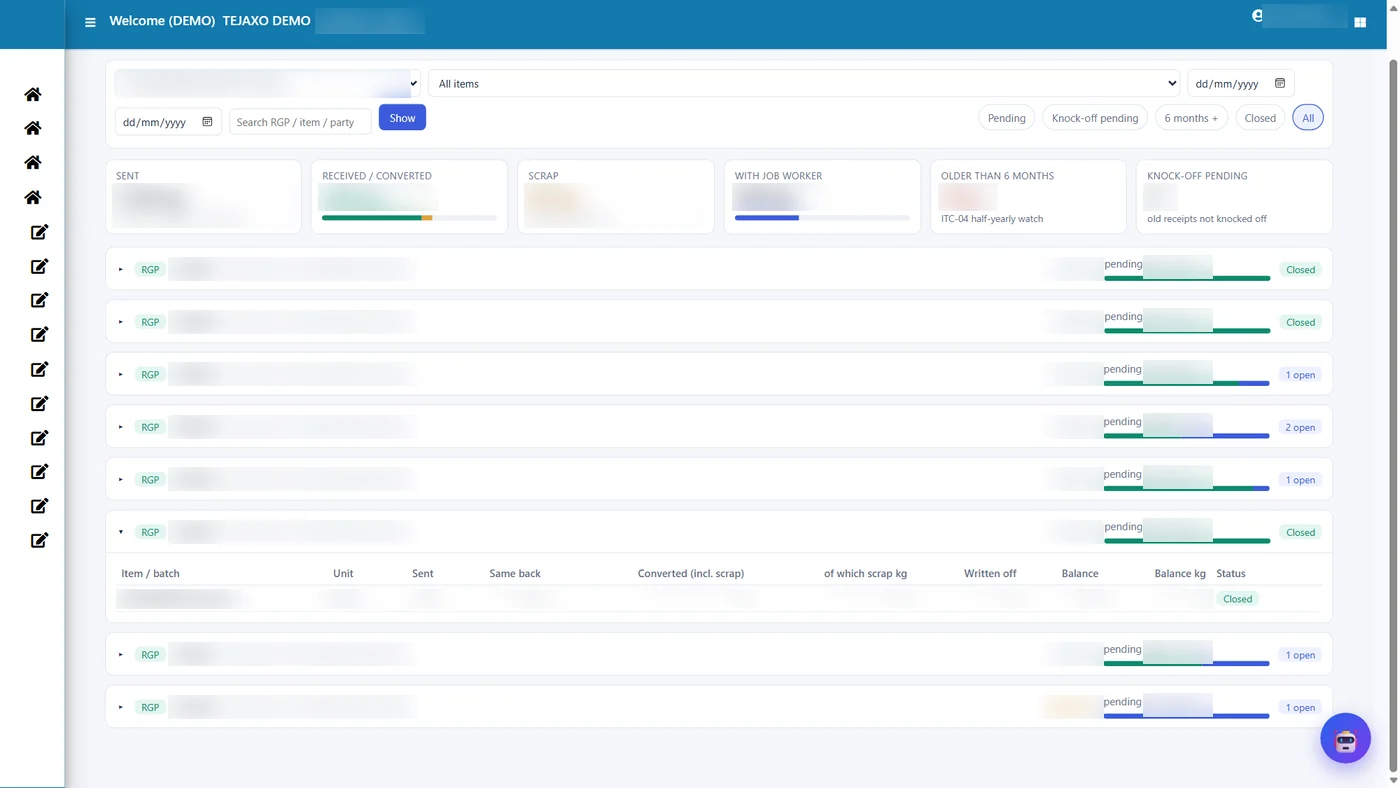
Many instrument makers send parts out for welding, precision machining, heat treatment or surface finishing. Each trip is a returnable gate pass (RGP) in Tejaxo ERP: what was sent, to whom, against which order, what came back, what was scrapped and what is still pending. Ageing of pending material and the job-work charges are visible, and the ITC-04 return for job work is prepared from the same records. A tag that is “at the welding vendor for nine days” shows up on the screen instead of being discovered on dispatch day.
Inspection and calibration records
Every inspection result is entered against the material receipt or the production stage, with accepted and rejected quantity and a mandatory rejection reason. Only accepted quantity moves forward, so a rejected plate cannot be packed by mistake. Quality reports include the incoming QC register, acceptance percentage and PPM, defect Pareto and cost of poor quality.
Instrument makers also depend on their own test equipment being in calibration. Tejaxo has delivered gauge and calibration solutions for clients – including a customer app to book calibration and repair, get a tentative quote, track the request and download reports – and calibration due dates of test equipment can be followed in the ERP so that a master gauge does not quietly go past its due date.
Serial numbers, labels and the documentation pack
Each instrument carries its own serial number from production to dispatch, and barcode and QR scanning in stores is live at Tejaxo clients. Because the serial number, the tag line, the heat number of the material and the inspection result are all linked, the documentation for a tag can be pulled together from the ERP rather than assembled from separate files. If a customer later reports a problem with one tag, the trace runs backward from the invoice to the material receipt and the supplier’s bill.
Cost and margin per order
Small made-to-order jobs make it easy to lose money without noticing. Tejaxo ERP calculates work-order cost from the material issued at its receipt rate, machine time, labour minutes, overheads and outside job-work charges, and compares it with the invoiced value. The owner sees which tags, materials or customers actually make money – and can ask for the same report on WhatsApp by voice or text.
What stays with people
The ERP removes the hunting and re-typing; it does not take decisions. Inspectors still pass or reject, the owner still approves purchase orders (also from the phone on WhatsApp), and every entry and approval is recorded in the audit trail with who, what and when.
A practical starting point
- Start with receipts. Capture heat number and MTC at incoming quality for every pressure-bearing material from day one.
- Enter orders tag by tag. One sales order line per tag with its own delivery date.
- Move vendor trips to RGP. Every part that leaves for welding or machining goes on a returnable gate pass.
- Add serial numbers and labels. Allot serial numbers in the ERP and scan them at packing.
- Then cost. Once the above is clean, order-wise cost and margin follow from the same data.
For the full industry view, read ERP for flow measurement and instrumentation manufacturers, see how heat number traceability works in forging and how job work on returnable gate passes is handled, or book a free consultation to see one of your own orders set up in Tejaxo ERP.
Frequently asked questions
What software do orifice plate and venturi manufacturers need?
A made-to-order ERP that handles one order line per tag, multi-level BOMs, heat number and MTC capture at incoming quality, outside welding and machining on returnable gate passes, inspection with accepted and rejected quantity, serial numbers and order-wise costing in one system. Tejaxo ERP covers all of these.
How do we link the MTC to a finished orifice plate?
Capture the heat number and MTC when the plate material is received and checked. The heat number stays with the batch when the material is issued to a work order, so the certificate is found from the finished plate instead of a folder.
Can every instrument have its own serial number?
Yes. In Tejaxo ERP each instrument carries its serial number from production to the packing slip and invoice, with barcode or QR scanning in stores.
How do we track parts sent out for welding or machining?
Each trip goes on a returnable gate pass (RGP) against the order: sent, received, scrap and pending quantity, ageing and job-work charges are visible, and the ITC-04 return is prepared from the same records.
Can we see which tags of an order are not ready?
Yes. Because every document refers back to the sales order line, open tags, parts at vendors and inspections due can be seen on one screen, and the owner can ask for the report on WhatsApp by voice or text.
Does Tejaxo support instrumentation manufacturers outside Delhi NCR?
Yes. Tejaxo supports clients across India on-site and remotely, with on-site support across the Delhi NCR industrial belts from its Palwal office.