
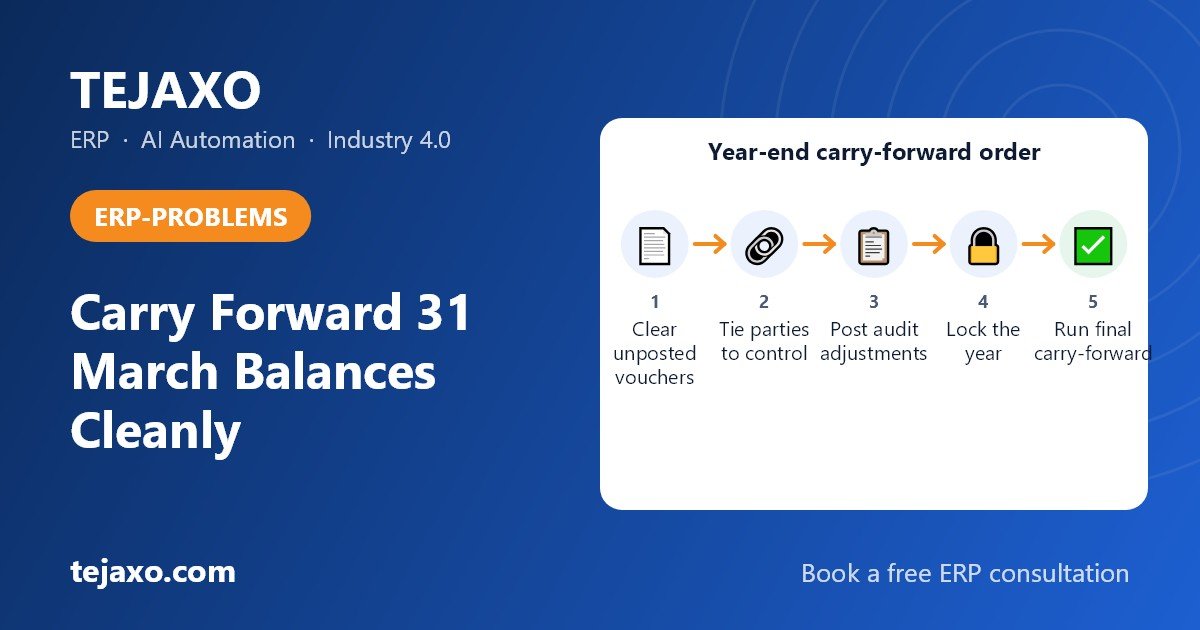
The closing balance as on 31/03/2027 is the balance of every ledger and every party at the end of financial year 2026-27 (1 April 2026 to 31 March 2027); the same steps apply to any 31 March. To carry it forward cleanly, make the books final first, lock the year, and run the final carry-forward last, so that the 1 April 2027 opening equals the audited closing.
In short, the sequence is:
- Stop back-dated posting and clear every unposted voucher.
- Run the party-wise trial balance and tie each sub-ledger to its control account.
- Post audit adjustments in the old year, then lock it.
- Run the final carry-forward and compare the 1 April opening with the locked closing.
If billing cannot wait for the audit, run a provisional carry-forward on 1 April and re-run it after the lock. All figures and party names below are sample values for “Tejaxo Manufacturing”.
Last reviewed: 2026.
What does the closing balance as on 31/03/2027 actually include?
A closing balance is the amount left in an account after every transaction up to the last day of the year has been posted. For a plant, a complete 31 March closing pack has these parts:
- Ledger-wise trial balance: every ledger with its debit or credit closing balance.
- Party-wise balances: debtors and creditors, ideally bill-wise, so each open invoice, advance and credit note is visible.
- Bank balances: balance as per books, uncleared deposits and payments, and the balance as per the bank statement.
- Stock: closing stock value carried into the balance sheet.
- Statutory balances: GST input credit, TDS and TCS payable, provident fund and ESI dues.
- Profit and loss: the year’s profit or loss that moves into reserves.
Why does the opening balance on 1 April not match the closing balance?
The first thing to check is timing: the year-end carry-forward may have been run before the books were really final. Back-dated entries and unposted vouchers can arrive after 31 March, and audit adjustments can follow weeks later. Each one changes the old year’s closing balance after the opening balance has already been created from the earlier figure.
The table links each cause to the symptom you see and the fix.
| Root cause | What you see | Fix |
|---|---|---|
| Carry-forward run before the books are locked | Opening differs from final closing by the late entries | Lock the year, then re-run the carry-forward |
| Back-dated vouchers posted after carry-forward | A party’s opening is lower or higher than the 31 March ledger | Compare the 31 March closing and the 1 April opening party by party; re-run the carry-forward |
| Draft or unposted vouchers | Purchase bill or receipt exists in documents but not in the ledger | List every draft voucher dated up to 31 March and post or cancel it |
| Audit adjustment journals | Audited closing differs from the books closing | Post adjustments in the old year, then re-run the carry-forward |
| Opening balances typed manually | Opening balance overwritten and no longer follows the closing | Remove manual overrides; use a repeatable carry-forward job |
| Bill-wise allocation differences | Party total agrees but the open invoices do not | Re-allocate receipts and payments against bills before closing |
| Profit and loss not transferred to reserves | Balance sheet opening does not balance | Transfer the year’s profit or loss as part of the carry-forward |
| Foreign currency not revalued | Foreign party balance differs from the revalued amount | Revalue at the closing rate before locking |
| Balance posted to the wrong party | One party is overstated, another understated | Correct the voucher in the old year, with an audit trail |
A common cause is a voucher dated on or before 31 March but entered after the carry-forward, such as a supplier bill or a sales invoice for late-March dispatches. Draft bills that nobody posted are another. Manually typed openings are the hardest to spot, because the system figure was silently replaced.
How do I diagnose the difference between closing and opening balances?
Compare the two reports at the same level of detail. Start with totals, then go down to ledgers, then to parties, then to bills.
Illustrative example (sample figures). The audited trial balance shows Tejaxo Customer A at 4,10,000 Dr, but the 1 April opening shows 3,85,000 Dr. Nobody changed the ledger on purpose, yet the two years no longer join. The first row of the table below is this party; the other three rows show different causes.
| Party (sample) | Closing 31/03/2027 | Opening 01/04/2027 | Difference | Cause found |
|---|---|---|---|---|
| Tejaxo Customer A | 4,10,000 Dr | 3,85,000 Dr | 25,000 | Sales invoice dated 30 March, entered on 5 April after the carry-forward |
| Tejaxo Vendor B | 6,40,000 Cr | 5,90,000 Cr | 50,000 | Purchase bill for goods received on 29 March saved as a draft and posted in April |
| Tejaxo Customer C | 2,15,000 Dr | 2,40,000 Dr | 25,000 | Credit note posted as an audit adjustment in the old year after the carry-forward |
| Tejaxo Vendor D | 3,00,000 Cr | 3,25,000 Cr | 25,000 | Opening typed by hand from a provisional figure |
The four differences add up to 1,25,000 without regard to sign. Three are timing problems and one is a manual override. Each is found quickly once you list only the parties that differ and sort their vouchers by posting date and entry date.
- Run the trial balance as on 31/03/2027 and save it as a file or PDF with the run date and time.
- Run the trial balance as on 01/04/2027 (opening) and compare it ledger by ledger. Keep only the ledgers where the two figures differ.
- Drill into each differing ledger by party. For debtors and creditors, export party-wise closing and opening into a spreadsheet and subtract. Parties with a non-zero difference are your short list.
- Open the voucher list for each short-listed party and sort by posting date and entry date. Vouchers dated on or before 31 March but entered after the carry-forward date are the first ones to examine.
- Check the audit trail for edits and deletions on those vouchers, with the user and the time.
- Check draft and pending documents, such as unposted purchase bills, receipts waiting for approval and journals saved but not posted.
- Check bill-wise allocation for any party whose total agrees but whose open bills do not.
If the difference sits on one party, look first for a single back-dated or unposted voucher. If it spreads across many ledgers, suspect that the carry-forward ran too early or that a manual opening entry overwrote the system figure.
What is the correct year-end sequence to carry forward without differences?
Follow this order. The target is that the final carry-forward comes last.
- Fix the cut-off. Decide which goods receipts, dispatches, expense bills and accruals belong to FY 2026-27. Goods physically received up to 31 March belong to the old year, with a bill or a GRNI (goods received not invoiced) accrual. For goods in transit, decide by the date on which risk and title pass to you (as per the terms of delivery), and apply that rule to every party.
- Stop back-dated posting for everyone except a named year-end user, with approval.
- Clear unposted vouchers. Post or cancel every draft, pending approval and saved-but-not-posted voucher dated up to 31 March.
- Reconcile the banks. Match each bank ledger to the statement and list uncleared items with their clearing dates.
- Reconcile sub-ledgers to control accounts. The total of party balances must equal the debtors and creditors control accounts. Do the same for inventory, fixed assets and GST ledgers.
- Post year-end journals: depreciation, provisions, accruals, foreign currency revaluation and closing stock.
- Run the closing reports as on 31/03/2027: trial balance, party-wise closing, bill-wise outstanding and bank reconciliation. Share party statements for balance confirmation.
- Hand over to the auditor and post the agreed audit adjustments in the old year.
- Lock the year by period or date, with user rights so that only an authorised person can unlock it.
- Run the final carry-forward and compare the 1 April opening with the locked closing, ledger by ledger and party by party. The difference should be zero.
If the audit is not finished by 1 April, billing still has to start, so the new year may need to open on a provisional carry-forward. Re-run the carry-forward after the audit adjustments are posted and the year is locked. This works only if the carry-forward is a repeatable job.
Can I post entries after 31 March for the previous year?
Yes, but only while the old year is still open, and every such entry must be visible and controlled. Late entries for the old year are normal: supplier bills arrive after month-end, and audit adjustments follow. A late entry becomes a problem only when it does not flow into the opening balance.
For companies, Rule 3(1) of the Companies (Accounts) Rules requires the accounting software used to maintain books to record an audit trail of every change, and the trail cannot be disabled. It applies to financial years starting on or after 1 April 2023, and auditors report on it under Rule 11(g) of the Companies (Audit and Auditors) Rules. The rule text is in the Companies (Accounts) Rules published on the Ministry of Corporate Affairs rules page, and the ICAI implementation guide on reporting under Rule 11(g) explains how auditors report on it. In practice, a back-dated edit after year-end leaves a record that the auditor can see.
This rule applies to companies only. If you run a proprietorship, a partnership or another kind of entity, it does not bind you in the same way, but the same control is good practice: keep an edit log, restrict old-year posting and record a reason for every late entry.
A practical policy for the post-31 March window:
- Allow old-year posting only for a named user or role, with approval.
- Record a reason for every late voucher.
- Run a daily or weekly report of vouchers entered after 31 March with a posting date up to 31 March.
- When the year is locked, make unlocking a controlled action. After any unlock, re-run the carry-forward.
How do I handle audit adjustments after the carry-forward?
Post the audit adjustment in the old year and re-run the carry-forward. Do not patch the opening balance directly. If you correct only the 1 April balance, the closing balance of the old year and the opening balance of the new year differ permanently, and every later comparison needs an explanation.
- Unlock the old year for the audit-adjustment user only.
- Post the adjustment journal with the auditor’s reference in the narration.
- Re-run the party-wise closing report and save it as the final version.
- Lock the year again.
- Re-run the carry-forward and compare opening with closing. If any manual opening entry was made earlier, remove it.
Keep the version history: a provisional closing, the audit adjustments, and the final audited closing. That is what an auditor or a reviewing manager is likely to ask for.
How do I reconcile banks and party balances before closing?
Bank and party reconciliations are places where unexplained differences can hide. For banks, the balance as per books, plus or minus uncleared deposits and payments, must equal the balance as per the bank statement. Clearing dates matter because a cheque dated 30 March but cleared on 3 April sits in the old year’s books and in the new year’s bank statement.
For parties, run bill-wise outstanding and compare it with the party’s own statement. For goods in transit and for credit notes, apply the cut-off rule from step 1 of the year-end sequence to every party. For a deeper walkthrough, read our article on bank reconciliation software in an ERP.
Which year-end checklist should a plant finance team use?
| Check | Done when | Evidence to keep |
|---|---|---|
| Cut-off of receipts and dispatches | Goods physically received up to 31 March are in the old year, with a bill or a GRNI accrual; goods in transit follow the written cut-off rule from step 1 of the year-end sequence | Goods receipt and dispatch register, and the written cut-off rule |
| No unposted vouchers | The draft and pending list for the year is empty | Pending voucher report with date and time |
| Bank reconciliation | Books and statement agree after uncleared items | Saved reconciliation per bank account |
| Sub-ledgers tie to control accounts | Party totals equal the control account | Reconciliation report per control account |
| GST input credit and opening credit | The input credit ledger agrees with the returns filed and the GSTR-2B statement, and the opening credit in the new year equals the closing credit | ITC reconciliation of books, GSTR-2B and GSTR-3B |
| Closing stock carry-forward | Closing stock value in the balance sheet equals the stock report, and the opening stock of the new year equals it | Stock valuation report as on 31 March |
| Creditor ageing for payment-timing rules | Small-supplier dues beyond the agreed or statutory period are listed | Vendor-wise ageing report |
| Year-end journals | Depreciation, provisions and revaluation posted | Journal register with narration |
| Balance confirmations | Debtor and creditor statements sent and replies tracked | Party statement and reply log |
| Lock and user rights | Year locked; unlock restricted and logged | Lock setting and audit trail |
| Carry-forward compared | Opening equals closing ledger by ledger and party by party | Opening versus closing report with zero difference |
For manufacturers, creditor balances at 31 March carry extra weight because of the payment-timing rule in Section 43B(h) for micro and small suppliers. Our guide to the 43B(h) report, TDS and TCS in an ERP explains the report you need before the year closes.
Manual files, desktop accounting or an integrated ERP: which handles year-end best?
| Area | Spreadsheets and manual files | Desktop accounting software | Integrated ERP (what to look for) |
|---|---|---|---|
| Opening balances | Typed or pasted by hand | Carried forward automatically on changing the period, or imported from the closing balances | Carried forward from the same database as a repeatable job |
| Late entries after carry-forward | Not visible unless someone compares by hand | Need a check that opening still equals closing | Flagged by posting date versus entry date |
| Sub-ledger to control tie-out | Manual | Report-based | Built into the same ledger and the operations modules |
| Stock, purchase and sales cut-off | Separate files | Often a separate system | Same data as the books, so cut-off differences are visible |
| Audit trail and locking | Only by file protection and version history; no entry-level log | Available; depends on setup | User-role locking and logged unlocks |
What does TallyPrime do at year-end?
When you change the current period in TallyPrime, the balances from the previous year carry forward automatically. Its help page on moving to the next financial year includes a checklist: confirm that the opening balances match the previous year’s closing balances, and that the GST opening credits are correct. For a new company, you export the old company’s closing balances and import them as opening balances; you can also import the audited closing balance as the opening balance. Tally suggests this route when you need historical data for year-end audits.
Whichever package you use, the comparison of closing against opening still has to be done and kept as evidence. This page covers the year-end routine. For a product comparison, see Tejaxo vs Tally. For loading balances when you move to a new system, see ERP go-live: party-wise opening balances.
What should a good ERP do at year-end, and what does Tejaxo ERP cover?
When you evaluate any system, check whether it can do the following:
- Lock periods by user role and record every unlock in an audit trail.
- Re-run the carry-forward after audit adjustments.
- Flag post-lock or late entries with the posting date, entry date, user and reason.
- Report opening against closing by ledger and by party.
- Tie debtors, creditors, stock and GST sub-ledgers to their control accounts.
- Reconcile banks, showing the balance as per books, uncleared items and clearing dates.
- Keep finance, sales, purchase and inventory on one live database, so that all of them share the same cut-off.
Tejaxo ERP runs finance, GST, sales, purchase, inventory and production on one live database, so the books and the operations modules work from the same data. For year-end, two things can be stated plainly:
- Financial-year check on production entries. The corrugation production entry validates that its date falls within the selected financial year before it saves. This is a production-entry check and is not a period lock on the books.
- Party-wise opening balances. Opening balances can be loaded party by party at go-live, so a new system starts from your audited closing.
For more on how the books and reports are organised, see our page on audit-ready books in Tejaxo ERP.
Ask us whether and how Tejaxo ERP handles period lock and carry-forward re-runs, and check it on your own data. To arrange that, book a free consultation.
If you already run SAP or Microsoft Dynamics, you do not need to replace it to get better controls. We do not replace your ERP, we extend it with shop-floor data, reports and automation around it.
Conclusion: how do I get a clean closing balance as on 31/03/2027?
Before the audit starts, run the opening versus closing comparison for debtors and creditors, and send any party that differs to the person who posted the voucher. The causes you find, whether late entries, draft bills, audit adjustments or manual openings, are what will break the next year-end if the process stays the same.
If you would like a second pair of eyes on that comparison, book a free consultation with Tejaxo Technologies Pvt. Ltd., or write to info@tejaxo.com or call or WhatsApp +91 96717 27474.
Frequently asked questions
How do I get the closing balance of every party as on 31 March?
Run the party-wise or bill-wise outstanding report as on 31 March after all vouchers up to that date are posted and any draft vouchers are cleared. Check that the total of party balances equals the debtors or creditors control account. Save the report with its run date, because late entries can change it.
Who should hold the unlock right?
Give it to one or two named senior finance users, such as the finance head and a deputy. Keep it separate from the daily posting role, record every unlock with user, time and reason, and require approval for each one. Remove the right again after the final re-run of the carry-forward.
What if the auditor changes a party balance after the opening bills are already raised?
Leave the new-year bills untouched. Post the adjustment in the old year and re-run the carry-forward, so the party’s opening moves by the adjustment amount. Then check that the opening bill-wise allocation still matches the party total, and send the party a revised statement if you had already shared the earlier one.
Which GST and statutory balances should I check before carrying forward?
Check the GST input credit ledger against the returns filed and the GSTR-2B statement, and confirm that the opening credit in the new year equals the closing credit. Tie TDS and TCS payable, provident fund and ESI dues to the payments made. Also list creditor dues to micro and small suppliers that fall under Section 43B(h).
What is the difference between a provisional and a final carry-forward?
A provisional carry-forward opens the new year on 1 April using books that are not yet audited, so billing can continue. The final carry-forward is run after the audit adjustments are posted and the old year is locked. Provisional works only if the carry-forward can be re-run; compare opening with closing after each run and keep the difference at zero.