
A manufacturer can be profitable on paper and still run short of cash, because the money is sitting with customers. The receivables report says “outstanding 2.6 lakh”, but the questions that matter are different: which bills, how old, which customers, and which of them need a call today. Bill-wise receivables ageing answers those questions – provided receipts are adjusted against the right bills. This guide explains how ageing works, why unadjusted receipts make it lie, how to calculate days sales outstanding, and a simple weekly collection routine.
Bill-wise, not just party-wise
A party-wise balance shows how much a customer owes in total. A bill-wise view shows each invoice, its date, its due date and what is still unpaid against it. Only the bill-wise view tells you that a customer with a modest balance has one invoice four months old – the one most likely to turn into a dispute or a bad debt. Every receipt should therefore be recorded against the invoices it pays, not as a lump sum against the party.
Ageing buckets
Ageing groups unpaid bills by how long they have been outstanding – typically 0-30, 31-60, 61-90 and over 90 days, counted from the invoice date or, better, from the due date so that credit terms are respected. The shape of the ageing matters more than the total: most of the money should sit in the first bucket, and anything in the last bucket needs a named owner and an action.
Worked example: why unadjusted receipts mislead
Tejaxo Manufacturing (sample data) has four open invoices for Tejaxo Customer and a receipt of 1,00,000 that the customer paid “on account”, without saying which bill:
| Document | Amount | Age | Bucket |
|---|---|---|---|
| INV-1 | 1,00,000 | 75 days | 61-90 |
| INV-2 | 80,000 | 50 days | 31-60 |
| INV-3 | 1,20,000 | 20 days | 0-30 |
| INV-4 | 60,000 | 10 days | 0-30 |
| On-account receipt | -1,00,000 | – | not adjusted |
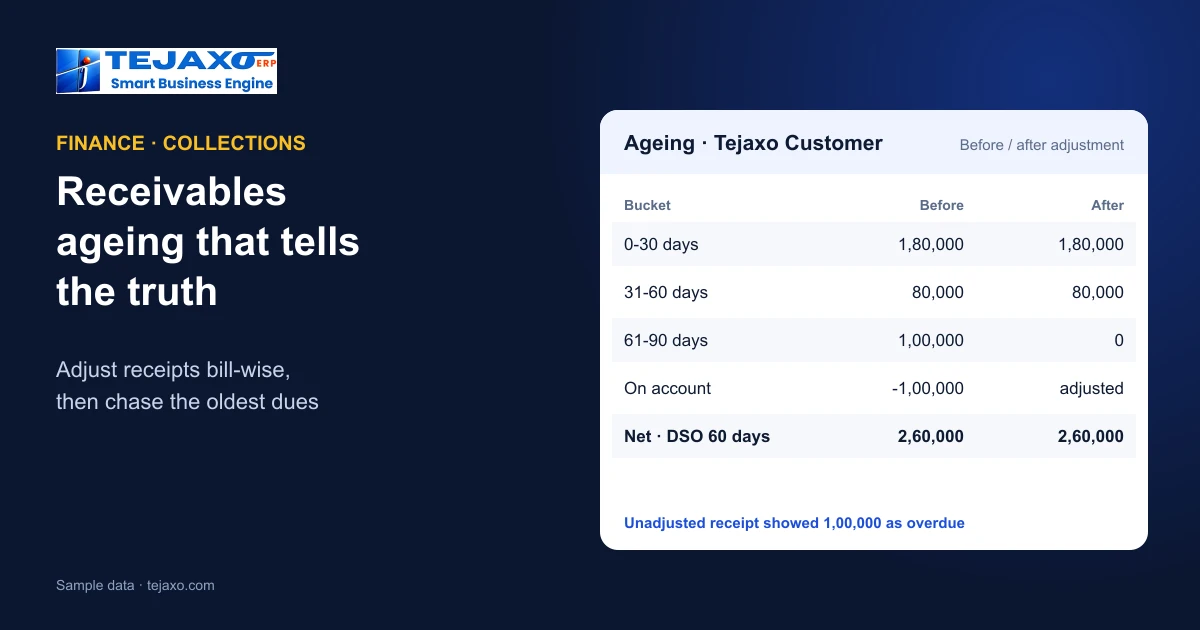
The net balance is 2,60,000. But until the receipt is adjusted, the ageing still shows INV-1 for 1,00,000 as 75 days old – and the collection team may chase a customer who has already paid it. Adjusting the receipt against the oldest bill first (FIFO) gives the true picture:
| Bucket | Before | After |
|---|---|---|
| 0-30 days | 1,80,000 | 1,80,000 |
| 31-60 days | 80,000 | 80,000 |
| 61-90 days | 1,00,000 | 0 |
| 90+ days | 0 | 0 |
| Net outstanding | 2,60,000 | 2,60,000 |
After adjustment, nothing is overdue beyond 60 days. The same applies to advances and credit notes: until they are knocked off against bills, the ageing overstates old dues. See reference adjustment and bank reconciliation for the mechanics.
Days sales outstanding (DSO)
DSO = receivables / credit sales in the period x days in the period. In the example, net receivables of 2,60,000 against credit sales of 3,90,000 over the last 90 days give DSO = 60 days. If the usual terms are 45 days, customers are paying about two weeks late on average. Track DSO monthly; a rising DSO with steady sales is an early warning on cash. Calculate it per customer as well: a single large customer drifting from 45 to 75 days can tie up more cash than all the small ones together.
A weekly collection routine
- Adjust first. Knock off every receipt, advance and credit note against bills before looking at the ageing.
- Start with the oldest bucket and the largest amounts in it.
- Check for disputes. Many old bills are stuck on a quality complaint, a short supply or a missing document; fix the cause, not just the reminder.
- Send reminders for bills coming due, not only for bills already overdue.
- Record every promise – date and amount – and follow up on the day.
- Link to dispatch decisions. Sales should see a customer’s overdue position before the next order is released.
Reading the ageing by customer and by salesperson
The same report cut by customer shows who pays late consistently and who is slipping; cut by salesperson or region, it shows where the follow-up is not happening. A customer whose 31-60 bucket grows month after month is changing its payment habits before it shows up as a problem. Share the customer-wise view with the sales team every week – they hold the relationships that collections depend on.
Where disputes come from
Bills that age past 60 days are often not about money at all. A short supply recorded at the customer’s gate, a rejected lot waiting for a credit note, a rate different from the order, or a missing test certificate can each hold up a payment. The cleaner the order-to-cash chain – order, packing slip, invoice and credit notes all linked – the fewer of these disputes arise; see OTIF and order backlog.
Bills over 90 days
The last bucket needs a decision, not another reminder. For each bill, record the reason it is unpaid and the next step: a corrected invoice or credit note, a meeting with the customer’s accounts team, a revised payment plan, or a provision in the books if recovery is doubtful. Review the list with the owner or finance head every month. A bill that has sat in the 90+ bucket for a year without a decision is no longer a receivable in practice, whatever the ledger says.
Export receivables
Export bills add currency and documents to the picture. Receivables are tracked in foreign currency, the realised rupee value differs from the invoice value, and the bank realisation certificate must follow. Tejaxo ERP’s export reports include foreign currency receivables, forex gain or loss and shipping bill / BRC pending, so export dues are aged and followed up like domestic ones – see export invoicing.
How Tejaxo ERP handles it
In Tejaxo ERP the order-to-cash chain ends in bill-wise receipts and ageing. Finance reports include bill-wise debtors outstanding and receivables with bill-wise ageing, with a print-ready payment reminder letter. Reference adjustment knocks off a party’s pending bills against advances, on-account receipts and credit notes – manually or by FIFO auto adjust – so the ageing is correct. The owner’s cockpit shows receivables due alongside cash and bank and the net liquid position, and the WhatsApp assistant answers receivables questions and sends reminders and due alerts – see ERP with WhatsApp automation.
Common mistakes
- Receipts posted on account and never adjusted, so ageing shows bills as overdue that are already paid.
- Ageing from invoice date when terms vary – a 60-day customer looks late at day 31.
- Chasing totals instead of bills, so the oldest invoice is never resolved.
- Collections working alone. Sales and dispatch should see overdue positions too.
Next step
See bill-wise ageing, reference adjustment and WhatsApp reminders on your own customers in a free demo.
Frequently asked questions
What is receivables ageing?
A report that groups unpaid customer bills by how long they have been outstanding – usually 0-30, 31-60, 61-90 and over 90 days – so collection effort goes to the oldest and largest dues first.
Why should receipts be adjusted bill-wise?
Because an unadjusted on-account receipt leaves old bills showing as overdue. Knocking receipts, advances and credit notes off against specific bills keeps the ageing true.
What is FIFO adjustment of receipts?
Applying a receipt to a customer’s oldest unpaid bills first, which is the usual default when the customer does not say which bill a payment is for.
How is DSO calculated?
DSO = receivables / credit sales in the period x days in the period. For example, 2,60,000 receivables against 3,90,000 credit sales over 90 days gives a DSO of 60 days.
Should ageing be counted from invoice date or due date?
From the due date where credit terms differ between customers, so that a customer on longer terms is not shown as late too early.
Does Tejaxo ERP show bill-wise ageing?
Yes. It shows bill-wise debtors outstanding and receivables ageing with a payment reminder letter, adjusts receipts by reference (manual or FIFO), and can send reminders and due alerts on WhatsApp.