
Ask a sales team how deliveries are going and the answer is usually “mostly fine”. Ask the customer and the answer is often different, because the customer remembers the late and short deliveries, not the average. OTIF – on time, in full – is the measure that puts both sides on the same number. It counts an order line as a success only when the full quantity arrived by the promised date. Together with a clear view of the order backlog, it tells the plant whether it is keeping its promises and where the next failure is coming from. This guide explains how to calculate both, with a worked example.
What OTIF measures
OTIF % = order lines delivered on time and in full / order lines due x 100. A line is on time when it is delivered on or before its committed date (or within the window agreed with the customer), and in full when the delivered quantity is at least the ordered quantity (or within an agreed tolerance). A line that is on time but short, or complete but late, is a failure. That strictness is the point: it measures the experience of the customer, not the average of the plant.
Line, order or quantity?
- By line – each order line with its own date is judged separately. The most common and the fairest when one order carries several items with different dates.
- By order – the whole order must be complete and on time. Stricter, and closer to how a customer with one assembly line sees it.
- By quantity – the share of the ordered quantity that arrived by the due date. Gentler, useful alongside OTIF to show how big the misses were.
Pick one definition, write it down, and use the same one every month and with every customer. When a large customer measures you with its own definition, track that one as well, because it is the figure in their supplier rating.
Worked example: eight order lines
Tejaxo Manufacturing (sample data) has eight order lines due for Tejaxo Customer this month:
| Line | Due | Sent | Qty | OT | IF | OTIF |
|---|---|---|---|---|---|---|
| 1 | Day 5 | Day 5 | 100 / 100 | Yes | Yes | Yes |
| 2 | Day 7 | Day 9 | 200 / 200 | No | Yes | No |
| 3 | Day 8 | Day 8 | 140 / 150 | Yes | No | No |
| 4 | Day 10 | Day 10 | 50 / 50 | Yes | Yes | Yes |
| 5 | Day 12 | Day 11 | 300 / 300 | Yes | Yes | Yes |
| 6 | Day 14 | Day 16 | 110 / 120 | No | No | No |
| 7 | Day 15 | Day 15 | 80 / 80 | Yes | Yes | Yes |
| 8 | Day 18 | Day 18 | 60 / 60 | Yes | Yes | Yes |
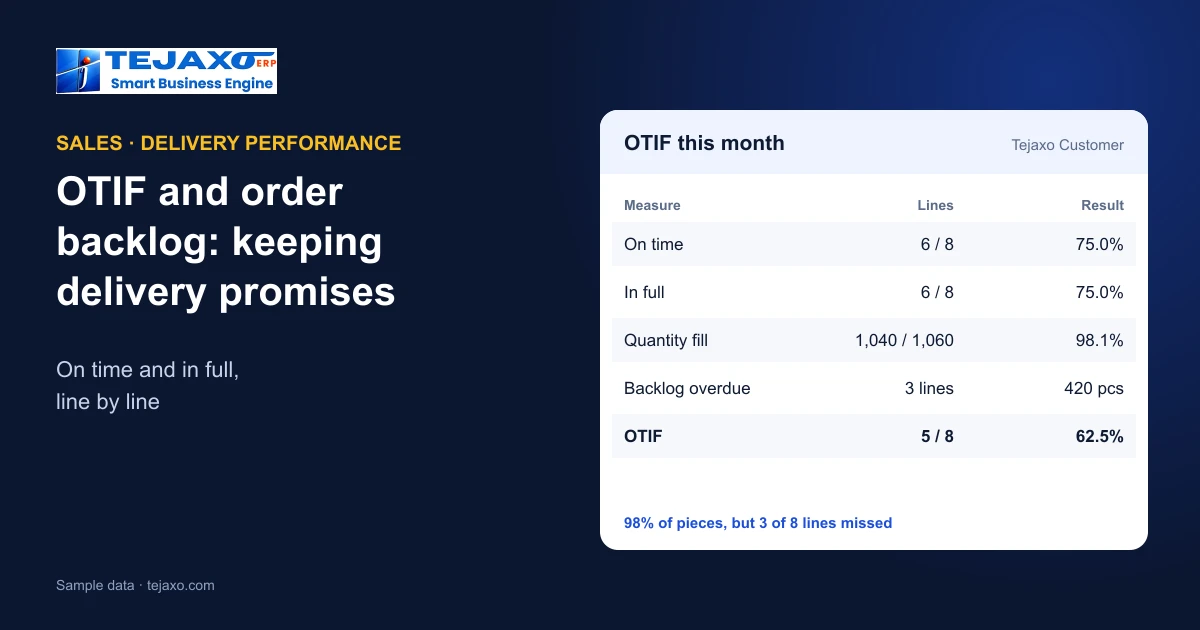
Six of eight lines were on time (75%) and six were in full (75%), but only five were both: OTIF = 62.5%. By quantity, 98.1% of the ordered pieces arrived – a figure that looks excellent while three of eight lines disappointed the customer. Line 6 failed both ways; line 3 failed only because 10 pieces were short.
Finding the causes
OTIF is only useful if every miss carries a reason. Typical reasons:
- Material short – a bought-out item or raw material arrived late.
- Capacity – the machine or line was booked with other work.
- Quality – parts rejected at final inspection, leaving the line short.
- Planning – the order was entered or released late.
- Dispatch – goods were ready but transport or documents were not.
Sorted by count, the reasons form a Pareto just like quality rejections – see how a defect Pareto works – and the top one or two are where improvement starts.
Order backlog: the misses that have not happened yet
OTIF looks back. The backlog looks forward: every open order line, grouped by how soon it is due. At day 20 of the month, the sample plant’s open lines look like this:
| Bucket | Lines | Qty |
|---|---|---|
| Overdue (due date passed) | 3 | 420 |
| Due this week | 5 | 900 |
| Due next week | 4 | 650 |
| Later | 6 | 1,400 |
| Total open | 18 | 3,370 |
The three overdue lines are already OTIF failures; the five due this week are the ones that can still be saved. A backlog review every morning – overdue first, then this week – with production and stores in the same room turns OTIF from a monthly report into a daily habit. Material for the lines due next week should already be checked against stock and open purchase orders – see how an MRP run finds shortfalls.
TAT to dispatch and order intake
Two more numbers complete the picture. TAT to dispatch – the days from order to dispatch – shows whether lead times are stable or creeping up. Order intake – new orders booked in the period against what was dispatched – shows whether the backlog is growing faster than the plant can ship. A growing backlog with a falling OTIF is the earliest warning that capacity or material planning needs attention.
How Tejaxo ERP handles it
In Tejaxo ERP the order-to-cash chain runs from CRM and quotation to a sales order with delivery schedules per line, a packing slip with finished-goods batches per order, the tax invoice and the receipt – each document pulled from the one before, so nothing is keyed twice. Sales reports include the order backlog, day-wise schedule, OTIF, TAT to dispatch, order intake, item-wise sales register, top customers and margin analysis, and customers can follow live order status. On the shop floor, work orders are created line-wise from sales orders and job cards are scheduled on each machine – see production planning.
Improving OTIF
- Commit dates the plant can meet. Check capacity and material before confirming, not after.
- Plan by line, not by order. Each line with its own date gets its own work order and material check.
- Review the backlog daily, overdue first.
- Record a reason for every miss, and act on the top reason each month.
- Share OTIF with key customers. A customer who sees the plant measuring itself honestly is more patient with the occasional miss.
Common mistakes
- Moving the due date when an order slips, so it never shows as late. Keep the original committed date for OTIF.
- Reporting quantity fill only. 98% of pieces can hide a third of lines failing.
- No reason codes. Without them, OTIF falls and nobody knows why.
- Counting dispatch instead of delivery without saying so. If transit time is long, agree which date counts.
Next step
See the order backlog, OTIF and TAT to dispatch on your own orders in a free demo, or work out reorder points for the material behind them with the free reorder point calculator.
Frequently asked questions
What is OTIF?
On time, in full: the percentage of order lines delivered by the committed date with the full ordered quantity. A line that is late or short counts as a failure.
How is OTIF calculated?
OTIF % = order lines delivered on time and in full / order lines due x 100. For example, 5 of 8 lines on time and in full gives 62.5%.
What is the difference between OTIF and fill rate?
Fill rate (quantity) measures the share of ordered pieces delivered; OTIF measures the share of lines that were both complete and on time. Fill rate can be 98% while OTIF is much lower.
What is an order backlog?
All open order lines not yet delivered, usually grouped by due date – overdue, this week, next week and later – so the plant can act before lines become late.
Should the due date be changed when an order slips?
Not for OTIF. Keep the original committed date so the measure stays honest; record the revised date separately.
Does Tejaxo ERP report OTIF and backlog?
Yes. Sales reports include order backlog, day-wise schedule, OTIF, TAT to dispatch and order intake, from sales orders with delivery schedules per line.