
For most manufacturers, payroll is not hard because of the arithmetic. It is hard because every month the same chain has to run without a break: attendance has to be final, overtime approved, leave applied, salaries calculated by group, PF and ESI worked out on the right wages, the statutory files prepared, the bank file made and the salary register filed – often for staff and workers with different rules, and sometimes for several plants. A mistake anywhere shows up as a wrong payslip, a rejected return or a notice. This guide walks through the monthly statutory payroll run step by step, with a worked example of PF and ESI for two employees.
The monthly chain
- Attendance: punches from biometric devices, corrected and approved, with leave and holidays applied.
- Overtime: calculated by the agreed rules for each employee group and approved.
- Salary process: earnings and deductions per employee, run per plant, month and pay group.
- Statutory: PF, ESI, labour welfare fund and professional tax worked out on the correct wage base.
- Files: the PF ECR, ESI contribution details, the NEFT bank file and the salary register.
- Payment and filing within the due dates.
PF in brief
Provident fund is generally 12% of basic wages plus DA from the employee, with a matching employer contribution split between the pension scheme and the provident fund. Contributions are commonly calculated on wages up to the statutory ceiling of 15,000 unless the employer has chosen to contribute on higher wages. The monthly ECR (electronic challan cum return) lists each member’s wages and contributions and is uploaded on the EPFO portal.
ESI in brief
Employees whose gross wages are within the ESI limit – 21,000 at present – are covered. The employee contributes 0.75% of gross wages and the employer 3.25%. Contributions are filed monthly on the ESIC portal. Coverage is decided by wages in the contribution period, so an employee whose pay crosses the limit mid-period has specific rules – follow the current notifications.
Worked example: two employees, one month
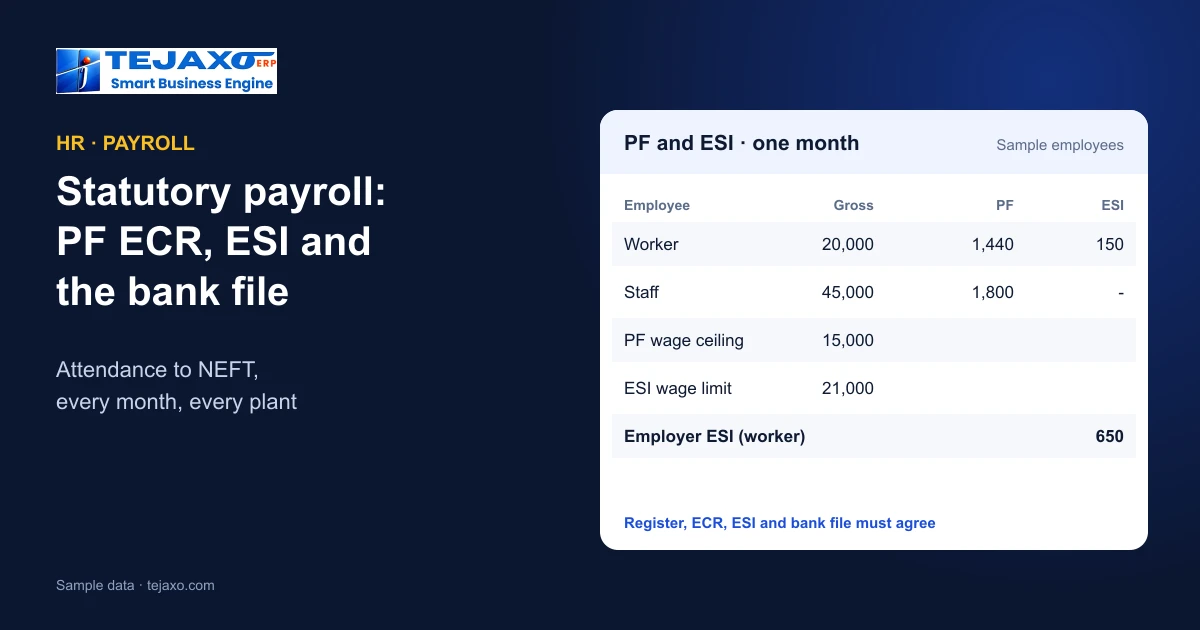
Tejaxo Manufacturing (sample data) pays a worker with gross wages of 20,000 (basic and DA 12,000) and a staff member with gross 45,000 (basic and DA 25,000). PF is calculated on wages up to the ceiling:
| Employee | Gross | PF (12%) | ESI (0.75%) | Net |
|---|---|---|---|---|
| Worker (sample) | 20,000 | 1,440 | 150 | 18,410 |
| Staff (sample) | 45,000 | 1,800 | Not covered | 43,200 |
The worker’s PF is 12% of 12,000 = 1,440, and ESI applies because gross is within 21,000: 150 from the employee and 650 from the employer. The staff member’s PF is capped at 12% of 15,000 = 1,800, and ESI does not apply. Net pay shown is before professional tax, labour welfare fund and other deductions such as advances or canteen. Rates and limits change from time to time – confirm current figures with your consultant before each year.
Professional tax and labour welfare fund
Professional tax and labour welfare fund are state subjects: whether they apply, the slabs and the due dates depend on the state where the employee works. A multi-plant company in more than one state needs the right state rules on each plant, which is one reason to run statutory settings per plant and per employee group rather than once for the whole company.
Staff and workers under different rules
Many plants pay staff monthly and workers on attendance, with different overtime rules, different PF wage choices and different canteen or allowance deductions. Running both groups in one salary process causes mistakes. Pay bands – one set of statutory and salary settings per employee group, each with its own attendance and salary run – keep them apart; see payroll for staff and workers with pay bands.
Arrears, joiners and leavers
Three situations cause most corrections. Arrears – a revision applied from an earlier month – need PF and ESI recalculated on the extra wages and reported correctly, not simply added to this month’s pay. Mid-month joiners are paid for the days worked, with statutory deductions on the actual wages and the member details registered before the return is filed. Leavers need their exit date recorded in the return so their accounts are closed properly. Handling these in the salary process, with an arrear report, keeps the next months clean.
Full and final settlement
When an employee leaves, the last salary is followed by a settlement of leave encashment, notice pay, bonus or gratuity where due, and recovery of advances or company property. It should use the same attendance and salary data as the regular run, so the final payslip agrees with the register and the statutory files for the month of exit, and nothing has to be worked out again on paper.
The bank file
Once salaries are approved, a NEFT bank file in the bank’s format pays everyone in one upload instead of individual transfers. The file should be generated from the same salary register that is filed, so the amounts paid, the register and the statutory returns all agree. Keep employee bank details under controlled rights – they are the most sensitive data in the payroll; see approval workflows and user rights.
Checks before you pay
- Head count: employees paid equals employees on the rolls, joiners and leavers included.
- Attendance closed: no pending regularisations or unapproved overtime.
- Statutory totals: PF and ESI totals in the register match the ECR and the ESI file.
- Variance: compare each employee’s net pay with last month and explain large differences.
- Bank file total equals net pay in the register.
How Tejaxo ERP handles it
Tejaxo ERP runs the chain from biometric punches to attendance with approvals, leave and overtime rules, then the salary process per plant, month and pay band, statutory PF ECR, ESI, LWF and PT, and finally the NEFT bank file and salary register. Pay bands keep separate PF, ESI, LWF, canteen, overtime and salary-component settings for each employee group in one plant, each with its own monthly attendance and salary run, and the salary slip, register, PF statement and ECR, ESI, LWF, overtime and arrear reports can be filtered by pay band. Settings can be copied to another plant. Biometric attendance works with face and card devices.
Common mistakes
- Running payroll before attendance is closed, then correcting through arrears every month.
- One rule set for staff and workers, so PF wage, overtime or canteen deductions are wrong for one group.
- Bank file made by hand from a spreadsheet, so paid amounts drift from the register.
- Missing a state rule for professional tax or labour welfare fund at a plant in another state.
Next step
See the attendance-to-bank-file payroll run with pay bands in a free demo.
Frequently asked questions
What is the PF ECR?
The electronic challan cum return filed monthly on the EPFO portal, listing each member’s wages and PF contributions for the month.
How is PF calculated for a factory worker?
Generally 12% of basic wages plus DA from the employee, with a matching employer contribution, commonly on wages up to the 15,000 ceiling unless the employer contributes on higher wages.
Who is covered by ESI?
Employees whose gross wages are within the ESI wage limit, currently 21,000. The employee contributes 0.75% and the employer 3.25% of gross wages.
Do professional tax and LWF apply everywhere?
No. Both are state subjects; applicability, slabs and due dates depend on the state where the employee works.
What is a NEFT salary bank file?
A file in the bank’s format listing each employee’s account and net pay, uploaded once to pay all salaries. It should be generated from the same salary register that is filed.
Does Tejaxo ERP handle statutory payroll?
Yes. It runs attendance to salary per plant, month and pay band, with PF ECR, ESI, LWF and PT, and produces the NEFT bank file and salary register.