
Tally Prime is a good fit for a manufacturer whose needs are mainly accounting, GST and simple stock with a basic bill of materials. Tejaxo ERP is the better fit once production planning, job work, quality, approvals or multiple plants need to run on one live system. Many Indian manufacturers do not have to choose one or the other: Tally can stay for accounts while Tejaxo ERP runs operations.
This is a fair comparison, not a pitch against Tally. Tally has earned its place in Indian factories, and for some businesses it is exactly the right tool. The question is where it stops being enough, and what that costs you in spreadsheets, rework and late decisions.
Where Tally Prime fits manufacturers well
Tally is accounting-first software, and it does that job very well. For a small manufacturer, that can be all that is needed. Tally is usually the right answer when:
- Accounts and GST are the main pain. You need vouchers, ledgers, GST returns, TDS and bank reconciliation handled by a tool your accountant already knows.
- The product is simple. One or two levels of bill of materials, a small number of items, and a stock journal that records raw material going in and finished goods coming out.
- One location, few users. A single plant where the owner or one accountant sees most transactions personally.
- Production is controlled on the floor. The supervisor knows what is running, and the office only needs to record what happened at the end of the day.
Tally Prime also offers features such as godowns, batches, price levels and job work handling. Exact capabilities depend on your Tally version, so confirm them with your Tally partner before relying on them for a specific process.
If this describes your business, moving to a full ERP too early adds training effort and process discipline you may not need yet. Staying on Tally is a sensible decision.
Where a manufacturing ERP becomes necessary
The signs that Tally alone is stretched are rarely about accounting. They show up in operations, as work that lives in spreadsheets, WhatsApp groups and people’s memory. Watch for these:
- Planning runs on Excel. Material requirements, machine loading and delivery promises are calculated by hand beside Tally.
- Stock does not match. The books show one figure, the store shows another, and nobody can say where the difference came from.
- No work-in-progress view. You only learn the cost of a job after it is finished, if at all.
- Job work is hard to reconcile. Material sent to job workers and received back in a different form, weight or quantity leaves open balances that nobody can explain.
- Approvals are informal. Purchase orders, discounts and payments move on phone calls rather than defined rights.
- More than one plant. Each unit keeps its own books, and the owner waits for consolidated figures.
- Customisation is slowing you down. Every new process needs a separate add-on or custom script, and nobody is sure what will break on the next upgrade.
A manufacturing ERP puts sales, purchase, stores, production, quality, finance and HR on one database, so each document pulls from the one before it and nothing is keyed twice. That is the core difference: Tally records what happened, while an ERP also runs the process that makes it happen.
Tally Prime vs Tejaxo ERP: feature comparison
The table below is a practical guide, not a scorecard. The Tally column describes typical use; check your own version and add-ons with your Tally partner.
| Area | Tally Prime (typical) | Tejaxo ERP |
|---|---|---|
| Accounting, ledgers and GST returns | Strong, familiar to most Indian accountants | Finance, GST and e-invoice modules inside the same platform |
| Simple BOM and stock journal | Available | Available, with multi-level BOM and process routes |
| Production planning and capacity | Limited; usually done in spreadsheets or add-ons | Production and planning boards, capacity screens and work orders |
| Shop-floor stages, rejection and downtime | Not a native focus | Stage-wise entries with rejection and downtime reasons |
| Job work and reconciliation | Basic job work handling; complex reconciliation needs extra effort | Returnable gate pass, job work BOM, batch tracing and write-off control |
| Quality inspection | Not a native focus | Template-based inspection linked to receipts |
| Approvals and user rights | Basic security levels | Workflow approvals with role-based rights |
| Multi-plant reporting | Possible with separate companies and consolidation effort | One database with plant-wise MIS |
| Machine and plant data | Not native | Machine, logger and SCADA data can flow into the ERP |
| Owner access | Reports on request | Owner dashboard and WhatsApp alerts and approvals |
Tejaxo ERP ships with 1000+ standard reports and 20+ modules, so most questions a plant head asks already have a report behind them. That is a starting point, not a promise that nothing needs configuring; every plant has its own process, and good implementation is about mapping that process properly.
Job work and traceability: the first place Tally strains
For many Indian manufacturers, job work is where the gap becomes obvious. You send coil, castings or components to a job worker. They come back as sheets, machined parts or coated items, with scrap and process loss along the way. GST rules on job work, including the ITC-04 return and the time limits on material lying with a job worker, mean you need to know exactly what is still outside your gate.
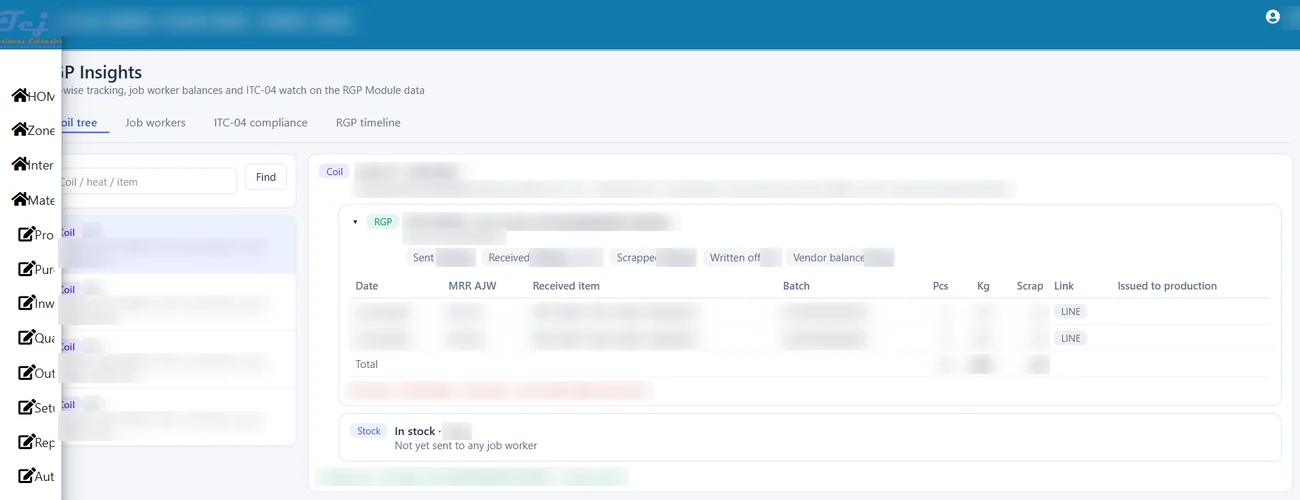
Consider a sample case at Tejaxo Manufacturing. One coil goes out, comes back as several sheet batches, and some small loss is written off. In a system built around vouchers, that story is spread over several entries and a spreadsheet. In an ERP built around traceability, each received batch knows its parent coil, and the balance with the job worker is always visible.
- Each sent line can be traced to the batches received back from it.
- Small losses are closed through a separate, reversible write-off instead of editing old documents.
- Ageing of pending lines helps you act before time limits are reached.
If job work is a large part of your business, read our guides on job work software with a returnable gate pass and see how the same logic applies to customer material in inward job work.
Multi-plant visibility and owner reporting
The second pressure point is management reporting. An owner with two or three plants typically asks simple questions: which plant sold more this month, where is stock piling up, and which orders are late. With separate Tally companies or spreadsheets, each answer takes a phone call and a day.
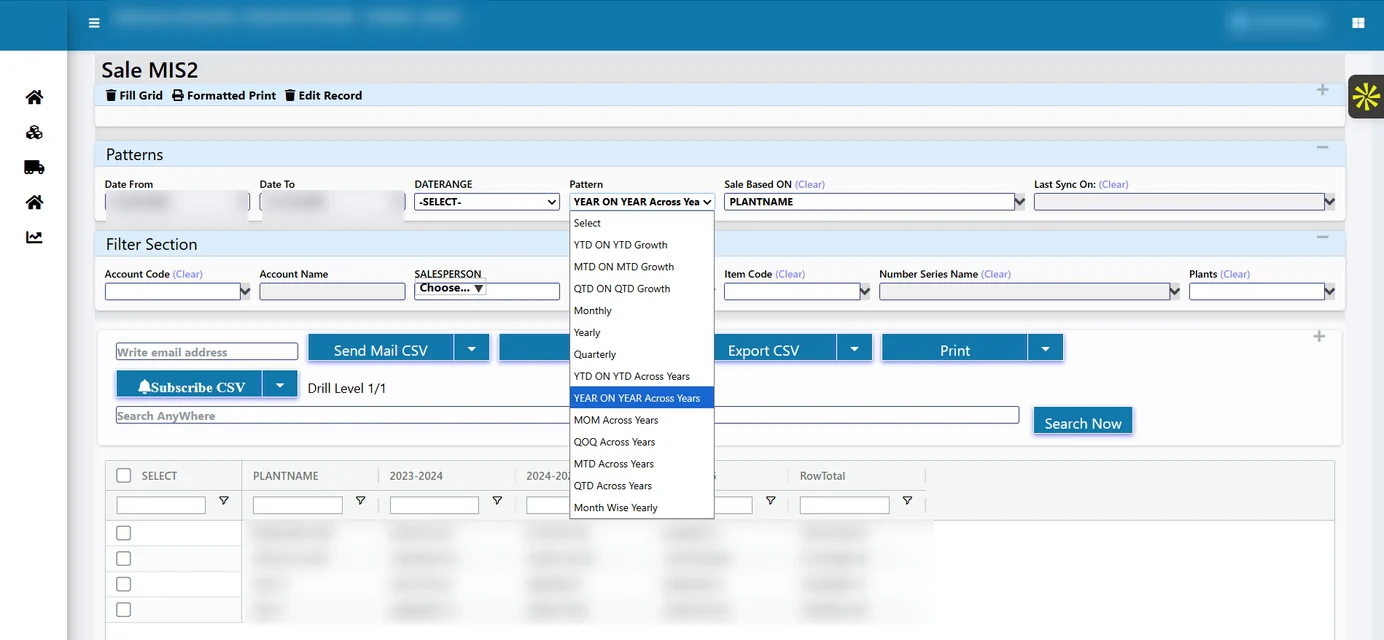
When all plants post to one database, the same question becomes a report. Plant-wise sales comparisons, stock by location and pending orders are filters on live data rather than a monthly exercise. Tejaxo ERP also lets owners ask questions and approve items through WhatsApp, so decisions do not wait until someone is at a desk. For a deeper look at this, see our note on multi-plant ERP with one-screen MIS.
The hybrid option: keep Tally, add Tejaxo ERP
Replacing Tally is not always necessary, and it is often not the best first step. Your accountant knows Tally, your auditor accepts it, and years of data sit inside it. A hybrid approach lets you keep those strengths while fixing the operational gaps.

In this setup, Tejaxo ERP handles the operational work: orders, purchase, stores, production, quality and job work. Tally continues as the accounting book. Tejaxo integrates with Tally, so the financial effect of operational transactions does not have to be typed again. The exact scope of what flows between the two is something to define during a demo against your own process.
The hybrid path has a clear advantage: your team learns one new system at a time, and you can decide later whether to move accounts into the ERP. If you want to understand both directions, read about Tejaxo and Tally integration and the step-by-step view in moving from Tally to an ERP for manufacturers.
A simple decision checklist
Score your business honestly against these questions. The more you answer yes, the stronger the case for an ERP.
- Do you plan production or purchases in a spreadsheet outside Tally?
- Do you have more than two levels of BOM, or products that change by customer?
- Do you send material to job workers and struggle to reconcile what comes back?
- Do you need batch or heat-wise traceability for customers or audits?
- Do you run more than one plant, or plan to?
- Do purchase orders, discounts or payments need approval before they go out?
- Do you need to know job-wise cost and profit while the job is running?
- Do you want machine or plant data in the same system as orders and stock?
- Does the owner want answers without waiting for someone to prepare a report?
If you said yes to two or fewer, Tally with good discipline may carry you for some time. If you said yes to four or more, the cost of staying on spreadsheets is probably higher than the effort of moving. In between, the hybrid option is usually the sensible route.
What to ask in any ERP demo, including ours
A fair comparison needs fair questions. Ask every vendor, Tejaxo included, to demonstrate rather than describe.
- Use your own process. Give the vendor one real job, one job work cycle and one purchase approval, and ask them to run it end to end.
- Ask about migration. What masters and opening balances can be loaded, who cleans the data, and how long does parallel running last?
- Ask about compliance. E-invoicing, e-way bill and ITC-04 requirements and thresholds change, so confirm current rules on the GST portal and ask exactly how each document is prepared and submitted in the vendor’s system.
- Ask about support. Who supports you after go-live, on-site or remote, and how are customisations handled across upgrades?
- Ask for references. Speak to manufacturers with a process similar to yours.
On our side, Tejaxo has been in business since 2017 and supports 50+ clients across India on-site and remotely. We are a focused Indian vendor, not a global brand, and a conversation about references and fit is the right way to judge whether we suit your plant. If you already run SAP or Microsoft Dynamics, our approach is different again: we do not replace your ERP, we extend it, as explained in our guide to extending SAP and Dynamics on the shop floor.
Plan the rollout, not just the purchase
Most ERP failures are rollout failures, not software failures. A few habits reduce the risk:
- Start with one process and one plant, then widen.
- Clean item, party and BOM masters before loading them.
- Name an owner on your side for each module.
- Train the store and production teams, not only the accounts team.
- Run parallel for a short, defined period, then switch off the old process.
Tejaxo ERP is built to reduce typing: machine data, scanned supplier invoices and WhatsApp voice or text entries can go in without keying, and people stay in control of what is approved. That makes day-to-day adoption easier for teams who dislike data entry.
Next step: test it against your own plant
The right answer depends on your products, your job work and your growth plans, not on a feature list. Bring one real process and let us show you how it would run, whether that ends in a hybrid setup with Tally or a fuller move. Book a free consultation and we will give you an honest view, even if the answer is that Tally is still enough for now.
Frequently asked questions
Can Tally Prime handle manufacturing?
Tally Prime handles basic manufacturing needs such as a bill of materials, stock journals, batches and godowns, along with accounting and GST. It suits simple products at one location. When you need production planning, shop-floor entries, quality checks, approvals or multi-plant control, most manufacturers add spreadsheets, add-ons or an ERP. Confirm exact features for your version with your Tally partner.
When should a manufacturer move from Tally to an ERP?
Move when operations, not accounting, cause the pain: planning done in Excel, stock that does not match, unclear job work balances, no work-in-progress costing, informal approvals or several plants. If four or more of these apply, an ERP usually pays back its effort. If fewer apply, Tally with good discipline can continue.
Does Tejaxo ERP replace Tally or work with it?
Both are possible. Tejaxo ERP can integrate with Tally, so Tally continues as the accounting book while Tejaxo handles operations such as sales, purchase, stores, production, quality and job work. Some businesses later move accounts into Tejaxo as well. The scope of data flow is defined against your process during a demo.
Does an ERP help with job work and ITC-04 compliance?
A manufacturing ERP helps by tracking each sent line, the batches received back, scrap and write-offs, and by ageing pending balances. That gives you the data needed to prepare job work returns and watch time limits. Always confirm current GST rules and filing requirements on the official GST portal.
How do I judge whether Tejaxo is the right vendor?
Ask for a demo using your own process, including one job work cycle and one approval. Request references from manufacturers with a similar process, and ask about migration, support and customisation across upgrades. Tejaxo has worked with businesses since 2017 and supports 50+ clients across India on-site and remotely.
One Response