
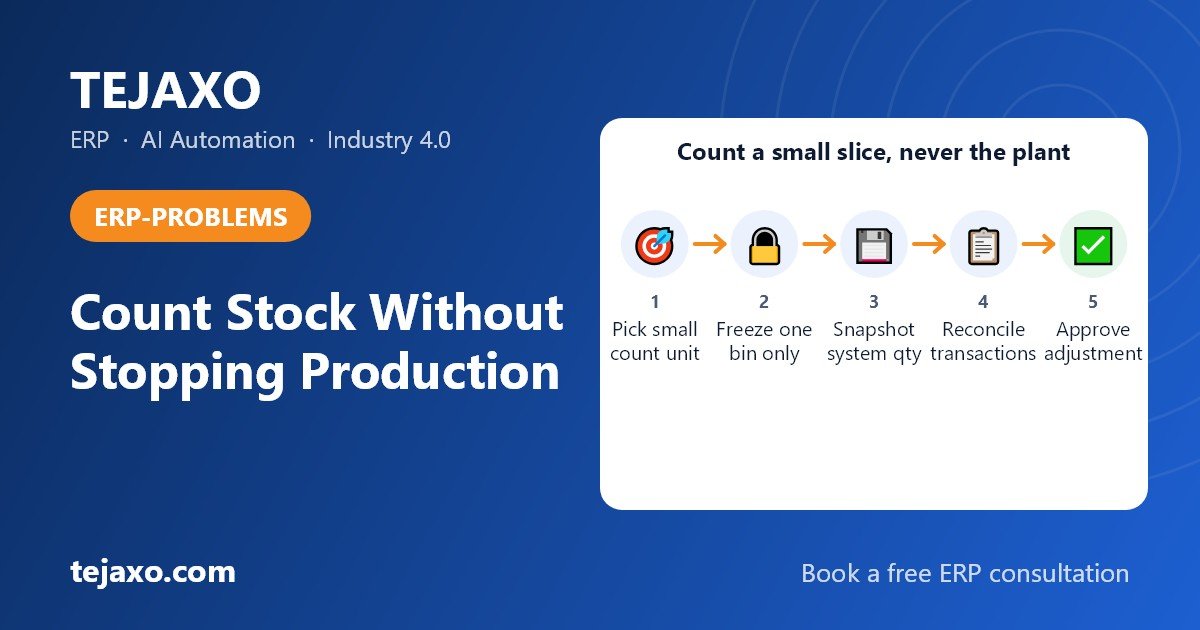
Yes, you can verify stock every month without stopping production or the store. The method is cycle counting: count a small, rotating slice of items each day, freeze only the bin or location being counted, and reconcile the count against transactions posted since the system snapshot. Run with a written policy and approval-gated adjustments, it can give the controller continuous audit evidence, provided every count and adjustment is documented.
This guide is for store heads and finance controllers in mid-size plants who face an annual audit count and want to replace it with a rolling programme. It concentrates on the mechanics: how to freeze, snapshot and cut off, how to trace a variance, and what an auditor will accept. How to build the ABC classes themselves is covered on a separate page, linked in the frequency section.
Can you count inventory while production is running?
Yes, provided you count in small units and control movement only in the unit being counted. Cycle counting means verifying a defined part of the inventory on a continuing schedule instead of verifying everything on one day. Because each count touches a few items or one location, the rest of the plant keeps issuing, receiving and dispatching.
Three ideas make this work in practice:
- Small count units: one bin, one rack or one item, not the whole warehouse.
- Snapshot and reconcile: the system quantity is recorded at the moment counting starts, and any issue or receipt posted afterwards is added or subtracted before variance is judged.
- Written cut-off rules: everyone knows which transactions belong before the count and which after.
Why does a once-a-year shutdown count fail?
An annual full count finds errors too late and too many at once. By the time the shutdown arrives, a year of small mistakes has accumulated, the root causes are hard to trace, and the team often adjusts the books just to close the audit.
Typical root causes in a mid-size plant:
- No rotating schedule: nobody owns a calendar of which items are counted when, so fast-moving and high-value items are checked no more often than dead stock.
- No way to freeze one location: the only option is to stop everything, so counting is postponed until a planned shutdown.
- Weak location structure: material sits in unnamed corners, so the system says an item is in one store while it is physically in another.
- Unposted or late transactions: issues to production recorded in a paper register or an Excel sheet and entered days later, or receipts physically in the store before a goods receipt exists.
- Unit of measure mismatches: stock held in pieces but issued in kilograms, or purchased in one unit and consumed in another.
- Unrecorded scrap and process loss: material consumed in production but never written off, so book stock stays higher than physical stock.
The annual count is also a comparison of an unreliable book figure against a rushed physical figure. Neither side is trustworthy, which is why the variance so often ends as a large adjustment nobody can explain.
How do you diagnose where your stock accuracy is breaking?
Find which error type creates your variances before you count more. Pick 30 to 50 items across classes, count them carefully, and for every variance trace the last few transactions. Group the causes and fix the biggest group first.
Use this diagnosis checklist:
| Symptom | Likely cause | Check |
|---|---|---|
| Physical stock is consistently lower than book | Unrecorded scrap, yield loss or unposted issues | Compare production output against material issued for recent work orders |
| Physical is higher than book | Receipts without a goods receipt, or returns not posted | Match gate entries to receipt documents for the period |
| Item found in a different bin | Wrong-bin putaway or transfers not recorded | Review location transfers and putaway discipline |
| Variance equals a fixed multiple | Unit of measure mismatch | Compare purchase, stock and issue units on the item master |
| Variance appears only after production runs | Backflush or BOM quantity errors | Compare BOM consumption with actual issues |
| Same items go wrong every month | Poor labelling or shared bins | Check bin labels and whether items are mixed |
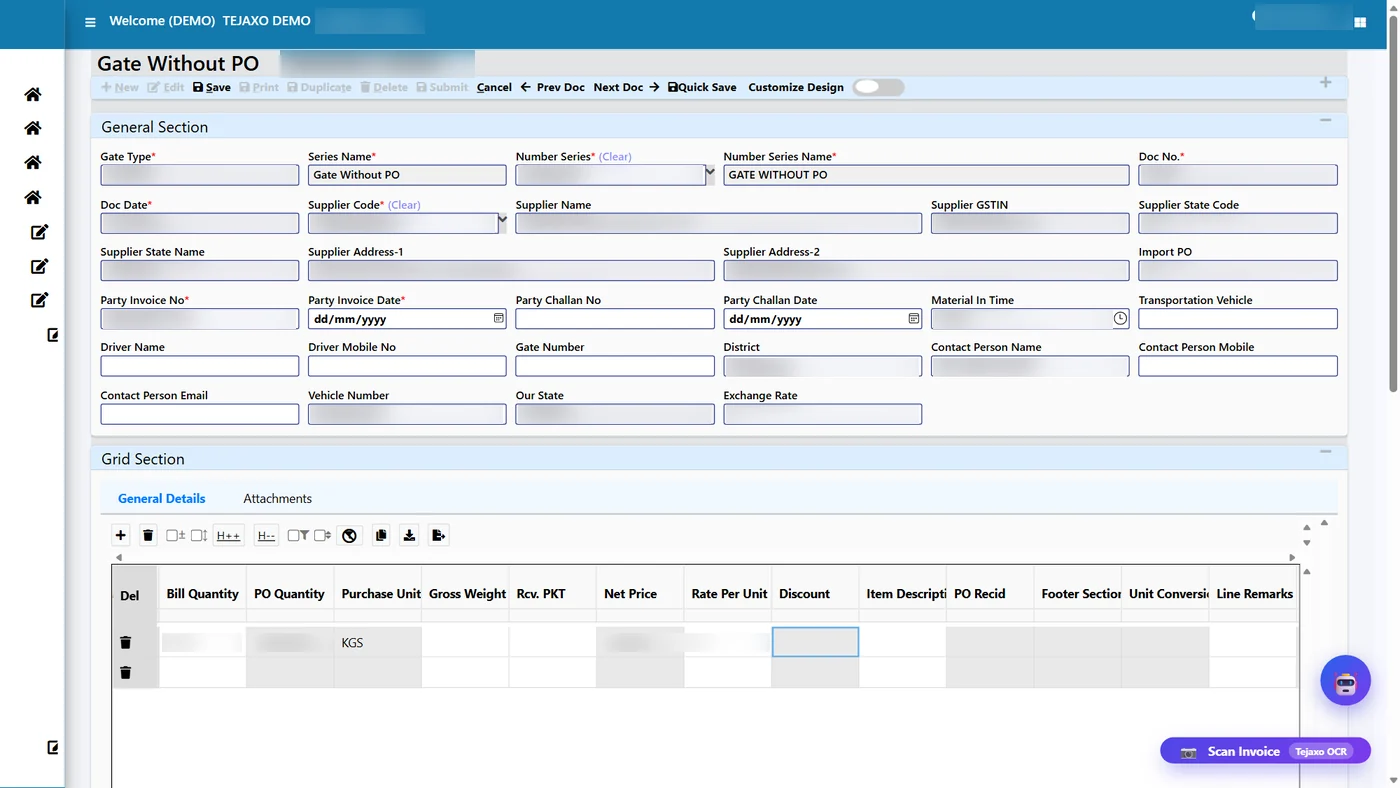
Receipts are a frequent source of error. If material enters the plant at the gate but is booked into stock days later, every count in that window will be wrong. Controlling the gate is part of controlling the count, as covered in our guide to material gate entry software for factories.
A worked variance trace: a kg-issued, piece-stocked item
This is an illustrative example, not a customer case. In a sample plant, Product A uses a small turned bush. The bush is stocked in pieces (nos) but the store issues it to job cards by weight in kg. The item master says 10 pieces per kg, while the real figure is 12 pieces per kg.
- The monthly A-item count shows physical stock 1,000 pieces below book on an item with a book balance of 4,000.
- The counter recounts and gets the same figure, so it is not a counting slip.
- The checker lists the last ten issues. Each was posted in kg, and the system deducted 10 pieces per kg.
- For every issue, the shortfall equals 2 pieces multiplied by the kg issued. Across ten issues of 50 kg each, that is 1,000 pieces.
- The fix is not a stock adjustment alone. Correct the conversion on the item master, post a one-time adjustment with the reason code unit error, and recount after the next few issues to confirm the gap has stopped growing.
The clue was a variance that moved in step with issued kg. Random loss or theft does not behave like that.
How do you freeze one location without stopping the store?
A mistake plants often make is freezing a whole rack, or a whole store, to be safe. Issues then pile up on paper slips, get posted in a batch after the hold is lifted, and the next count starts with the same mess the freeze was meant to avoid. Freeze at the smallest practical unit, normally one bin, rack or item-location pair, and only for the minutes the count takes. Other locations carry on receiving and issuing. A freeze means no transaction is posted against that location until the count is closed or released.
Follow these steps:
- Generate the count task for a defined location and list of items.
- Record the system quantity at that moment as the snapshot. Keep it hidden from the counter (a blind count) so the counter does not simply confirm the book figure.
- Place a visible hold tag on the location, and block postings in the system if your ERP supports it.
- Count, and recount immediately if the figure differs from the snapshot beyond tolerance.
- Close the task, release the location and apply any approved adjustment.
A caution on system blocks: location-level posting blocks need care in a busy store. If a bin is held when an urgent production issue arrives, the storekeeper either waits or issues on paper and posts later, which recreates the unposted-issue problem you are trying to remove. Keep holds to the minutes the count takes, schedule A-item counts outside peak issue hours, and agree a rule for urgent issues, for example release the hold, issue, then recount.
If your system cannot block postings at location level, use snapshot-and-reconcile instead. Count at any time, then add every receipt and subtract every issue posted between the snapshot and the count before you call it a variance.
How often should A, B and C items be counted?
Count items in proportion to their value and movement. Common practice is A items monthly or quarterly, B items twice a year and C items once a year. In our sample plant we count more often: A monthly, B quarterly and C twice a year. Frequencies are a management decision, not a legal rule, so set them to match your risk and audit needs. For how to build the A, B and C classes, see our article on ABC and FSN analysis for inventory cycle counts.
| Class | What it represents | Sample plant frequency | Method |
|---|---|---|---|
| A | High value or critical items | Monthly | Blind count, recount on any variance |
| B | Medium value | Quarterly | Location-wise rotation |
| C | Low value, high volume | Twice a year | Zone sweep or sampling |
| Triggered | Zero or negative balance, after large receipt, at reorder point | Immediately | Exception count |
A worked sample schedule
Take a sample plant with 3,000 stocked items. Suppose 600 are A items, 900 are B items and 1,500 are C items.
- A items counted monthly: 600 counts a month, 7,200 a year.
- B items counted quarterly: 3,600 counts a year.
- C items counted twice a year: 3,000 counts a year.
That is about 13,800 counts a year. Over roughly 250 working days it is around 55 counts a day. At an assumed five minutes a count, that is under five hours of counting time daily, which two trained counters can cover alongside other store work. These are sample numbers; use your own item counts and timing from a pilot.
Every item is counted at least once during the year, which matters for audit coverage. Items that show repeated variances should be moved up a class until they stabilise.
How do you handle transactions that happen during a count?
Set a cut-off rule and apply it the same way every time. The cleanest rule: any issue, receipt or transfer posted before the snapshot time belongs to the opening figure; anything posted after is a movement to be reconciled against the count.
- Receipts in flight: material at the gate without a goods receipt is not stock. Keep it in a gate or receiving area, separate from counted bins.
- Issues in flight: material handed to production but not yet posted must be posted or physically moved to a staging area before the count of that bin.
- Transfers between locations: post the transfer before counting either side, or count both locations together.
- Returns and rejections: hold them in a quarantine location so they do not distort usable stock.
The reconciliation formula is simple: expected quantity = snapshot quantity + receipts since snapshot − issues since snapshot. The variance is the counted quantity minus expected quantity.
What do you do with WIP and shop-floor stock?
Treat work in progress and line-side material as a separate location type with its own counting rule. Shop-floor stock is often where book and physical diverge, because it moves quickly and is frequently consumed before it is posted.
- Create named staging and line-side locations so material issued to a work order has a defined home.
- Count line-side stock at shift change or during a planned changeover, when the line is idle anyway.
- Count WIP by work order or job card at stage boundaries rather than by walking the floor.
- Record scrap and rejection at each stage so loss is visible instead of hiding in the variance.
Coil and sheet work shows why. In an illustrative case, a sample plant issues a 500 kg coil to a press for Product A blanks. The blanks are booked in, but the offcut and edge trim are never booked as scrap. Each month the coil balance on the book is a little higher than what is physically left, and the gap equals the unrecorded offcut weight. A scrap entry at each stage closes that gap at source.
Material that sits with job workers or outside parties needs a separate reconciliation against challans, not a bin count. Tejaxo ERP handles this through returnable gate pass reconciliation, described in our guide to job work software with returnable gate pass.
What variance is acceptable and who approves adjustments?
Set tolerance by item class and value, and never allow an adjustment without approval. There is no universal figure. Record-accuracy targets of roughly 95 to 99 percent or better on A items are often quoted in cycle counting practice; treat that as a typical industry benchmark, not a standard, and confirm it against your own pilot. The table below is an example starting point to adjust, not a rule.
| Item class | Example quantity tolerance | When exceeded |
|---|---|---|
| Critical A (single source or line-stopping) | 0%, any difference is recounted | Investigate cause before any adjustment |
| Other A items | Up to 1% | Recount, then trace the last transactions |
| B items | Up to 2% | Recount, adjust with reason code |
| C items | Up to 5%, subject to a value cap | Recount, adjust with reason code |
The CARO 2020 figure of 10 percent in aggregate for a class is a reporting threshold for the auditor, not a target. Aim to sit well inside it. The approval levels below sit on top of the tolerance table.
| Variance level | Action | Approver |
|---|---|---|
| Within tolerance | Adjust after one recount | Store head |
| Above tolerance, below value limit | Investigate cause, then adjust with reason code | Store head and plant head |
| Above value limit | Root cause review before any adjustment | Finance controller |
Every adjustment should carry a reason code such as process loss, unposted issue, wrong bin or unit error. Over a few months the reason codes tell you where to fix the process. Without reasons, the programme only moves numbers around.
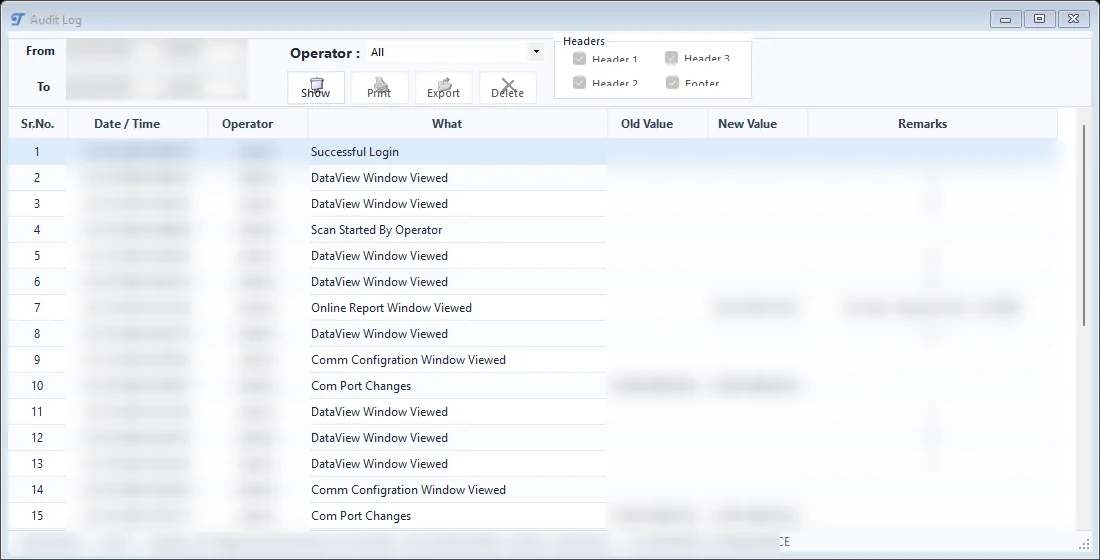
Keep the adjustment trail complete: who counted, who recounted, who approved and when. This log is the evidence your auditor will ask for.
Will auditors accept cycle counts instead of a year-end count?
Often yes, if the programme is documented, covers every item during the year and its results are reliable. Under auditing standards such as ISA 501, where inventory is material the auditor must obtain evidence on existence, usually by attending the count or performing alternative procedures. With a perpetual system and a sound cycle count programme, auditors commonly test counts near the year-end rather than require a full shutdown. Always agree the approach with your auditor in advance.
Prepare this evidence pack:
- A written cycle count policy with classes, frequencies and tolerances.
- A count calendar showing every item covered at least once in the year.
- Count sheets or system records with counter, recount and approver details.
- A variance log with reason codes and adjustment entries posted to the books.
- A year-end roll-forward showing movements from the last count to the balance sheet date.
- Auditor attendance on a sample of counts near year-end.
In India, the auditor’s report under CARO 2020 also comments on whether physical verification was done at reasonable intervals and whether discrepancies of 10 percent or more in aggregate for a class of inventory were properly dealt with in the books. Confirm the exact wording and your obligations with your statutory auditor. For valuation, quantities feed the lower of cost and net realisable value measurement required under Ind AS 2 and IAS 2, so accurate quantities protect the accounts as well as operations.
Annual count, cycle count or perpetual inventory: which should you use?
Most plants need a combination: a perpetual system that updates stock on every transaction, verified by cycle counts. A full count then becomes optional rather than compulsory.
| Aspect | Annual full count | Cycle count | Perpetual record |
|---|---|---|---|
| Production impact | Shutdown of store and often plant | Minimal, one location at a time | None |
| Error detection | Once a year | Continuous | Only through recording discipline |
| Root cause tracing | Difficult | Easier, errors are recent | Depends on audit trail |
| Audit evidence | Strong on one date | Strong if documented and complete | Needs physical verification |
| Effort pattern | Large peak | Small daily load | Daily posting |
A perpetual record without counts drifts, and counts without a reliable record cannot be reconciled. You need both.
How do you start a rolling count programme in 30 days?
Begin with a pilot on one store or one item class, fix what you find, then extend. A small start gives credible numbers before you commit the whole plant.
- Week 1, clean the structure: name every location, label every bin and check units of measure and conversions on the item master.
- Week 1, classify: run ABC by annual consumption value and mark critical items.
- Week 2, write the policy: frequencies, tolerances, cut-off rules, approval limits and reason codes.
- Week 2, train counters: blind count, recount rule and how to hold a location.
- Week 3, pilot: count the A items of one store, log every variance and trace its cause.
- Week 4, review and fix: correct the process causes, then build the calendar for the full year.
Review accuracy monthly. Track the share of counts within tolerance, repeat offenders and top reason codes. Accuracy should improve as causes are removed, not just as adjustments are posted.
What should an ERP do to support cycle counting without a shutdown?
In an ERP, a count is a controlled transaction, not a spreadsheet exercise. Look for stock by location and batch, schedule generation, a location hold, scanner or mobile counting, variance routing for approval and a full audit trail.
| Capability | Why it matters |
|---|---|
| Item classification (ABC) from consumption data | Drives count frequency without manual lists |
| Count schedule generation | Gives each counter a daily task list |
| Location or bin hold | Allows counting without stopping the store |
| Blind count and recount workflow | Stops counters copying the book figure |
| Barcode or QR based counting | Reduces item and batch identification errors |
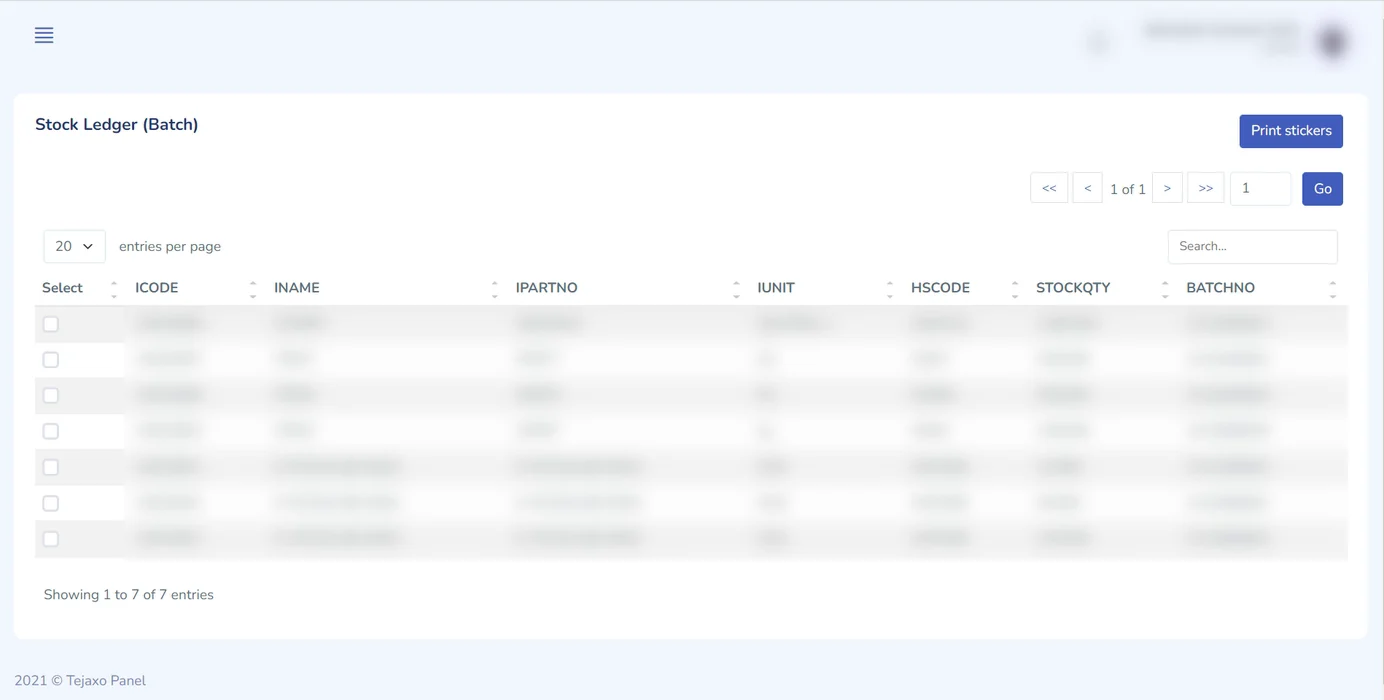
| Batch-wise and location-wise stock ledger | Lets you count and reconcile at the level where errors occur |
| Approval-gated adjustments posted to accounts | Keeps stock and finance in step |
| Audit log of views and changes | Gives the auditor evidence of who did what |
| Variance analytics by reason, item and location | Turns counts into process improvement |
Tejaxo ERP runs procurement, gate, stores, quality, production and finance on one live database, so receipts, issues and stock sit alongside the accounts. Batch-wise stock with QR sticker printing per batch is part of the stores side, and our warehouse management software page describes the wider warehouse capability. Count functions differ between systems and each plant’s location structure is different, so ask any vendor, including us, to demonstrate the exact count, hold and adjustment flow on your own item and location structure before you decide. If you run SAP or Microsoft Dynamics, the same checklist applies: we extend your ERP rather than replace it.
How many counters and how much time do you need?
Size the team from your schedule, not from the warehouse area. Divide total counts per year by working days, multiply by minutes per count and add time for recounts and investigation.
In the sample plant above, about 55 counts a day at five minutes each is under five hours daily. Add roughly 20 to 30 percent for recounts, walking and paperwork in the early months, which brings it to about six hours, or two part-time counters. Barcode or QR scanning reduces both time and wrong-item errors. As variances fall, the recount load falls too, and time can shift from counting to fixing causes such as conversion errors and unposted issues.
What is the first step to take this month?
Do not start with the whole plant. Pick one store, take its A items only, and run weeks 1 to 4 of the 30-day plan above: clean the locations and conversions, set tolerances and cut-off rules, count blind, and trace every variance to a reason code. At the end you will have a real variance log, a measured minutes-per-count figure and a first set of process fixes. That is what your controller and statutory auditor will want to see before you retire the annual shutdown count.
If you would like to see how stock, gate, production and finance can work from one database with controlled adjustments and an audit trail, our team can walk through it on your own store structure. Book a free consultation to plan your A-item pilot, or write to info@tejaxo.com.
Frequently asked questions
What is the difference between cycle counting and a physical inventory?
A physical inventory counts all items on one date, usually with a shutdown. Cycle counting verifies a defined part of the inventory on a continuing schedule, so every item is covered over the year without stopping operations. Cycle counting finds errors sooner and makes root causes easier to trace, while a full count gives a single-date snapshot.
Can I count stock without stopping production?
Yes. Count in small units such as one bin or rack, freeze only that location for the short count period, and reconcile against issues and receipts posted since the system snapshot. The rest of the store and the plant keep working. A written cut-off rule is needed so every transaction is treated consistently.
How often should A, B and C items be counted?
A common practice is to count A items monthly or quarterly, B items about twice a year and C items once a year, so every item is counted at least annually. This is a management policy, not a legal rule. Increase frequency for items that show repeated variances or are critical to production.
Will auditors accept cycle counts instead of a year-end count?
Often they will, if you have a documented policy, a calendar covering every item during the year, count records with approvals, a variance log with adjustment entries and a year-end roll-forward. Auditors usually test counts near the year-end. Agree the approach with your statutory auditor before you drop the annual count.
What count variance is acceptable?
There is no universal figure. Set tolerance by item class and value, tighter for A items and wider for C items, and require recount before any adjustment. Escalate variances above a value limit to the finance controller, and record a reason code for every adjustment so patterns become visible.
How do I handle material on the shop floor during a count?
Give line-side and staging stock named locations, post issues before counting, and count at shift change or a planned changeover when the line is idle. Count work in progress by work order at stage boundaries, and record scrap at each stage so process loss does not appear as an unexplained variance.