

Casting yield calculation answers one question: out of every kilogram of metal you melt, how much leaves the foundry as a good casting? Divide the weight of good castings by the metal poured (pouring yield) or by the metal charged (overall yield), multiply by 100, and always state which base you used. This article gives the formulas, one worked heat on sample numbers, and a charge-by-charge method for tracking metal, returns and rejections in an Indian foundry.
What is casting yield?
Casting yield is the share of metal that ends up in saleable castings. The trouble is that two people can quote different yields for the same heat, because they divide by different weights. Some guides divide by the total material weight, others by the metal poured into the mould. Both are valid, but they measure different things. Define all three before you compare any numbers.
| Yield type | Formula | What it tells you |
|---|---|---|
| Melting yield | Liquid metal tapped ÷ metal charged × 100 | How much metal survives the furnace (oxidation, slag, spillage) |
| Metal usage (pouring-stage) yield | Metal poured ÷ liquid metal tapped × 100 | How much tapped metal reaches a mould rather than staying in the ladle or being lost |
| Pouring (casting) yield | Good casting weight ÷ metal poured × 100 | How much of the poured metal becomes a good casting, after gating, risers and rejections |
| Overall yield | Good casting weight ÷ metal charged × 100 | The whole chain, from furnace charge to good castings |
Overall yield is the product of the three stage yields. That makes it easy to see which stage is leaking.
The mass balance behind every heat

Every heat obeys one balance. Whatever you charge into the furnace has to be accounted for:
Charge = good castings + gating and risers + rejected castings + melt loss + metal left in the furnace or ladle
If your records do not close this balance, your yield figure is an estimate, not a measurement. Gating, risers and rejected castings are not lost metal. They are returns, which go back into the next charge. Melt loss and ladle or furnace residue are the real losses. That distinction matters for cost, and we return to it below.
Casting yield calculation: worked example on sample numbers
The figures below are invented for illustration. Take one grey iron heat at Tejaxo Manufacturing in an induction furnace, making Product A.
Step 1: The charge
- Pig iron: 250 kg
- Steel scrap: 200 kg
- Returns (runners, risers, rejected castings): 500 kg
- Alloy additions: 50 kg
- Total charge: 1,000 kg
Step 2: Melt loss and tapping
Assume 3% melt loss, which is 30 kg. Liquid metal tapped is 970 kg. Published foundry calculation guides put induction melting of clean steel scrap at roughly 2% to 4%, so 3% is a sensible sample figure. Your own furnace, scrap quality and practice will differ, which is why you should measure it heat by heat.
Melting yield = 970 ÷ 1,000 = 97.0%
Step 3: Ladle and furnace residue
Suppose 20 kg stays behind as ladle skull, spillage and furnace heel. Metal poured into moulds is 950 kg.
Metal usage yield = 950 ÷ 970 = 97.9%
Step 4: What the 950 kg became
- Gating and risers: 380 kg
- Castings made (as cast): 570 kg
- Rejected castings (foundry and fettling): 50 kg
- Good castings: 520 kg
Check: 520 + 50 + 380 = 950 kg. The poured weight balances.
Pouring yield = 520 ÷ 950 = 54.7%
The as-cast yield, before rejections, is 570 ÷ 950 = 60.0%. The rejection rate by weight is 50 ÷ 570 = 8.8%.
Step 5: Overall yield
Overall yield = 520 ÷ 1,000 = 52.0%, which equals 0.970 × 0.979 × 0.547.
| Line | Sample weight (kg) |
|---|---|
| Charge | 1,000 |
| Melt loss | 30 |
| Ladle and furnace residue | 20 |
| Gating and risers (returns) | 380 |
| Rejected castings (returns) | 50 |
| Good castings | 520 |
| Total accounted | 1,000 |
Charge calculation: working backwards from the order
Planning a heat runs the same formula in reverse. The required molten weight is divided by (1 − melting loss %).
In the sample heat you need 950 kg poured plus 20 kg of residue, so 970 kg of liquid metal. With 3% melt loss:
Charge = 970 ÷ (1 − 0.03) = 1,000 kg
For a customer order, divide the good casting weight by the overall yield. To ship 1,000 kg of good castings at 52% overall yield, you need to melt about 1,923 kg. Most of that comes back as returns, so the metal you must actually buy is far smaller.
Track every charge: heat log and returns ledger
The sample heat hides a trap. It used 500 kg of returns, but only 430 kg of returns were generated (380 kg gating and risers plus 50 kg rejects). The difference came out of the returns stock. Here is the ledger:
| Returns ledger | Sample kg |
|---|---|
| Opening returns stock | 1,200 |
| Generated in this heat | 430 |
| Reused in this heat | 500 |
| Closing returns stock | 1,130 |
On paper this heat bought only 500 kg of fresh metal (250 pig iron, 200 steel scrap, 50 additions) for 520 kg of good castings. That looks better than 100% metal efficiency. It is not real. In steady state the fresh metal needed per heat is good castings plus melt loss plus residue: 520 + 30 + 20 = 570 kg. The extra 70 kg was borrowed from the returns stock. If you do not track returns generated against returns reused, a drawn-down stock quietly flatters your yield and your cost per kg.
A heat log that closes the balance needs these columns for every heat:
| Field | Why it matters |
|---|---|
| Heat number, date, furnace, shift | Identity for traceability |
| Charge by material (pig iron, scrap, returns, additions) | Cost and chemistry control |
| Total charge and tapped weight | Gives melt loss % for that heat |
| Metal poured and residue | Separates ladle loss from furnace loss |
| Good castings, gating and risers, rejections | Closes the mass balance |
| Returns generated and returns reused | Keeps the returns ledger honest |
| Chemistry and pouring temperature | Links rejections to melt conditions |
The weights should come from a weighbridge or platform scale at the charging bay and at dispatch, not from estimates at the end of the month. For related ideas on weighing and costing, see our guide on work order costing and job profit.
Where rejections hide, and how to attribute them
Rejections are the largest controllable leak in the sample heat after the gating system, and they are the most often misreported. A casting rejected after machining carries the cost of the metal, moulding, fettling and machining, but many foundries log it only as a number of pieces.
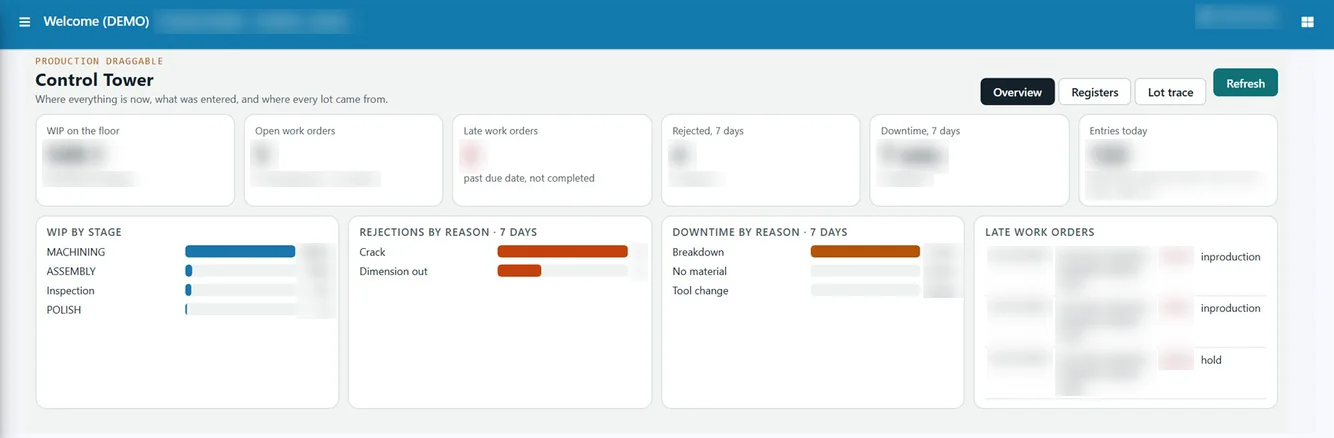
Record each rejection with three details: the stage where it was found (moulding, knockout, fettling, machining, customer), the cause code (sand inclusion, shrinkage, cold shut, dimensional, hardness), and the weight. Then you can answer questions that actually move yield:
- Which pattern or product has the highest rejection by weight?
- Which cause dominates on which shift or furnace?
- How many rejections are found late, where the cost is highest?
A Pareto of causes by weight is a better starting point than a monthly average. Our article on PPM, defect Pareto and cost of poor quality shows how to build one.
Common errors that distort casting yield
| Error | Effect | Fix |
|---|---|---|
| Mixing yield bases (charge vs poured) | Two teams quote different figures for one heat | Publish the definition next to every yield number |
| Returns reused without a ledger | Yield looks better while returns stock falls | Track generated against reused for every heat |
| Melt loss not recorded per heat | Scrap quality problems stay hidden | Weigh charge and tapped metal every heat |
| Rejections logged by count, not weight | Heavy castings are under-weighted in reports | Record rejected kg and cause code |
| Spreadsheets that never reconcile with weighbridge slips | Mass balance does not close | Capture weights at source and reconcile daily |
| Charge mix changes ignored (rusty or sandy scrap) | Melt loss and chemistry drift | Record scrap grade and supplier per charge |
How to improve casting yield
Work stage by stage, using the three yields from the first table.
- Melting yield: use clean, dry, properly sized scrap, limit time at high temperature, and keep slag practice consistent. Higher furnace metal yield cuts melting cost and also shortens payback on furnace investment.
- Metal usage yield: match the tap weight to the mould weight for the heat, so less metal is left in the ladle.
- Pouring yield: review gating and riser design for high-volume patterns. Lighter gating raises yield, but only if it does not raise shrinkage rejections. Test changes pattern by pattern and compare heat records before and after.
- Rejections: attack the top two causes from your Pareto before anything else.
Energy follows the same logic. Every kilogram melted and then returned as a runner has already consumed energy, so a higher pouring yield lowers the energy used per tonne of good castings.
Traceability, the BIS quality control order and why yield data matters
The Cast Iron Products (Quality Control) Order, 2024 was notified in June 2024 under the BIS Act, 2016, and covers grey iron castings under IS 210:2009. Please verify the current product scope and compliance dates on the BIS or gazette website before you act on them. For licensed makers, the practical point is simple: you need to show which charge, melt chemistry and inspection results belong to which batch of castings. The same heat-wise records that give you an accurate yield also give you that traceability. For a comparable approach in another metal-forming process, read about heat number traceability in forging.
Closing the loop with an ERP
Spreadsheets work for one furnace and one supervisor. They fail when several heats run per shift, returns move between bays, and rejections are found in machining days later. The numbers that decide yield sit in different places: weighbridge slips, charge sheets, moulding records, quality reports and dispatch. Someone has to key them together, and the balance rarely closes.
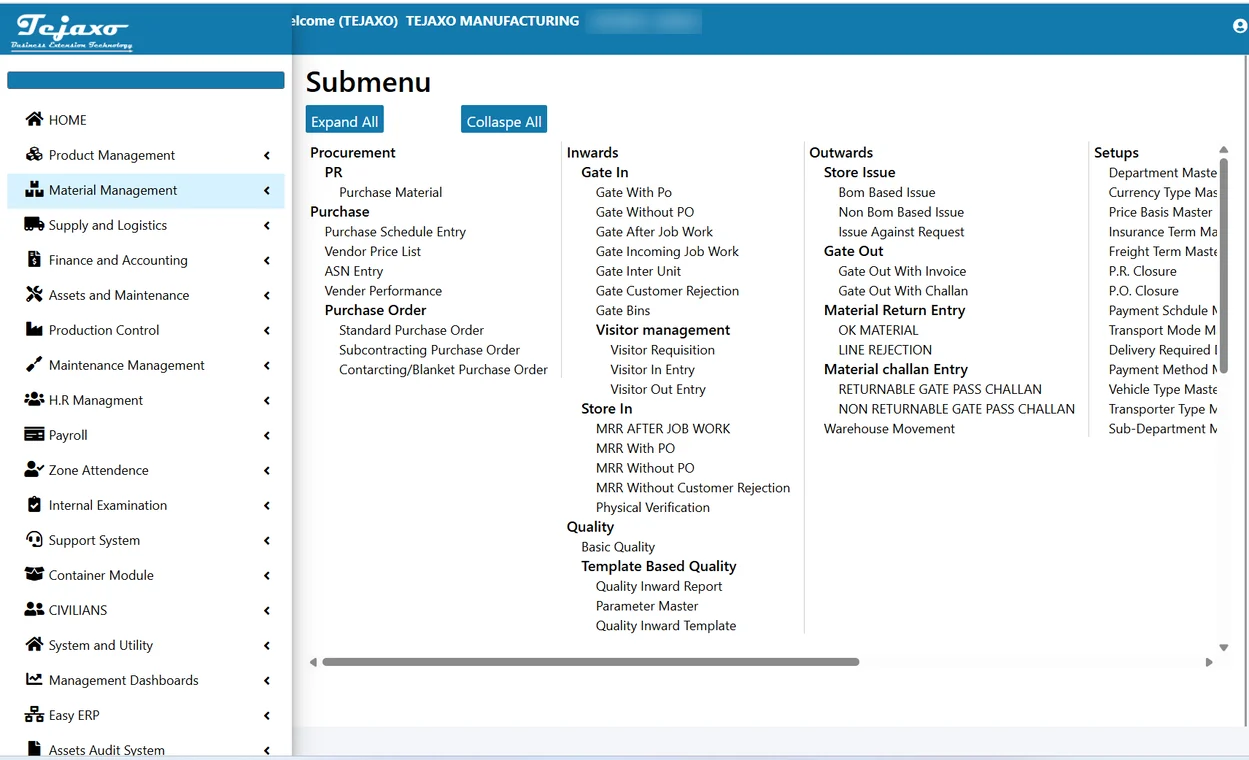
Tejaxo ERP keeps stores, production, quality, dispatch and finance on one live database, so the weight captured at gate entry, the charge issued from stores, the quality result and the dispatch of good castings all refer to the same records. That is what lets a heat-wise ledger for charge, returns and rejections be built without re-keying. See how this fits foundry operations on our casting and foundry ERP page. We can walk you through how a heat log and returns ledger map to the system in a short session. We do not replace your metallurgical judgement. The ERP gives your team clean data to apply it to.
Next step: measure your own yield for one week
Pick one furnace and run the heat log above for a week. Compute melting, pouring and overall yield for every heat, and reconcile returns generated against reused. You will probably find the loss is in a different stage than you assumed. If you want to automate that loop, book a free consultation with Tejaxo and we will review your current charge, returns and rejection records with you.
Frequently asked questions
What is the formula for casting yield?
Casting yield (%) = weight of good castings ÷ weight of metal poured × 100. Some sources divide by the total metal charged instead, which is better called overall yield. Always state the base. For example, 520 kg of good castings from 950 kg poured gives a pouring yield of 54.7%, while the same 520 kg from a 1,000 kg charge gives an overall yield of 52.0%.
What is the difference between casting yield and melt loss?
Melt loss is metal lost in the furnace through oxidation, slag and spillage. It is expressed as a percentage of the charge. Casting yield measures how much of the poured metal becomes good castings after gating, risers and rejections. Melt loss is a genuine loss, while gating and risers are returns that go back into the next charge.
How do I calculate furnace charge with melting loss?
Divide the molten metal you need by (1 − melting loss as a decimal). If you need 970 kg of liquid metal and expect 3% melt loss, the charge is 970 ÷ 0.97 = 1,000 kg. Add any ladle or furnace residue to the required molten weight first, and use your own measured melt loss rather than a general norm.
Should returns be counted in casting yield?
Returns such as runners, risers and rejected castings are part of the charge and the mass balance, but they are not new metal. Track returns generated against returns reused for each heat. If you reuse more than you generate, the returns stock falls and your yield and cost per kilogram look better than they really are.
How can a foundry improve casting yield?
Measure each stage separately: melting yield, metal usage yield and pouring yield. Then reduce melt loss with clean, dry scrap and consistent slag practice, match tap weight to mould weight, review gating and riser design pattern by pattern, and cut the top rejection causes using a defect Pareto by weight and stage.
What records do I need for heat-wise yield tracking?
For every heat, record the heat number, furnace, charge by material, total charge, tapped weight, metal poured, residue, good castings, gating and risers, rejections with cause and stage, and returns generated and reused. Weights should come from scales and weighbridges. These same records also support batch-wise traceability for quality control requirements.