“What will the ERP cost?” is the first question every factory owner asks, and the hardest one to compare across vendors. ERP pricing in India comes in two main models – a one-time licence with a yearly AMC, or a recurring subscription – and quotes bundle very different things under the same word. This guide explains both models, what really drives the cost of a manufacturing ERP, and a simple way to compare quotes over five years instead of on the first invoice alone.
The two ERP pricing models
One-time licence + yearly AMC. You pay once for the right to use the software, and then a yearly annual maintenance contract (AMC) for support, monitoring and upgrades. The software usually runs on your own server or a private cloud you control, and the data stays with you.
Subscription (SaaS). You pay a recurring fee – monthly or yearly, often per user – and the vendor hosts the system. The first year looks cheaper, but the fee never stops, and it usually rises with every user you add.
| Licence + AMC | Subscription | |
|---|---|---|
| Upfront cost | Higher (licence) | Lower |
| Yearly cost | AMC only | Full fee every year |
| Where it runs | Your server, private cloud or hybrid | Vendor’s cloud |
| Data | Stays with you | On the vendor’s platform |
| If you stop paying | Software keeps running; support stops | Access stops |
| Adding users | Depends on licence terms | Usually a higher fee |
What actually drives the cost of a manufacturing ERP
- Modules. Accounts and GST alone cost less than production planning, quality, job work, payroll and plant dashboards together. Buy what the plant will use in the first year and add the rest later.
- Plants and companies. Multi-plant setups need plant-wise numbering, stock and books, plus consolidated reports.
- Users and devices. Office users, shop-floor tablets, scanners and biometric devices all count in some way.
- Customisation. Screen and report changes made by configuration cost little; genuinely new processes are development work. See ERP customisation without breaking upgrades.
- Data migration. Cleaning and loading item masters, parties, BOMs and opening balances is real work – see ERP data migration.
- Integrations. Machines and PLCs, weighbridges, an existing SAP or Dynamics system, WhatsApp alerts.
- Hosting. Your own server, a private cloud or a hybrid setup each have their own running cost, separate from the ERP itself.
- Training and go-live support. Key users trained on your own data, and someone on call during the first month-end close.
Worked example: comparing two quotes over five years
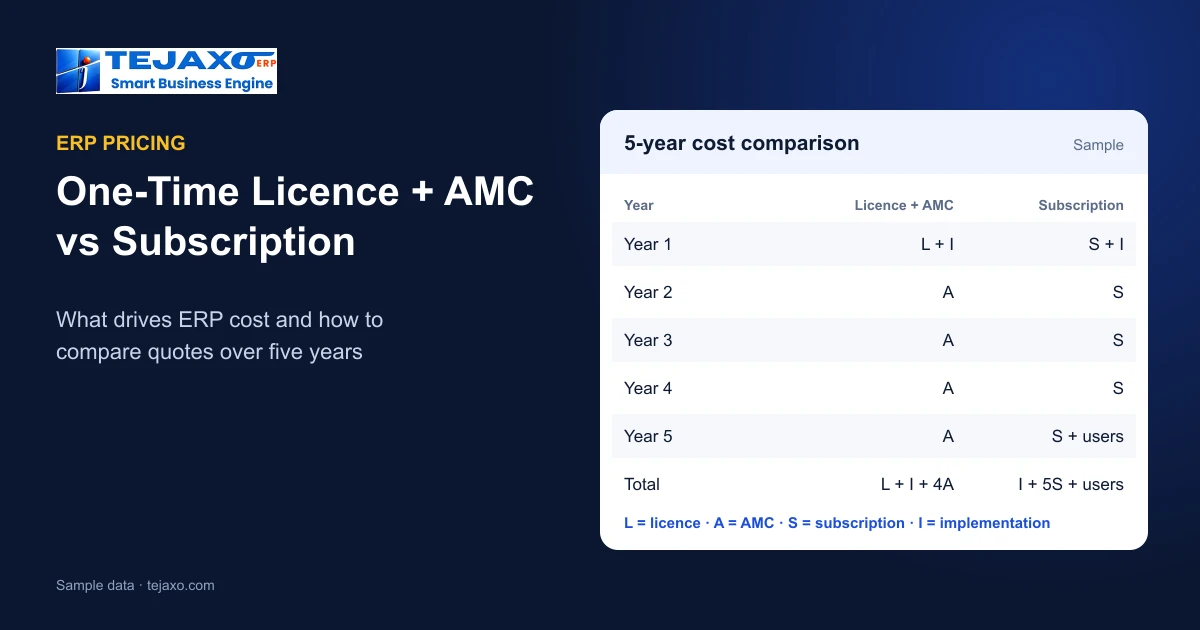
Tejaxo Manufacturing (sample) received two quotes. Instead of comparing the first invoice, its accountant wrote both in the same five-year form, using letters rather than amounts:
| Year | Quote 1: licence + AMC | Quote 2: subscription |
|---|---|---|
| Year 1 | L (licence) + I (implementation) | S (subscription) + I |
| Years 2-5 | 4 x A (AMC) | 4 x S, plus more for every new user |
| Five-year total | L + I + 4A | I + 5S + extra users |
Written this way, the question becomes simple: is the licence (L) more or less than five years of subscription minus four years of AMC (5S – 4A)? For most plants that plan to run the same system for many years, the licence model costs less over time, while a subscription can suit a business that is unsure how long it will keep the system. The accountant also listed, line by line, what each quote included – migration, training, customisation hours, integrations, hosting – because a cheaper quote often leaves these out and adds them later.
Questions to ask every vendor
- What exactly does the AMC or subscription include – support hours, bug fixes, statutory updates (GST, payroll), new versions?
- Is data migration included, and for which masters and openings?
- How are change requests priced after go-live?
- Where will the system run, and who owns the data and backups?
- What happens if we stop the AMC or the subscription?
- Can we start with some modules and add others later at the same terms?
- Will we see a pilot on our own items and customers before the final commitment?
Hidden costs to watch
- Per-user creep – a subscription that is cheap for 10 users and expensive for 40.
- Statutory updates charged separately – GST returns and payroll rules change every year.
- Reports outside the package – every new report quoted as development.
- Exit cost – getting your own data out in a usable form.
- Internal time – key users need time set aside for testing and training; budget for it.
How Tejaxo prices Tejaxo ERP
Tejaxo ERP is sold as a one-time licence plus a yearly AMC covering support, monitoring and upgrades, provided by the same team that implements the system, with NDA and documentation. It runs on your own server, a private cloud or a hybrid setup. The approach is low-risk: a discovery workshop, then a pilot on your own masters – items, parties and BOMs – with a live month, then go-live with training and ongoing support. Prices are given on request, because they depend on the modules, plants and integrations a plant actually needs. See the ERP implementation process and when to move from Tally to an ERP.
Where the system runs also affects the cost; read cloud ERP vs on-premise for SMEs in India.
Common mistakes
- Comparing year-one cost only, when the system will run for many years.
- Buying every module on day one and paying AMC on modules nobody uses yet.
- Not asking what the AMC includes, so upgrades or statutory changes are billed again.
- Skipping the pilot, so problems with masters and processes surface only after full payment.
Next step
Get a quote based on your own plants, modules and integrations – book a free consultation.
To see which modules a manufacturer actually needs before comparing prices, read our manufacturing ERP software guide.
Frequently asked questions
How is manufacturing ERP priced in India?
Mainly in two ways: a one-time licence with a yearly AMC for support, monitoring and upgrades, or a recurring subscription, often per user, hosted by the vendor.
What is AMC in ERP?
An annual maintenance contract paid every year after the licence. It typically covers support, bug fixes, monitoring and upgrades. Ask each vendor exactly what their AMC includes.
Is a one-time ERP licence cheaper than a subscription?
Over many years it usually is, because after the first year you pay only the AMC. Compare both models over five years, including implementation, migration and extra users.
What drives the cost of a manufacturing ERP?
Modules, number of plants, users and devices, customisation, data migration, integrations with machines or other systems, hosting, and training.
How is Tejaxo ERP priced?
Tejaxo ERP is sold as a one-time licence plus a yearly AMC covering support, monitoring and upgrades. Prices are given on request.
Can we start with a few modules and add more later?
Ask every vendor this before signing. Starting with the modules the plant will use in the first year keeps the initial cost and AMC lower.