ERPNext, Odoo or an India-built ERP is mostly a choice between two ways of buying: open-source, modular software that you shape with a partner or your own team, or a manufacturing ERP from an Indian developer who also implements and supports it. Neither is right for every factory. The better choice depends on who will own the system after go-live, and on how well each option handles one of your own orders in a demo.
Disclosure: this guide is written by Tejaxo Technologies, the developer of Tejaxo ERP. We describe our own product in detail and the other options by type only. Features, editions and terms change, so confirm the current position with each vendor or partner before you decide.
The real difference is who owns the system
ERPNext and Odoo are well-known open-source, modular ERP products. A manufacturer usually starts with a few modules and adds more, either through an implementation partner or with an in-house technical team. Tejaxo ERP is an example of the other model: manufacturing ERP software built in India, implemented and supported by the team that develops it.
Both models can work. What changes is who answers these questions three years after go-live:
- Who changes a report or a screen when the plant asks for it?
- Who tests your changes when a new version comes out?
- Who is responsible when production, stores and accounts show different figures?
- If your partner or your key developer leaves, who can take over?
Ask this before you compare features. A feature list tells you what can be done; these answers tell you who will do it.

Side by side: what changes for a manufacturer
| Question | Open-source, modular ERP with a partner or in-house team | India-built manufacturing ERP from the developer |
|---|---|---|
| Who implements | A partner you choose, or your own team | Usually the developer’s own team |
| Who changes the software | Your partner or your developers; the choice stays with you | Usually the developer, under a support agreement |
| What you must check | The partner’s experience in your type of manufacturing, and who maintains the customisation later | References in your type of manufacturing, and how dependent you become on one vendor |
| Internal team needed | More, if you keep customisation in-house | Usually less: a key user in each department |
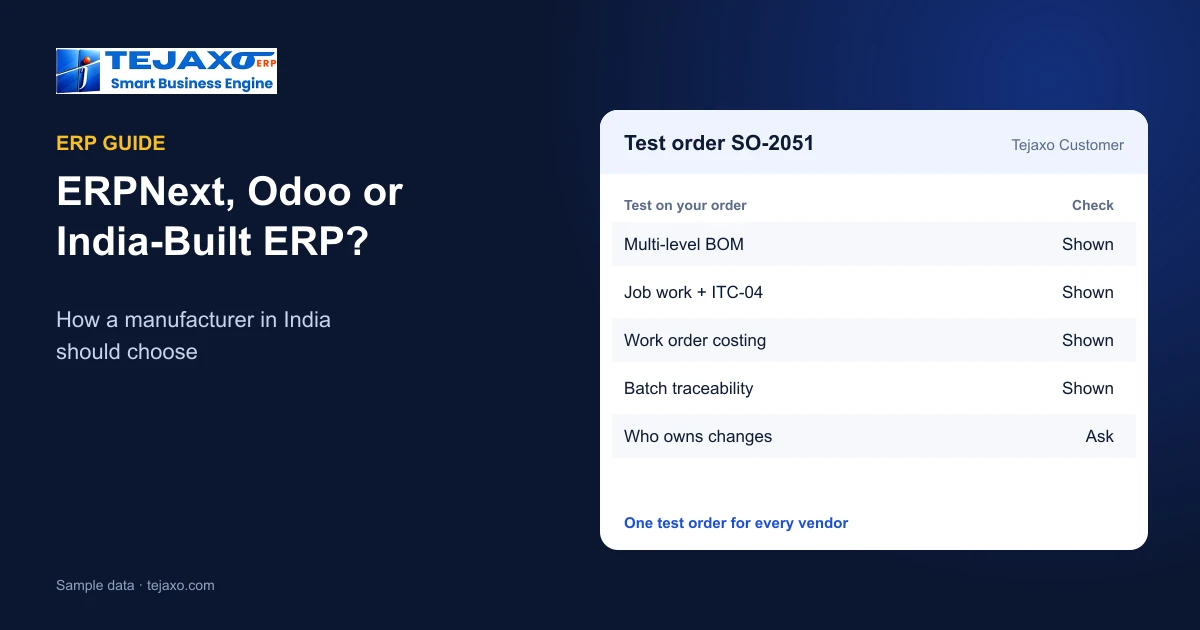
| Best way to test it | A demo on your own order, run by the partner who will implement it | A demo on your own order, run by the team who will implement it |
This table describes the two buying models in general, not any one product or partner. A strong partner on an open-source product can serve you better than a weak developer on its own product, and the reverse is also true.
What to test, whichever you choose
Indian manufacturing has needs that a general demo rarely shows. Test these on your own data:
- Order-wise production: does a sales order become its own work order and job cards?
- Multi-level BOM: can you see the full structure on one screen, with quantities multiplied down? (See what a multi-level BOM tree looks like.)
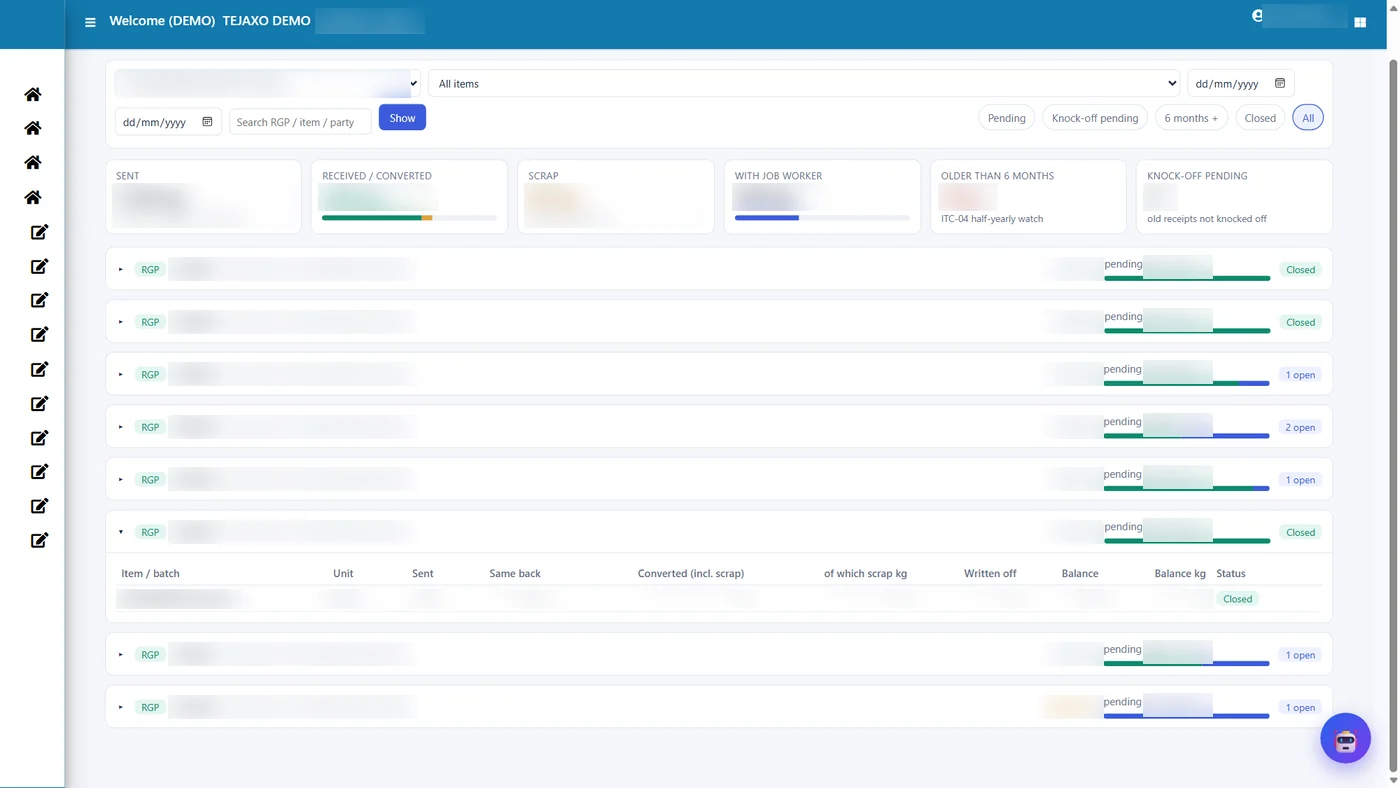
- Job work: are parts at job workers tracked on returnable gate passes, and does the system prepare ITC-04? (Background: job work on returnable gate passes.)
- Job costing: where does each figure in a work order cost come from?
- Traceability: can you go from an invoice back to the batch of raw material?
- GST and export: GST returns, LUT or IGST export invoices, and shipping bill details, as you actually file them.
- Daily use on the shop floor: who enters production, on what device, and how long does it take?
Worked example: one test order for any demo
Give every vendor or partner the same order, so the comparison is fair. A sample brief for Tejaxo Manufacturing could be:
- Tejaxo Customer orders 20 units of Product A, due in 30 days.
- Product A has a three-level BOM: 2 sub-assemblies and 14 parts, of which 3 are bought out.
- One part goes to Tejaxo Vendor for plating under a returnable gate pass; 2 pieces come back rejected.
- Show the shortage list, the job cards, the material at the job worker, and the cost of the finished order.
- Now change the order to 25 units. Show what changes, and who has to do what.
Note how much was shown on the live system and how much was on slides, and how many items were promised as “customisation”. Those promises are the ones to price and put in writing.
Where Tejaxo ERP fits
Tejaxo ERP suits small and mid-sized manufacturers in India that want production, stores, quality, job work, costing, GST and payroll from one vendor, without keeping a development team. The brand has been in the ERP business since 2017 and serves more than 50 clients with over 20 modules and more than 1,000 reports. The head office is in Palwal, Haryana, with on-site and remote support across India.
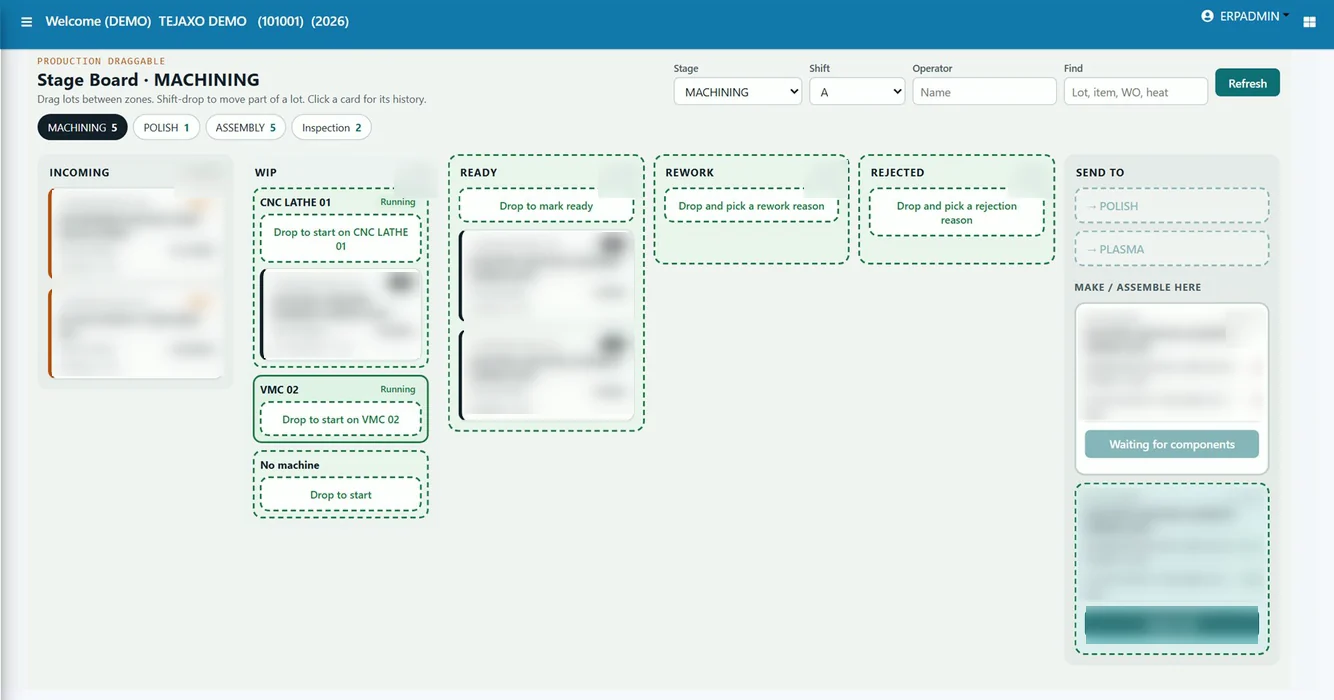
- Work orders from sales orders, job cards scheduled on each machine’s hours, and BOM Tree for multi-level BOMs.
- Work-order costing: material at the rate of the batch issued, machine minutes, labour and overhead.
- Job work orders and returnable gate passes, with ITC-04 Table 4 and Table 5A.
- Batch traceability forward and backward, serial numbers and barcode / QR scanning.
- Reports and graphs on WhatsApp by voice or text, and approvals from the phone.
- Cloud hosted by Tejaxo, on-premise, private cloud or hybrid.
Two honest limits. Tejaxo ERP is licensed with a yearly support contract and pricing is given on request after a discussion, so it is not a software you download and try alone. And you depend on one vendor for changes, so check that the support terms suit you. See Tejaxo ERP modules or how manufacturing ERP is priced.
When an open-source, modular ERP may suit you better
- You have, or plan to keep, developers who can own the system for years.
- Owning and changing the code yourself matters more to you than having one vendor responsible.
- You have found a partner with proven work in your type of manufacturing, and you have spoken to their clients.
- Your processes are simple enough to start with a few standard modules.
If none of these is true, a developer-supported manufacturing ERP is usually the lower-risk start. For the wider market, including global suites, read ERP software for machine manufacturers: options compared and how to choose the right ERP in India.
Common mistakes when choosing
- Comparing licence cost alone. Add implementation, customisation, hosting, support and your own team’s time over five years.
- Treating “open source” as “free ERP”. The software licence is one cost; making it fit a factory is usually the larger one.
- Judging the product, not the people. Meet the team who will implement it, not only the sales team.
- Customising before learning the standard flow. Run one plant or one product line first. Customisation without breaking upgrades explains how to keep changes under control.
- Leaving data to the end. Masters and opening balances take longer than most plans allow, whichever system you choose.
To see the test order above run in Tejaxo ERP, book a free consultation or message us on WhatsApp at +91 96717 27474.
Our guide to ERP for the manufacturing industry lists the modules and the questions to compare any of these options on.
Frequently asked questions
Is ERPNext or Odoo better for a manufacturer in India?
We do not rank them; both are well-known open-source, modular ERP products, and the result depends heavily on the partner or team who implements them. Run the same test order, with your own BOM and job work, on each option before deciding.
Is an open-source ERP free for a factory?
The software licence is only one part of the cost. Implementation, customisation, hosting, training and long-term support usually cost more, so compare the total over five years. Confirm the current licence terms with the vendor or partner.
What is an India-built manufacturing ERP?
An ERP developed in India for Indian factories, usually implemented and supported by the developer itself. Tejaxo ERP is one example, with GST, job work with ITC-04, production and costing in one system.
When should a manufacturer choose an open-source ERP?
When you have developers who can own the system for years, or a partner with proven work in your type of manufacturing, and when owning the code matters more to you than having one vendor responsible.
Can Tejaxo ERP be tried on our own order?
Yes. Book a free consultation and share one order with its BOM, and the team will show it in Tejaxo ERP, on-site or online.
Does Tejaxo publish its ERP price?
Tejaxo ERP is sold as a one-time licence with a yearly support contract. Pricing is given on request after understanding the plant, because it depends on modules and users.